

Traveling across Germany, I expected precision timetables, serious faces and postcard villages that shut down at 6 p.m. I found those things sometimes. But what surprised me far more was how often the reality veered from the clichés: regional cultures that felt like different countries, trains that were both admirably affordable and maddeningly late, cities that pulsed with diversity, and small towns where the loudest sound after dark was still the clink of beer glasses. Germany in 2026 is a country in motion, and crossing it revealed a place more contradictory, human and quietly charming than I ever imagined.
The Myth of Perfect Punctuality Meets Real-World Railways
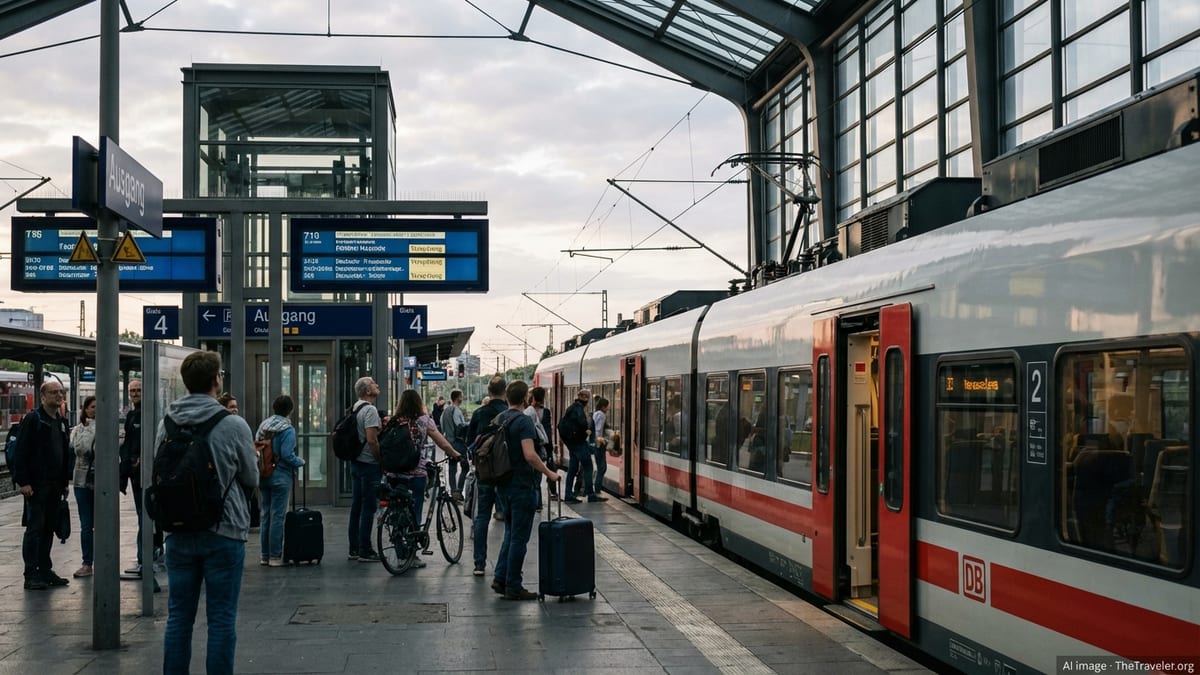
Like many visitors, I landed in Germany imagining that trains operated with surgical precision. The reality on the ground was more nuanced. Germany’s rail network remains one of the most extensive in Europe, and you can still cross the country comfortably by train. But the romantic idea of everything running exactly on time quickly collided with construction bottlenecks, congested routes and a national operator that openly admits it is in a difficult transition phase. Long-distance trains in particular have struggled with delays in recent years as repair works intensify on aging tracks and signaling systems.
What surprised me most was not that delays existed, but how normal they felt to locals. People sighed, refreshed their apps and quietly reshuffled their plans. On the platforms in Berlin, Hamburg or Cologne, loudspeaker announcements about “Baustellen” and diverted routes became part of the soundtrack of travel. Yet there was also a sense that the country was choosing to fix the system rather than simply endure it. Entire key corridors, such as the line between Berlin and Hamburg, have faced long closures for renovation, turning a short two hour ride into a much longer detour but promising faster, more reliable links in the future.
The good news for travelers is that planning with a margin of error goes a long way. Connections usually exist, staff are used to helping stranded passengers, and information boards are clear even when the timetable is not. The surprise is psychological: the image of flawless German punctuality does not survive first contact with today’s long-distance rail network, but the depth and reach of that network still make train travel the backbone of a cross country journey.
The 49 Euro Dream Evolved: What the Deutschlandticket Really Feels Like
No single policy changed the experience of getting around Germany as much as the Deutschlandticket. Launched in 2023, this nationwide monthly pass for local and regional public transport started at 49 euros and later rose in price. By 2025, travelers were paying closer to 58 euros per month for unlimited rides on local trains, buses, trams and metros, with another increase announced for 2026. Even with the hike, regularly using the ticket felt like an extraordinary bargain compared with many other European countries, especially for anyone covering long regional distances.
In practical terms, the Deutschlandticket opens up the country in slow motion. It does not cover high speed ICE or most other long distance services, so you trade speed for savings. Instead of blasting from Munich to Berlin in four hours, you hopscotch across the map on regional trains, stopping in small cities you might never have heard of. On my own trip, that meant unexpected coffee breaks in towns whose names I learned only from station signs, and wide open views of countryside I would have missed from a high speed corridor.
What surprised me was how the ticket reshaped the travel culture, not just the budget. Trains were fuller than I expected on minor routes, with day trippers, commuters and students using the same pass. More than fourteen million people were using it by the end of 2025, according to public transport statistics, and that demand was clearly visible on busy weekends. At the same time, the system showed its strain. Some regions reported overcrowding, and certain special permissions to use long distance trains with the ticket were scaled back or cancelled as costs rose.
For a visitor, the key is to embrace the ticket as an invitation to wander rather than a guarantee of speed. Buy it at the start of a month, download a regional transport app, and let the map of local and regional lines guide your plans. The Deutschlandticket will not deliver you to every meeting on the dot. It will, however, make Germany feel smaller, more accessible and more spontaneous than its old reputation for rigid planning suggests.
North to South Feels Like Different Countries
Crossing Germany from the North Sea to the foothills of the Alps, I was struck by how quickly the country seemed to change character. In Hamburg and Bremen, the mood felt maritime and understated, with brick warehouses, harborside promenades and a certain salt in the air. Move south to Cologne or Düsseldorf and rivers replace ports as the main stage, with the Rhine shaping skylines, festivals and daily commutes. Farther still in Bavaria, from Nuremberg down to Munich and the lakes beyond, timbered houses and mountain silhouettes nudged the landscape closer to postcard notions of Central Europe.
The surprise was just how strong regional identity remains in an otherwise tightly knit federal republic. Speech patterns shifted from the crisp consonants of northern cities to softer dialects in the south. Even the bakery counters changed subtly. In the north, fish rolls and dark breads dominated. Around the Rhine, you hit shelves of pretzels and rich loaves. In Swabia, near Stuttgart and Ulm, you are encouraged to try filled pasta and hearty stews that feel closer to Alpine cooking. Culinary lines blurred at the edges but were clear enough to notice on a train journey from one end of the country to the other.
Those shifts extend beyond taste. In some small towns in eastern Germany, I felt the legacy of industrial decline and demographic change in quieter streets and shuttered factories at the edge of town. In prosperous corners of the south, shiny headquarters of global companies sat near meticulously maintained villages. Yet even here, the pattern was not uniform. University cities like Leipzig or Freiburg buzzed with energy and youthful diversity that challenged the idea of any one region having a fixed personality.
For travelers, the takeaway is that “going to Germany” is really shorthand for visiting a cluster of distinct regions bound together by history, language and institutions but still very much themselves. Planning an itinerary that combines a northern port, a central river city and a southern Alpine gateway will feel more like visiting three neighboring countries than moving within a single homogeneous state.
Cities More Diverse and Creative Than Their Stereotypes
Another surprise was just how multicultural and creative many German cities have become. Places like Berlin and Frankfurt have long had international reputations, but walking through neighborhoods in Cologne, Hamburg or Stuttgart drove home the scale of change. Kebab shops sat next to Vietnamese bakeries, West African grocery stores shared blocks with traditional German pubs, and Friday prayers spilled quietly onto side streets while church bells rang a few blocks away.
For a country that is often caricatured as socially conservative and reserved, the everyday reality in urban centers felt far more relaxed. Street festivals in summer filled squares with food trucks and music that had little to do with sausages and brass bands. Public art ranged from polished museum shows to thriving graffiti scenes along canals and rail yards. Many cities have invested heavily in bike lanes, green spaces and waterfront promenades, and it shows in the daily life of residents who picnic in parks, swim in rivers where the water is clean enough and treat summer as an open air living room.
I was also struck by how many former industrial or port areas had been reinvented. In the Ruhr region, once synonymous with coal and steel, cities now market themselves around culture, universities and design. Old factories house museums, theaters and co working spaces. In Hamburg, parts of the harbor front are being reshaped into mixed use districts of offices, apartments and concert halls, even as container terminals continue their work nearby. This layering of old and new gives German cities a distinctive feeling: they are not pristine, but they are constantly negotiating between past and future.
The best way to experience this side of Germany is simply to walk. Skip a tight schedule of museum visits and allow a day to drift through residential neighborhoods, follow tram lines, detour into parks and watch how people actually use their cities. The surprise is not only in the sights themselves but in how unhurried, safe and livable many city centers feel, despite the usual European challenges of housing costs and traffic.
Quiet Sundays, Cash Culture and Other Everyday Quirks
It is often the small frictions that make a country feel foreign, and Germany delivered several that caught me off guard. The biggest was the near sacred status of Sunday as a day of rest. Outside of major train stations and tourist zones, most shops close, and city centers become suddenly quiet. For locals, it is a chance to see family, stroll in the park or linger in cafes. For an unprepared traveler who arrives on a Sunday with an empty fridge or a forgotten power adapter, it can be a mildly shocking exercise in enforced downtime.
Money habits offered another surprise. Germany is known for its caution toward digital change, and although contactless payments have spread rapidly in the wake of the pandemic, cash retains a stubborn presence. Independent cafes, small bakeries and local markets often still prefer bills and coins. On several occasions I was grateful for having a few euros in my pocket when card terminals went down or were politely refused. The country that builds luxury cars and precision machinery can still feel curiously analog at the moment of payment.
Etiquette also takes some adjustment. At first, the directness of German communication can feel brusque to visitors from cultures that rely on small talk or softening phrases. Restaurant service tends to be efficient rather than effusive, and strangers are not quick with smiles. But stay longer and you notice the flip side: when Germans offer friendliness, it is rarely superficial. Invitations to join a beer garden table or a family barbecue felt deeply genuine, and conversations, once started, moved quickly from weather to politics, work and personal values.
For travelers, the key is to prepare for these rhythms instead of resisting them. Plan your shopping before Sunday, carry some cash and do not interpret concise communication as hostility. Germany’s quirks may seem rigid at first glance, but they often protect a cherished work life balance and sense of personal space that many visitors come to appreciate.
Nature, Villages and a Surprisingly Soft Side
Germany’s industrial power and big city skylines can overshadow the fact that much of the country is green, quiet and deeply attached to nature. Between almost any pair of major cities, regional trains slip past forests, vineyards, river valleys and patchwork fields dotted with wind turbines. National parks and protected landscapes are never far away, whether it is the jagged peaks of the Bavarian Alps, the volcanic hills of the Eifel, the dense woods of the Black Forest or the chalk cliffs and dunes along the Baltic Sea.
What surprised me was not just the scenery, but how integrated it felt into daily life. Hiking is not a niche hobby but a national pastime, supported by well marked trails, hut networks and local trains that deposit walkers right at the trailhead. On sunny weekends, carriages filled with boots and backpacks as families, pensioners and groups of friends headed out for a “Wanderung.” Beer gardens and cafes near popular routes seemed to function as communal living rooms, where muddy boots were no barrier to ordering a slice of cake.
Village life, too, had a softer edge than I anticipated. In small towns from Franconia to Schleswig Holstein, I found manicured flower boxes, tidy public playgrounds and a surprising number of well maintained public pools. Local festivals celebrated everything from wine and asparagus to medieval history and modern art. While some rural areas clearly struggle with aging populations and limited services, many villages still project a quiet pride. Volunteer fire brigades and local clubs anchor community life, and visitors often find themselves gently but firmly invited to join in, whether that means a seat at a communal table or a ticket to the brass band concert in the town square.
For anyone building an itinerary, it is worth carving out days that are not built around landmarks but around landscapes. Use the Deutschlandticket to reach a small town, follow a marked trail into the hills or along a river, and end the day in a beer garden watching the sky change color. It is in these slower moments that Germany’s softer side comes into sharpest focus.
Sustainability, Construction and a Country Mid Renovation
Traveling across Germany in 2026 feels a bit like walking through a house mid renovation. Construction sites are visible almost everywhere, especially on rails and roads. At first it is easy to see them only as an inconvenience. Platforms close, road lanes narrow, diversions appear. But look closer and a broader picture emerges of a country trying, sometimes clumsily, to retrofit its powerful industrial base for a lower carbon future.
On the railways, decades of underinvestment are now colliding with ambitious modernization plans. The result is a patchwork of speed restrictions, detours and temporary closures. Long distance punctuality has dipped into uncomfortable territory, with barely more than half of trains arriving within a generous delay window during some recent months. Officials have set more modest punctuality targets for the next few years while promising a rebuilt network by the end of the decade. For travelers, that means a period of patience: more engineering works now, in theory, for more reliable journeys later.
Energy and climate policy are visible in small but persistent ways. Wind turbines dot ridgelines, solar panels cover the roofs of barns and suburban houses, and new electric charging points appear in parking lots from Berlin to provincial supermarket chains. Cities expand bike lanes and roll out low emission zones. At the same time, Germany’s status as a car manufacturing giant is impossible to miss. Highway rest stops fill with latest generation vehicles, and suburban streets still prioritize parking over playgrounds.
The tension between environmental ambition and industrial habit gives the country a particular atmosphere of transition. Visitors may find themselves delayed by rail construction one day and then whisked along a gleaming new high speed stretch the next. They may admire forests and rivers that are fiercely protected while also passing coal plant sites in the process of being phased out or repurposed. Germany is not a finished sustainability success story, but crossing it by train and foot makes clear that the debate plays out in concrete, steel and timetables as much as in political speeches.
The Takeaway
By the time my journey across Germany ended, the neat mental picture I carried on arrival had been replaced by something messier, and far more interesting. The country did not match its global image of flawless efficiency, yet it delivered on reliability often enough to make deeply ambitious travel possible without a car. Its people were not uniformly stern or humorless; in fact, some of the warmest invitations I received on the road came from those who initially seemed the most reserved.
What surprised me most was the way opposites coexist. Germany is at once wealthy and anxious, orderly and improvisational, rooted in tradition and racing to adapt. Its trains are both a symbol of national frustration and a daily lifeline that connects millions of people, helped in recent years by a flat rate ticket that made public transport more accessible than ever, even as prices inched upward. Its cities are industrial yet green, historical yet experimental, and its countryside is far from a museum piece, shaped constantly by debates over energy, agriculture and tourism.
For travelers prepared to accept delays, embrace regional differences and lean into the country’s quiet rhythms, a cross Germany journey offers rich rewards. It is not a theme park of stereotypes but a living, sometimes chaotic society whose surprises appear not only in grand cathedrals and Alpine views, but in train station bakeries, Sunday stillness and the warmth of conversations that start with a hesitant “Entschuldigung” and end an hour later with restaurant recommendations and family stories.
FAQ
Q1. Is it still worth traveling across Germany by train despite the delays?
Yes. While long distance punctuality has worsened in recent years, the network remains extensive, comfortable and safe. With some extra buffer time and flexibility, trains are still the most rewarding way to cross the country.
Q2. What is the Deutschlandticket and can tourists use it?
The Deutschlandticket is a monthly flat rate pass for local and regional public transport throughout Germany. Its price increased after launch but it remains good value. Tourists can purchase it and use it on buses, trams, metros and most regional trains.
Q3. Does the Deutschlandticket include high speed ICE trains?
No. The pass generally excludes ICE, IC and EC long distance services, which require separate tickets. The Deutschlandticket is best for slower regional journeys and local transport rather than rapid cross country trips.
Q4. How different are Germany’s regions for a first time visitor?
The differences are noticeable. Northern cities feel maritime and understated, central regions revolve around rivers and industry, and the south leans more Alpine and traditional. Dialects, food and local customs shift as you move, so combining several regions makes the trip richer.
Q5. Are Sundays really that quiet in Germany?
Yes. Most shops close on Sundays outside of stations and tourist zones, and city centers can feel calm compared with weekdays. Cafes, restaurants and many museums stay open, so it is a good day for walks, parks and relaxed sightseeing rather than shopping.
Q6. How widespread is English, and do I need German to travel?
In larger cities and tourist areas, many people speak at least basic English, especially younger generations and those working in hospitality. In small towns and rural areas, German is more common, but simple phrases, translation apps and a patient attitude are usually enough.
Q7. Is Germany as cash focused as people say?
Card and contactless payments have expanded significantly, especially in chains and larger businesses. However, some smaller cafes, bakeries and local shops still prefer or accept only cash, so carrying some euros is practical.
Q8. How safe did Germany feel when traveling across the country?
Germany generally felt very safe, both in cities and smaller towns. Normal big city precautions apply at night or in crowded places, but violent crime against visitors is relatively rare and public transport is widely used at all hours.
Q9. When is the best time of year to travel across Germany?
Late spring and early autumn often offer the best balance of pleasant temperatures, greener landscapes and fewer crowds than peak summer. Winter has its own charm with Christmas markets, but days are short and conditions can be cold and wet.
Q10. How should I plan for construction and timetable changes?
Check rail apps shortly before travel, expect potential delays, and avoid very tight connections when possible. Construction works are common, but alternative routes and replacement services are usually provided, so a bit of flexibility goes a long way.