

I went to Jozani Forest expecting a serene national park experience, a deep dive into Zanzibar’s last remaining tropical forest and a respectful encounter with its famous red colobus monkeys.
What I actually got was a mix of genuine natural magic, rushed guiding, minor crowd chaos, and that familiar Zanzibar feeling that you are always half a step away from overpaying if you do not do your homework.
It was not a disaster, but it was far from the romantic jungle walk I had imagined. If you are planning to go, it is worth understanding what Jozani really is in practice and how to shape the visit so it works for you.
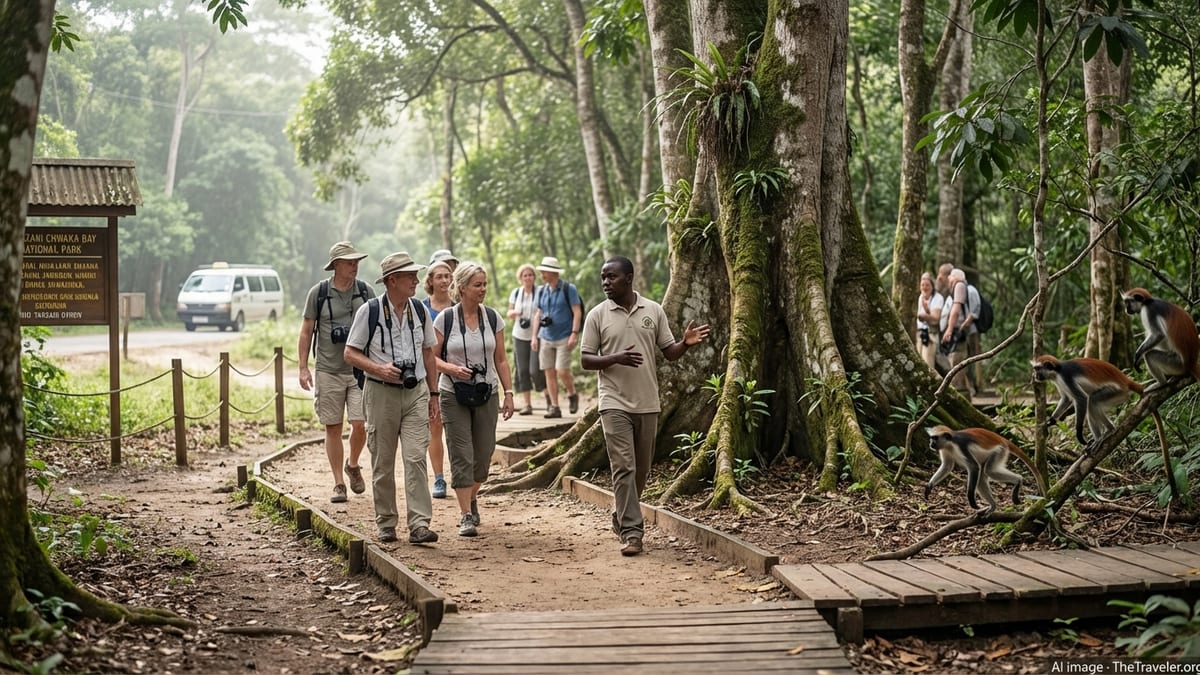
Getting There: A Simple Journey That Still Caught Me Out
I started the day in Stone Town, assuming Jozani Forest would feel like a remote protected area hours away. In reality, it sits right off the main road that connects Stone Town with the east and southeast beaches, roughly 35 to 40 kilometers away depending on where you start. Driving time is usually quoted at about 45 to 60 minutes, and that matched my experience. What surprised me was how un-remote it felt. One minute I was passing villages and small shops, and the next I was at the park gate.
I opted for a private taxi instead of an organized tour. The driver quoted a price that initially felt steep for a short trip, but in Zanzibar almost all transfers feel steep if you compare them to mainland prices or your own country. When I later checked, other travelers were reporting similar taxi rates and typical full tour prices, so I had not been uniquely scammed; this is simply the going rate for that level of convenience. If you are on a tight budget, it is technically possible to use a dala dala minibus from Zanzibar Town or the southeast beaches, with fares in the small handful of dollars range. However, that adds time, crowding, and some confusion because you still have to walk from the roadside drop-off to the gate. I was happy I did not try to improvise public transport on a hot, humid morning.
On arrival, the entrance process was more structured than I expected. Jozani is formally Jozani Chwaka Bay National Park, and there is a central gate and visitor center area where you pay your entrance fee. Recent information and on-the-ground signs pointed to standard foreigner rates roughly in the 10 to 25 US dollar range per adult, depending on how the fees are packaged and which operator you ask. The important detail for me was that the official entrance ticket covers a guided walk. You cannot simply wander around on your own; all visitors are expected to go with a guide. That was fair enough in terms of safety and conservation, but it immediately meant my experience would be on someone else’s timetable.
First Impressions: A Small, Structured Park, Not a Wild Jungle
Once I had my ticket, I was ushered toward a shaded waiting area with a handful of other visitors. I had pictured arriving at a sprawling forest where I would choose a trail and disappear into the trees. Instead, Jozani felt like a compact, highly managed park hub. There was a visitor center, basic toilets, a small café, and several guides coordinating groups. Within minutes I realized this was not going to be a solitary nature immersion. It was going to be a series of short, carefully orchestrated experiences: the forest trail, the monkey viewing area, and the mangrove boardwalk.
The first surprise was how quickly my guide tried to form a group. A couple from Europe, a family with children, and me were merged into a single party. That made logistical sense, but it changed the tone of the visit. Instead of a low, quiet walk where I could ask deeper questions, I ended up in a slightly chaotic group where the guide had to pitch his explanations to the lowest common denominator and keep everyone moving in sync. If you dream of long, contemplative hikes, Jozani as it is organized for standard visitors will not give you that.
That said, my very first steps into the forest were still impressive. The air was instantly cooler and wetter. Tall trees rose above us, some with huge buttress roots and ferns clinging to their trunks. Sunlight filtered through the canopy in narrow shafts, and the soundscape shifted from engines and human chatter to birds and the faint crackle of leaves. Even in a group, the transition from road to forest felt sharp and almost theatrical.
The Forest Walk: Beautiful, Short, and More Superficial Than I Hoped
The forest trail is the core of the standard Jozani experience. In principle, it is a loop of a couple of kilometers, with guides quoting a duration of about one hour. My guide led us along a clearly marked path, at times on compacted soil, at times on short sections of boardwalk or platforms. He stopped regularly to point out particular trees, lianas, and medicinal plants. Some of his explanations were genuinely interesting. I learned about the age of a massive mahogany tree, heard stories of traditional uses of different leaves, and got a quick primer on how groundwater shapes the forest here.
What disappointed me was how rushed it all felt. We seemed to be trying to hit a checklist of talking points rather than truly inhabiting the forest. Whenever I lingered to take a photo, I felt the guide’s eyes urging me forward. When the children in our group got restless, the pace subtly increased. The humidity did not help. Even in the mid-morning, the forest was warm and sticky, and a couple of people in the group were clearly wilting. That probably contributed to the sense that we were being hustled along so nobody would overheat or complain.
Another surprise was the lack of wildlife sightings during the forest portion itself. I had naively imagined seeing monkeys and birds all along the trail. In reality, the mid-forest is quiet. The famous red colobus monkeys tend to hang around the edges of the forest near the road and the cultivated areas, where they feed on leaves. Inside the denser forest it was mostly trees, fungi, and insects. That is not a flaw in the ecosystem, of course, but expectations matter. Because so much marketing focuses on the monkeys, I had subconsciously assumed the trail and the monkey encounters were one and the same. They are not.
Meeting the Red Colobus: Magical and Slightly Awkward
The red colobus monkeys are the star of Jozani, and they are the reason many visitors come at all. After the forest loop, we were taken to a different area closer to the road where the monkeys were known to be feeding. There was nothing subtle about it. Our guide stopped, scanned the trees, conferred with another guide, and then announced that a group had been spotted a few minutes’ walk away. We followed him along a narrow path and almost immediately found ourselves in the middle of a cluster of colobus spread across low branches and shrubs.
Seeing them up close was undeniably special. The monkeys have distinctive coats with reddish highlights, long tails, and expressive faces. They seemed fairly unfazed by our presence, occasionally glancing down but mostly focusing on stripping leaves with quick, deliberate movements. At one point a youngster clambered along a branch barely above my head, and I could see the fine details of its fur. The proximity was much closer than I had anticipated.
Unfortunately, this was also where the experience started to feel uncomfortable. Despite clear rules about not touching, not feeding, and keeping a respectful distance, the reality of several groups of tourists funnelled into the same small space is messy. A couple of visitors in another group edged within arm’s reach of the monkeys for selfies. Guides did warn them, but there was an undercurrent of resignation as if this happens all day, every day. The monkeys themselves are now so habituated to humans that they barely react to people walking right under them. From a purely photographic perspective, it was wonderful. From a conservation and ethics perspective, it felt borderline.
I also could not shake the sense that we were all ticking a wildlife box. The guide gave us about ten or fifteen minutes to watch and take photos, then politely started to herd us back toward the main area. There was little space for simply standing still and observing their behavior over time. If you are someone who loves to sit quietly and watch animals for longer periods, the standard format will probably frustrate you. It is built around quick viewing, not prolonged, patient observation.
The Mangrove Boardwalk: A Highlight I Nearly Skipped
Before visiting, I had read that the usual Jozani visit includes both the forest and a short walk through the mangroves of Chwaka Bay. After the monkey encounter, our guide asked whether we wanted to continue to the mangrove boardwalk. A couple of people hesitated, thinking they had already seen the main attractions. I am glad I insisted on doing it, because for me this was the most peaceful and unexpectedly rewarding part of the day.
The boardwalk sits a short drive from the main entrance, near an area where brackish water flows in and out with the tide. A raised wooden walkway winds through the mangrove roots, allowing you to get close to the ecosystem without damaging it or sinking into the mud. By the time we stepped onto the planks, the bulk of the morning groups had already passed through, and the place was almost quiet.
Here I finally got the slower, more contemplative moment I had wanted. Our guide explained the difference between mangrove species, pointed out tiny crabs scurrying on the roots, and highlighted how important the mangroves are as nurseries for fish and as coastal protection for Zanzibar. There were no monkeys here, no crowds pushing for photos, and far less pressure to move quickly. I could hear water gurgling softly under the boards and the occasional splash of something unseen dropping into the channels.
The boardwalk itself is fairly short, perhaps twenty to thirty minutes at a relaxed pace, but it added a crucial layer of context to the visit. Jozani is not just a patch of pretty forest with monkeys. It is part of a larger protected area that includes mangroves and seagrass meadows in the bay, all linked in a fragile chain. I left the boardwalk feeling I had actually learned something meaningful about the island’s ecology, rather than just collected photos of a rare primate.
Crowds, Guides, and the Subtle Pressure to Spend
One of my main frustrations with Jozani was not the place itself but the human choreography around it. Guide services are officially included in the entrance fee, and a portion of park revenue is meant to support conservation and community projects. In theory that is a positive model. In practice, it creates a dynamic where the schedule is optimized around short, repeatable loops rather than deeper engagement.
My guide was friendly and clearly knowledgeable, but I still felt like part of a volume operation. Group sizes waxed and waned as people were added and peeled off, depending on arrival times and language preferences. There was little room to say, “Can we slow down here?” or “Can we skip that section and spend more time somewhere else?” Every time I asked a more detailed question, the guide gave a brief answer and then gently pivoted back to his usual script, probably because he had several other people to think about.
There was also, inevitably, the money question. While the guide was technically “included,” the expectation of tipping hovered in the background. This is normal across Tanzania, and I personally have no issue tipping someone who has provided a service. The discomfort came from a lack of clarity. No one from the park explained expected tipping ranges, and that vacuum often encourages visitors to either undertip out of confusion or overtipping out of guilt. Outside the park gate there were a few stalls selling souvenirs and snacks. Nothing was overly aggressive, but there is a familiar rhythm: you pay the entrance, you pay or tip the guide, you consider a carved monkey or a keyring on your way out. None of this ruined the visit, but it did contribute to a sense that the experience is monetized in layers.
If you are comparing a do-it-yourself park visit with an organized full-day tour that bundles Jozani with a spice farm, village visit, or another stop, the difference in total cost is not huge. Many operators offer combined tours for a rate that covers hotel pickup, entrance fees, and guiding. I chose to come independently anyway, hoping that would give me more control. In hindsight, I do not think I gained much by arranging my own taxi and paying the park directly, apart from the flexibility to choose my start time.
What I Would Do Differently Next Time
Walking out of the park and back toward the line of waiting taxis, I realized my visit had been both worthwhile and slightly unsatisfying. If I were to do it again, there are several things I would change to shape the day more to my preferences.
First, I would aim to arrive as early as realistically possible, close to opening time. Jozani officially opens in the morning around 7:30, with last entry mid- to late afternoon. I went mid-morning and immediately fell into the main wave of day tours. A first-light arrival would likely mean cooler temperatures, fewer groups on the trail, and slightly more relaxed guiding. It might also improve chances of seeing monkeys without feeling hemmed in by other visitors.
Second, I would be much clearer with the guide upfront about what I wanted from the visit. On arrival I simply joined whatever group was forming. Next time, I would politely ask to be in a smaller group if possible, and I would say openly that I am fine walking more slowly and do not mind spending extra time on fewer sections. That might not always be feasible on busy days, but voicing preferences matters. Guides are used to people wanting a quick in-and-out. If you are the rare person who wants to slow down, you probably have to say so.
Third, I would consciously combine Jozani with another nearby experience in a structured way, rather than improvising. The visit itself is relatively short: two to three hours is enough for the forest, monkeys, and mangrove boardwalk. By noon, I was essentially done. Many tour operators pair Jozani with a spice farm or a village visit, making a full day that feels more balanced. If you only dedicate half a day to Jozani, you might end up feeling like you spent more money and logistics effort on transport than on time in nature.
Finally, I would manage my expectations differently. Jozani is not a vast untouched wilderness. It is a small national park on a busy island, designed to be accessible to almost any visitor for a short, supervised encounter with a unique ecosystem. If you go expecting Serengeti-like expanses or deep backcountry solitude, you will be disappointed. If you go expecting a well-organized nature walk, a glance into Zanzibar’s ecological heart, and a close but somewhat managed meeting with red colobus monkeys, you are much more likely to appreciate it for what it is.
The Takeaway
Looking back, I am glad I visited Jozani Forest, even if the day did not match the romantic image I had built beforehand. I saw an endemic primate up close. I walked under the shade of an old forest that has somehow survived centuries of pressure. I learned something about mangroves and the delicate balance between tourism and conservation on a small, heavily visited island. None of those are trivial experiences.
At the same time, I cannot pretend it was perfect. The visit was shorter and more controlled than I would have liked. The presence of multiple groups, the brisk pace of the guide, and the subtle push towards tipping and shopping all chipped away at the sense of wildness. I also left with lingering questions about how comfortable I am with wildlife that has become so habituated to humans that we can stand directly under their feeding trees without them batting an eyelid.
Would I recommend Jozani Forest to others? Yes, but with caveats. If you have only a limited time on Zanzibar and you care at all about nature, it is one of the few places where you can see something genuinely unique without major effort. Families with children, casual travelers, and anyone who wants a gentle introduction to the island’s ecosystems will likely find it rewarding. The trails are short, the boardwalk is safe, and the monkeys are almost always visible.
However, if you are a serious wildlife enthusiast, a birder looking for long, quiet hours, or someone who dreams of unstructured trekking, you may find Jozani a bit too packaged. In that case, you might still want to go, but treat it as a short, informative stop rather than the centerpiece of your trip. Go early, set your expectations appropriately, and you will probably walk away with a handful of memorable photos, a deeper appreciation for Zanzibar’s natural challenges, and a more honest understanding of what conservation looks like on a tourist-heavy island in the real world.
FAQ
Q1. How long does a typical visit to Jozani Forest take?
Most standard visits, including the forest trail, the red colobus viewing area, and the mangrove boardwalk, take around two to three hours from the moment you enter the gate. You should also factor in travel time from your hotel, which can add one to two hours round trip depending on whether you are coming from Stone Town or the beach areas.
Q2. What are the current opening hours and can I enter without a guide?
When I visited, Jozani Chwaka Bay National Park was open daily from early morning to late afternoon, with last entry typically around mid to late afternoon. Visitors are not allowed to wander independently on the main trails; a park guide is effectively mandatory and is usually included in the entrance fee. The exact schedule can change seasonally, so I would confirm times with your hotel or a local operator the day before you go.
Q3. How much should I expect to pay for the entrance fee and guiding?
Entrance fees for foreign visitors are generally in the rough range of 10 to 25 US dollars per adult, and that typically includes the services of a guide for the standard loop. Children often pay a reduced rate and very young kids may enter free. Tipping the guide is customary but not formally defined, so I would bring small bills in Tanzanian shillings or dollars to tip according to how satisfied you are with the experience.
Q4. Is it better to visit Jozani Forest on a tour or independently?
I went independently with a private taxi, paid my own entrance, and joined a guide at the gate. In hindsight, I do not think I saved much money or gained significant extra freedom compared with joining a reputable organized tour. If you prefer simplicity and door-to-door logistics, a combined tour that includes Jozani and another activity like a spice farm is a sensible choice. If you value flexibility on timing, arranging your own transport is still perfectly feasible.
Q5. Will I definitely see the red colobus monkeys?
Sightings are never absolutely guaranteed, but the red colobus are so habituated and so commonly found near the forest edge that the chances are extremely high. Guides are in constant communication about where the groups are feeding, and my group saw them easily for about ten to fifteen minutes at close range. If you go during normal visiting hours, you should reasonably expect to see them.
Q6. What should I wear and bring for the visit?
I found light, breathable clothing and comfortable closed shoes ideal, especially because the forest can be humid and the paths occasionally muddy. Insect repellent, sunscreen, and a hat are useful, even though much of the walk is shaded. Carry a refillable water bottle and possibly a small snack, since there is not a lot of food on offer inside the park itself and the visit can extend over the late morning or early afternoon.
Q7. Is Jozani Forest suitable for children and older travelers?
Yes, the standard trails are short, relatively flat, and well maintained, so most reasonably mobile visitors can manage them without difficulty. Families often bring children, and the monkey viewing area and mangrove boardwalk tend to be particular favorites. Older travelers or anyone with mobility concerns should still mention this to their guide, who can adjust the pace and avoid any optional sections that might be slippery or uneven after rain.
Q8. Can I visit Jozani Forest in the rainy season?
You can visit year-round, and the forest can actually look particularly lush during the rains. The main downside is muddier trails and higher humidity, which can make walking less comfortable. Some sections of the boardwalk can be a bit slick after heavy showers, so non-slip footwear matters even more. If you are prepared for occasional rain and do not mind a bit of mud, the rainy season does not make the park off-limits.
Q9. Is photography allowed, and are there any restrictions?
Photography is widely allowed on the trails, in the monkey areas, and on the mangrove boardwalk, and I saw plenty of people with phones and cameras. The main restrictions relate to behavior rather than equipment: you should not use flash directly at the animals, should not try to touch or feed the monkeys, and should avoid blocking paths or getting so close that you stress the wildlife. If in doubt, asking your guide is the safest approach.
Q10. Who is Jozani Forest best suited for, and who might be disappointed?
In my view, Jozani is ideal for travelers who want an easy, half-day nature excursion, families with children, and anyone who wants to see the red colobus monkeys without committing to a multi-day wildlife trip. It may disappoint visitors who expect long, quiet hikes, serious birdwatching opportunities, or a remote wilderness experience. If you approach it as a short, structured window into Zanzibar’s natural side rather than a grand safari, you are more likely to leave satisfied.