

I had seen the dreamy photos of La Jolla’s sea caves, turquoise water, and swirls of orange garibaldi fish for years, so when I finally made it to the La Jolla Underwater Park, my expectations were unfairly high.
What I actually found was a mix of serene marine sanctuary, chaotic beach logistics, fickle ocean conditions, and a few surprises that completely reshaped how I think about “bucket list” coastal experiences.
Planning the Trip: What I Thought I Was Signing Up For
Before I went to the La Jolla Underwater Park, I had this very Instagram-curated vision in my head. I pictured paddling effortlessly into sea caves, crystal-clear water beneath me, bright orange garibaldi flickering around my kayak, and maybe a few leopard sharks gliding past as an added bonus. In reality, planning a visit here feels less like dropping into a postcard and more like assembling a moving puzzle around tides, tour schedules, and Southern California crowds.
I quickly learned that the “Underwater Park” is not a single, clearly marked attraction but a marine protected area spread between La Jolla Cove and La Jolla Shores, overseen by lifeguards and governed by a surprisingly strict set of rules. Certain gear is forbidden inside the Cove, kayaks must launch from Shores, and sea cave entry is always “conditions permitting,” which is a polite way of saying you might not get the cave moment you came for at all. I knew some of this in theory, but it only really hit me once I started booking.
Most of the experiences that get marketed to visitors are run through local outfitters: guided kayak cave tours, kayak-and-snorkel combos, or straightforward snorkel rentals. Nearly all of them emphasize that your plans can change at the last minute if swells pick up, visibility drops, or the lifeguards restrict access. I appreciated the honesty, but it also meant I had to accept that the most iconic part of La Jolla, the caves, were not a guaranteed part of my day.
In the end, I booked a morning kayak cave tour that promised a chance to paddle along the cliffs and possibly into one of the sea caves, plus I planned to snorkel later on my own near La Jolla Cove. On paper, that sounded like a full day of underwater adventure. In practice, the day ended up being defined just as much by crowds, parking, and cold Pacific water as by wildlife and scenery.
First Impressions: Parking Anxiety and Beach Chaos
My first surprise hit even before I saw the ocean: parking. The La Jolla Shores area, where most kayak shops are based, has a beach lot and residential street parking, but on a busy day it feels like a scavenger hunt with a timer. I circled blocks, watched other cars stalk the same spots, and did that awkward slow roll behind departing beachgoers just to have a shot at their space. It was stressful and not the relaxed coastal morning I had hoped for.
When I finally parked a few blocks from the main strip, I walked past a tightly packed cluster of surf schools, kayak shops, and snack spots, all funneling people to the same stretch of sand. The vibe was energetic and friendly but also a bit chaotic. Groups in mismatched wetsuits, families juggling floaties and coolers, and tour leaders shouting head counts made it clear this was a machine designed to process a lot of people through a relatively small area.
Checking in at the kayak shop was efficient but felt rushed. I signed waivers, stashed my bag in a paid locker, got a helmet and life vest, and listened to a safety briefing that tried to cram ocean etiquette, paddle basics, and wildlife rules into just a few minutes. The staff were upbeat and clearly knew the routine, but I definitely felt like part of a production line. For anyone who expects a more intimate, slow-paced nature introduction, this can be jarring.
Walking the short distance from the shop to the beach with a group, kayaks stacked in the sand and guides wrangling participants, I realized that the romance of “paddling out into a protected marine sanctuary” starts from a very busy, very human staging area. It is not a secluded cove where you quietly slip into the water. It is a popular urban beach that just happens to lead into a spectacular underwater park.
Kayaking the Ecological Reserve: Beauty, Effort, and a Big Cave Letdown
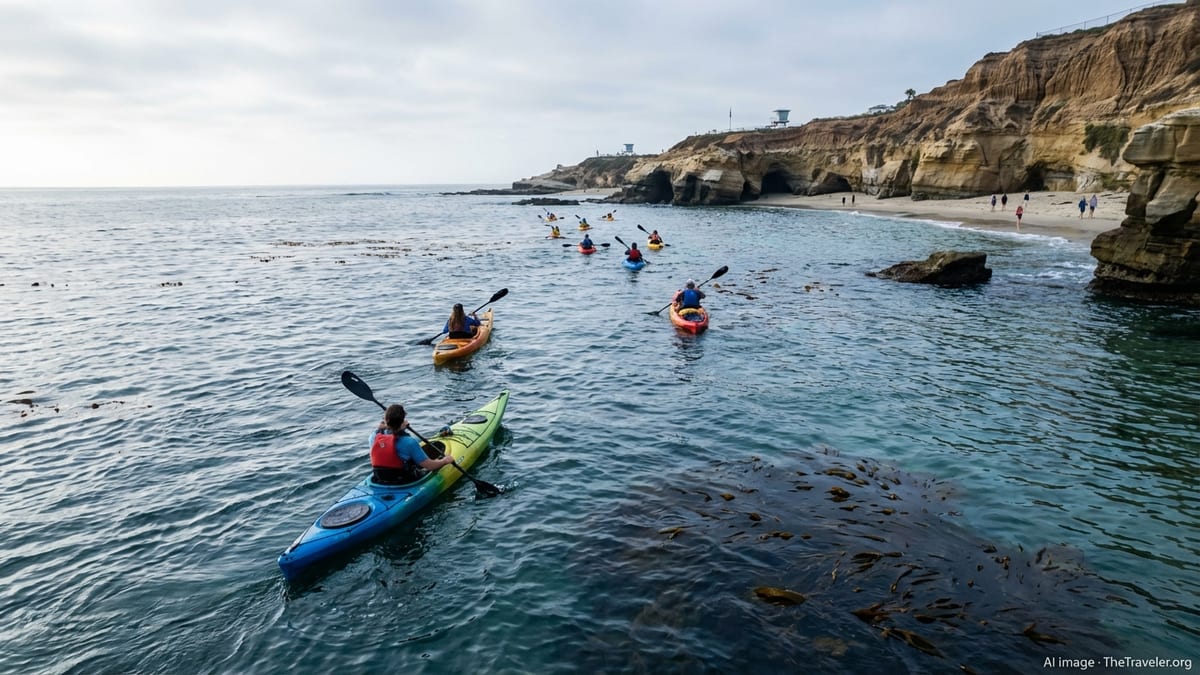
Once we were actually in the water at La Jolla Shores, the mood shifted. The waves were relatively gentle thanks to reefs offshore, and after a wobbly start getting past the break, I fell into a rhythm with my paddle. The shoreline opened up to a long, curved view of cliffs and scattered buildings perched above, and the water took on that surprising blue-green clarity that La Jolla is famous for, especially on calmer days.
Paddling across the reserve toward the sea caves was the first moment that matched the brochures. Kelp forests swayed just below the surface, and from time to time my paddle brushed a frond or I saw flashes of fish below. A few sea lions barked from the rocks in the distance. Even with other tour groups in the area, the scale of the coastline helped it feel more expansive and less crowded than the beach itself.
The big question, though, was whether we would actually get to go inside a cave. Our guide was honest from the start: surf at the cave entrances was borderline, and the lifeguards had the final say. As we approached the cliffs, I could see exactly why they were cautious. The water at the cave mouths was surging in and out, creating a washing-machine effect that looked less like a mellow paddle-through and more like a place where you could easily tip if you mis-timed a stroke.
In the end, we did not go into any caves. We hovered just outside, getting explanations about the geology and history while we bobbed in the swell and watched other groups also hanging back. Intellectually, I completely understood and agreed with the call; nobody on a vacation needs a head injury or a rescue. Emotionally, it was hard not to feel disappointed. The “kayak cave tour” became a “kayak near the caves tour,” and that rebranding happened in real time, on the water, rather than in the marketing copy I had read in advance.
On the plus side, the guide filled the gap with genuinely interesting commentary about the marine reserve, the restrictions on fishing and collecting, and the way the canyon offshore drops dramatically in depth, attracting an unusual mix of sea life. Still, the highlight for me ended up being the paddle itself and the views of the cliffs, not the fabled moment of entering a cave that I had quietly built the day around. It was a useful reminder: when tours say “ocean conditions permitting,” they really mean it.
Snorkeling at La Jolla Cove: Clear Water, Cold Shock, and Wildlife Reality
Later in the day, I headed over to La Jolla Cove with a mask, snorkel, and wetsuit. The Cove is inside the marine reserve, so the rules are stricter here: no kayaks launching, no surfboards, no collecting shells or disturbing wildlife. The beach itself is small and can feel crowded quickly, but standing on the sand and looking into the water, I could see why this place has a reputation among snorkelers. The visibility was much better than in most Southern California spots I have visited, with kelp fronds and rocks clearly visible from shore.
The first surprise was the water temperature. Even in warmer months, the Pacific here is brisk, and I was grateful for the wetsuit. Without it, I would not have lasted long enough to enjoy much of anything. Entering the water is simple in terms of surf, but the bottom is rocky and uneven, and I watched more than one person slip or stub a toe. It is not a soft, sprawling sandy beach; it is a compact entry point into a rocky marine world that happens to have sand at the edge.
Underwater, the marine life did not disappoint, but it also did not feel as dense and cinematic as many photos suggest. I saw a good number of garibaldi, some smaller fish darting through the kelp, and a sea lion cruising by in the distance before rocketing up to the surface. It was the kind of slow, observational snorkeling that rewards patience rather than a nonstop wildlife show. If you go in expecting wall-to-wall creatures on every glance, you might be underwhelmed. If you enjoy simply hanging in the water watching subtle movements in the kelp, it is quietly mesmerizing.
Another surprise was how tiring it was to stay relaxed in the water while managing the crowd. Swimmers, free divers, and snorkelers crisscrossed the area, and I constantly had to look up to avoid bumping into someone. The marine sanctuary rules make this a safer environment for wildlife, but they do not automatically create a feeling of solitude for humans. I ended up swimming a bit farther out, where the density of people thinned and I could enjoy the reserve in relative peace, but that is not necessarily comfortable for every visitor, especially weaker swimmers.
Leopard Sharks, Sea Lions, and the Wildlife Lottery
One of the big marketing hooks for La Jolla Underwater Park is wildlife. Depending on the season and exact location, you might see harmless leopard sharks congregating in shallow water near La Jolla Shores, orange garibaldi glowing against the rocks, swooping cormorants, and plenty of sea lions. That narrative is everywhere, so it is natural to arrive with a mental checklist of animals you hope to spot.
In my case, the wildlife experience was memorable but less dramatic than I had imagined. I did not snorkel during the peak leopard shark season, so I did not get the classic “surrounded by dozens of sharks” scene that fills social media feeds. I knew that was seasonal and luck-dependent, but part of me still hoped a few might glide by anyway. Instead, my time in the water relied heavily on the regulars: garibaldi, smaller schooling fish, and the occasional sea lion in the distance.
What surprised me most was that some of the standout wildlife moments actually happened from land. At the Cove, I watched sea lions hauled out on rocks just a short distance from the pathway, barking at each other and occasionally splashing into the water. From the bluffs, I could see the dark patches of kelp beds and occasional shapes below the surface, even without getting wet. That visual overview helped me appreciate the scale of the Underwater Park in a way that being inside the water could not.
Still, the experience felt genuinely wild in a way I appreciated. There were no guarantees, no staged encounters, no feeding. The guides were clear that wildlife sightings vary day by day and that getting skunked on certain animals is always a possibility. It is not an aquarium; it is a marine reserve that humans are allowed to visit under strict rules, and that means patience and a bit of humility are required. If you go in with a flexible mindset, even a day with “only” fish and kelp can feel special. If you arrive expecting a constant parade of animals, you may leave feeling like you missed something, even though nothing was ever promised.
Conditions, Logistics, and Physical Demands: What No One Puts in the Brochure
One of the most important lessons I learned at La Jolla Underwater Park is that this is not a casual, flop-in-the-water experience for everyone. Even on a relatively calm day, ocean kayaking requires some effort, and snorkeling here demands at least basic comfort in open water. That is not to say it is extreme, but it is physical, and the environment is dynamic.
Paddling out from La Jolla Shores means dealing with waves at the launch, swell rolling under your kayak, and the occasional awkward crossing with other groups. Getting past the surf zone without tipping takes a bit of coordination, and landing back on the beach at the end can be just as tricky. The guides do their best to coach people through it, but it is not the same as paddling on a lake. I saw a few people capsize near shore, and while everyone emerged more amused than injured, it is something to factor in if you are nervous around the ocean.
Snorkeling comes with its own set of demands. The water is cold, the bottom is rocky, and there is no perfectly contained “beginner area” that is free of other swimmers and changing depths. A wetsuit is strongly recommended unless you are particularly tolerant of chilly water. The lifeguards are attentive, but they are overseeing a lot of people at once, and you need to be honest with yourself about your swimming ability before heading too far from shore.
Then there are the small but accumulative logistical frictions: paying for lockers, finding street parking that will not result in a ticket or towing, carrying gear a few blocks in the sun, and dealing with sand stuck to everything you own. None of this is unique to La Jolla, but it does chip away at the fantasy of a seamless marine adventure. I left at the end of the day pleasantly tired but also aware that this is not the ideal setting for someone who just wants to dabble in the ocean without much effort.
What I Would Do Differently Next Time
Looking back, there are a few things I would absolutely change if I returned to the La Jolla Underwater Park. The first is timing. I would aim harder for a shoulder-season weekday and arrive very early in the morning, both to make parking less stressful and to enjoy a quieter beach and better odds of calmer conditions. Even a one-hour shift earlier in the day could have made my launch and landing feel less congested.
I would also choose my experiences more selectively. Doing both a kayak tour and separate snorkeling on the same day sounded efficient but ended up feeling a bit rushed. Next time, I might commit fully to either a dedicated kayak-and-snorkel guided combo or a relaxed half-day spent just snorkeling and observing from shore. Splitting the focus made me feel like I was slightly racing the clock in both activities.
In terms of expectations, I would consciously downgrade the cave component from “must-do highlight” to “possible bonus.” If I ever do get to paddle into a sea cave here, I will treat it as luck meeting good conditions rather than something I am owed because I booked a particular tour. That mental shift alone would probably make the day feel less like a gamble and more like an exploration.
Finally, I would prepare better for the practical realities: bring thick-soled water shoes for the rocky entries, plan on a wetsuit even in warmer months, and pack lightly so I am not juggling unnecessary belongings between lockers, beach, and car. None of those changes alter the core of the experience, but they would make the edges far smoother.
The Takeaway: Who La Jolla Underwater Park Is Really For
By the end of my visit, I felt both impressed and a little exhausted. La Jolla Underwater Park is truly special from an environmental perspective: a protected marine area with clear water (on good days), varied habitats, and enough wildlife to remind you that the Pacific is very much alive beneath the surface. It is also a busy, popular, sometimes chaotic place where the reality of heavy use and unpredictable ocean conditions collides with the dreamy images that first draw people there.
If you are an experienced swimmer, reasonably fit, and comfortable with the idea that the ocean always has the final say, this place can be magical. You are likely to appreciate the subtle rewards: hovering over a kelp bed as sunlight filters down, spotting a single sea lion weaving through the water, or sitting in your kayak just offshore while waves boom into the caves nearby. For you, the effort, the crowds, and the occasional disappointment will feel like a fair trade for access to a living marine sanctuary.
If you are nervous in the ocean, expect guaranteed cave entries or wildlife encounters, or dislike crowds and logistical friction, you may find the experience more frustrating than fulfilling. This is not the carefully curated, all-conditions-friendly environment of a resort lagoon. It is rawer, more conditional, and less forgiving of unrealistic expectations. That does not mean you should skip it, but it does mean you should choose your activities and timing with extra care.
For me, the visit was worth it, but not in the picture-perfect way I once imagined. It was worth it because it forced me to trade fantasy for reality and to appreciate the park as a place where nature sets the agenda and humans fit in around the edges. I would go back, but I would go back differently: earlier, better prepared, more patient, and more willing to let the day unfold on the ocean’s terms.
FAQ
Q1. Do I need to be an experienced swimmer to enjoy La Jolla Underwater Park?
For snorkeling, you should be a confident swimmer in open water, since conditions and depths change quickly. For guided kayak tours, basic comfort in the water is usually enough, as you wear a life vest and stay with a group.
Q2. Can I always kayak into the sea caves?
No. Entering the sea caves depends entirely on ocean conditions like swell, tides, and visibility. Even on a “cave tour,” you may only be able to paddle near the caves rather than inside them.
Q3. Is the water really that cold, and do I need a wetsuit?
The Pacific here is brisk most of the year. A wetsuit is not strictly required but makes snorkeling and longer swims far more comfortable, especially if you get cold easily.
Q4. How bad is parking near La Jolla Shores and La Jolla Cove?
Parking can be frustrating on weekends, holidays, and sunny days. Expect to circle for a spot, park several blocks away, and allow extra time before any scheduled tour.
Q5. Is La Jolla Underwater Park suitable for young kids?
It depends on the child and the activity. Calm shoreline play at La Jolla Shores is generally fine, but snorkeling and kayaking in open water are better for older kids who are confident swimmers and comfortable following instructions.
Q6. Will I definitely see leopard sharks or sea lions?
Wildlife sightings are never guaranteed. Leopard sharks are seasonal and most visible at certain times of year, while sea lions are more common but still move around. Think of animals as a bonus, not a promise.
Q7. Do I need to book a guided tour, or can I just rent gear?
You can rent gear, but if you are new to ocean kayaking or unfamiliar with local conditions, a guided tour offers structure, safety oversight, and context that make the experience less stressful and more informative.
Q8. How crowded does it get, and does that ruin the experience?
It can be very crowded, especially at midday and in peak season. While the crowds do chip away at the sense of solitude, the area is large enough that you can usually find slightly quieter pockets if you are willing to swim or paddle a bit farther.
Q9. What should I bring that I might not think of?
Sturdy water shoes or sandals with good grip, a well-fitting wetsuit or plan to rent one, minimal valuables, a towel, and sunscreen you are comfortable reapplying around sand and salt spray.
Q10. Is La Jolla Underwater Park still worth visiting if I am on a tight schedule?
It can be, but you should keep your plans simple. Choose one main activity, build in extra time for parking and changing, and be prepared to adjust if ocean conditions limit what is possible that day.