

I finally made it to the Houston Museum of Natural Science, the hulking glass-and-stone box at the edge of Hermann Park that every local seems to treat as a default weekend plan. I went in with high expectations built from years of hearing “You have to see the dinosaurs” and scrolling past slick social posts.
What I found inside was a mix of genuinely impressive galleries, a few borderline chaotic crowds, and a pricing structure that felt more like an attraction complex than a straightforward museum. I left both glad I went and very sure I would plan the visit differently next time.
Getting There, Tickets, and My First Reality Check
The museum sits in Houston’s Museum District, right across from Hermann Park, which is convenient if you are already downtown or in the Medical Center. I arrived by car and immediately hit my first surprise: the parking garage attached to the museum is not cheap. The official guidance makes it sound like just another nice amenity, but by the time I paid for garage parking and general admission, I felt like I had just paid for a theme park, not a museum visit. There is some street parking in the area, but much of it was full when I arrived in mid-morning, and I did not want to circle endlessly, so I surrendered to the garage.
Ticketing was my second reality check. General admission covers the permanent exhibit halls, but almost everything that sounds particularly exciting beyond that has its own separate ticket: the Cockrell Butterfly Center, the Burke Baker Planetarium, the Wortham Giant Screen Theatre, and any major special exhibition. The base price for general admission itself is substantial for a museum, and I noticed quickly how fast the numbers climb once you add one or two “extras.” I went in knowing this on paper, but standing at the counter doing the math for a hypothetical family visit made it feel more painful. It is very easy to underestimate the true cost of a day here if you do not read the pricing grid carefully in advance.
I chose to buy only general admission on this visit, partly out of curiosity about how worthwhile the core museum is on its own. I was also trying to see if this could be a reasonable budget visit. Watching families in front of me decide which children would get to see the butterflies and which would not, because of cost, was a sobering moment that shaped how I felt about the rest of the day.
Crowds, Layout, and the Pace of the Day
Once I stepped past the ticket area, the museum opened up into a buzz of activity and noise. This is not a contemplative, whispery sort of museum. It is loud and busy, with large school groups, strollers, and a lot of sensory input. If you thrive on energy and motion, the atmosphere is lively and fun. If you prefer quiet galleries, you will need to manage your expectations.
The layout is both linear and disorienting at the same time. There are several floors and wings, and while signage is present, it is not always obvious how to move efficiently between specific collections. I found myself occasionally doubling back or popping out of one hall into a gift shop or lobby, trying to figure out where to go next. It is not confusing enough to ruin the visit, but it does cost you time and energy, especially if you are trying to target specific halls in a limited window.
Because I went on a regular daytime visit rather than a free Tuesday evening, the crowds were intense but manageable. I could always get close to what I wanted to see, though I sometimes had to wait out a wave of kids taking selfies with dinosaur jaws or gemstone clusters. I can easily imagine the free evenings being both a blessing and a curse: free entry to the permanent halls is fantastic, but squeezing through when everyone else has the same idea could be frustrating. If you are planning to go during one of those free windows, I would mentally prepare for lines, noise, and a slower pace.
I had penciled in about three hours for my visit, and that was ambitious. Even without any paid extras, it would be easy to spend a full day here if you are methodical and like to read labels. I ended up moving faster than I wanted to in several halls, which left me both impressed by the scale and slightly annoyed with myself for underestimating how much time the place demands.
The Dinosaur Hype: Morian Hall of Paleontology
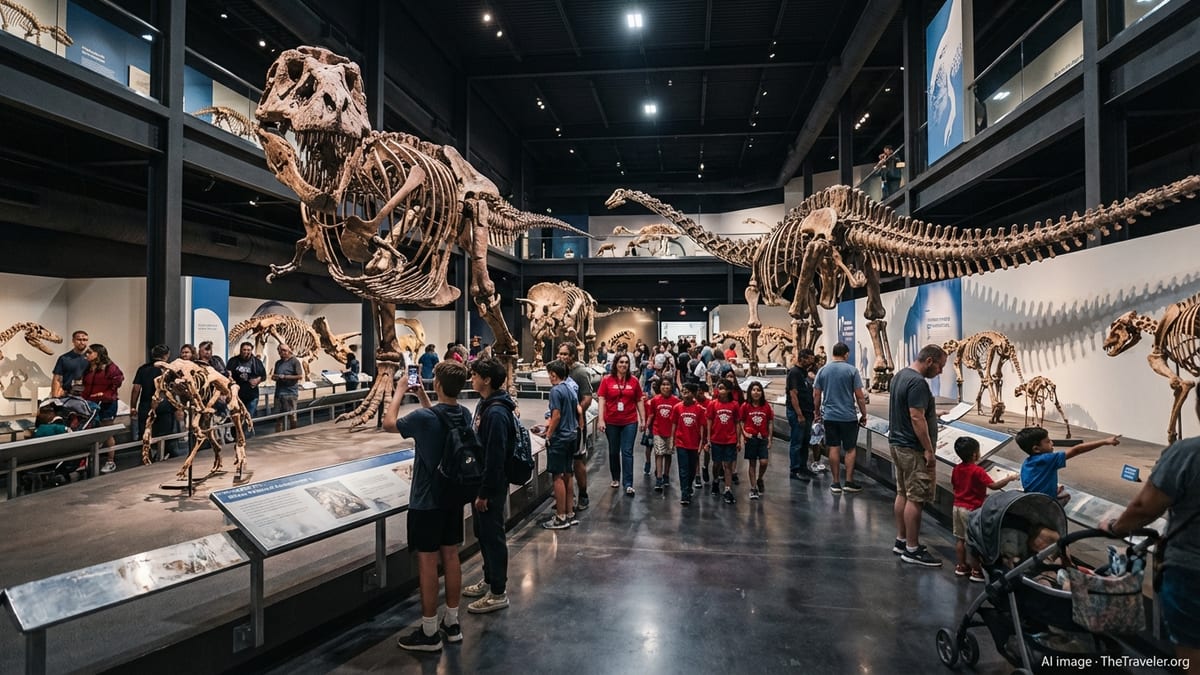
Everything I had heard about the dinosaur hall turned out to be mostly true. The Morian Hall of Paleontology is the star of the museum, and it earns that status. The space is long, winding, and theatrically lit, with skeletons posed in mid-attack or mid-sprint, rather than the old-fashioned static “line of dinosaurs on pedestals” approach. Walking into the hall, I felt a genuine sense of awe. The scale of the specimens, the way they are layered at multiple levels, and the dramatic staging all work together to create a cinematic experience.
The educational content is there if you want it: panels explain evolutionary relationships, paleo-environments, and how scientists piece together what we know from fossil evidence. The hall is designed so that you can enjoy it at multiple levels. You can simply walk through and be wowed by the bones, or you can slow down and read your way through the science. I appreciated that flexibility, especially in a crowded space.
What surprised me, though, was how uneven the experience felt in practice. At peak times, the hall turns into a slow-moving river of people. I often found myself reading a panel with a child literally pressed against my elbow, or waiting for groups to finish taking photos under a towering predator. The lighting, which is perfect for dramatic skeletons, makes the labels a bit hard to read in spots. It is very much a production: impressive and Instagram-ready, but occasionally at the expense of comfort and reflection.
Even with those frustrations, the dinosaur hall alone justifies a significant portion of the admission price. If I were to return, I would seriously consider timing my visit to hit this hall right when the museum opens or later in the day when crowds thin. Coming here on a free Tuesday evening, specifically for this hall, would make sense if I were willing to accept the crowd factor as part of the deal.
Gems, Egypt, and the Mix of Old-School and Spectacle
After the dinosaurs, I moved into the gem and mineral halls, and this was one of the biggest pleasant surprises of the trip. I expected a few cases of shiny rocks and maybe some jewelry. Instead, I walked into a series of galleries overflowing with crystalline forms, gemstones, and minerals arranged with real care. The variety and scale are impressive. Some cases focus on raw mineral specimens, others on polished and cut stones, and others on themed displays that connect geology to everyday life.
The design of these halls is more traditional than the dinosaur gallery, but in a good way. The lighting makes the stones glow without feeling like a nightclub, and the explanations are clear and at a reasonable reading level. This was one of the few spaces where I felt I could actually move at my own pace and get lost in the details. It is easy to underestimate how engaging a room full of rocks can be until you find yourself lingering over an iridescent cluster or a massive geode.
The Hall of Ancient Egypt, on the other hand, left me with mixed feelings. It is visually rich, with reconstructed tomb spaces, statues, funerary objects, and mummies. The atmosphere is dark and moody, clearly designed to evoke mystery. At first glance, it is fascinating: carved faces emerging from dim corners, hieroglyphs lit just enough to catch your eye. But as I moved through, I found myself wishing for more clarity and less mood. Labels can be text-heavy or oddly placed, and the narrative sometimes feels fragmented. I occasionally felt like I was walking through a theatrical set rather than a coherent story about ancient Egyptian life and death.
Ethically, I also found myself uneasy at times. The display of human remains is framed as educational, but the tone of the room and the way visitors reacted often felt more like curiosity and entertainment than reflection. That is not unique to this museum, but it did color my experience. It left me wanting a bit more visible context about how the collection was acquired and how the museum addresses those concerns today.
Science for Kids, or Anyone Who Likes Buttons and Screens
Beyond the headline halls, the museum has a lot of space dedicated to hands-on or family-friendly science areas. Some of these sections are clearly geared toward younger visitors, with interactive exhibits about energy, earth science, or human biology. The design leans heavily on buttons, screens, and big visual models. These areas struck me as both engaging and slightly dated at the same time.
On the positive side, kids were clearly having fun. I saw plenty of families camped out by tornado simulations, fossil dig pits, and physics demonstrations. The interactivity kept younger children occupied long enough for adults to absorb at least some of the accompanying explanations. In a city where the heat can make outdoor activities brutal for much of the year, an indoor science playground has real value.
But some of the exhibits, particularly the ones heavy on older-style digital interfaces, feel like they belong to another decade. Touchscreens that respond slowly, graphics that look like they have not been updated in years, and occasionally confusing instructions all added up to a sense that parts of the museum’s “interactive” layer have not quite kept pace with current design standards. In a place that charges premium pricing and promotes itself as a top-tier science destination, this gap is noticeable.
Still, if I were visiting with children, I would be grateful these areas exist. They offer a break from reading plaques and staring at cases, and they give kids a sense of agency. I just came away thinking that the museum spends a lot of effort on spectacle in headline areas, while some of the quieter, educational corners could use refreshing.
The Extras I Skipped and Why I Would Plan Them Differently
One big decision I made, and slightly regretted, was skipping the paid extras: the Butterfly Center, the planetarium, the giant screen theater, and the current special exhibition. Part of the reason was budget. Looking at the combined price for all of them on top of general admission made my eyes widen. The other reason was time. I knew that if I tried to stack on multiple timed tickets, I would be rushing through the permanent halls to make showtimes, which did not appeal to me on a first visit.
Talking with people in line and eavesdropping on conversations, I kept hearing praise for the Butterfly Center and the planetarium in particular. Several visitors said they came mostly for those and treated the rest of the museum as an add-on. That says a lot about how central these “extras” actually are in the overall experience. In some ways, HMNS is structured less like a single museum and more like a cluster of attractions under one roof, each with its own line at the register.
If I could redo my visit, I would either commit fully to the extras or skip the museum entirely that day and choose a free Tuesday evening for the permanent halls alone. The middle ground I tried, where I paid for general admission only on a regular day and then hesitated at every up-sell, left me feeling slightly shortchanged. Not because the permanent exhibits are weak, but because the whole building is designed around the idea that you will build a custom bundle of experiences.
On a future visit, I would likely pick either the Butterfly Center or the planetarium and build my schedule around that one timed ticket. I would accept the higher overall price as the cost of a “big day out” and make sure I arrived early enough to explore a couple of key permanent halls before and after. Trying to bolt those experiences onto an already rushed timeline is where things start to feel stressful and expensive.
Service, Amenities, and the Little Frictions
From a practical standpoint, the museum operates like a well-oiled attraction most of the time. Staff at the ticket counters were efficient and patient, especially given the number of questions they fielded about pricing and memberships. Security checks were quick, and there were clear reminders about no food or drink in exhibition areas. I rarely felt confused about basic do’s and don’ts inside.
The amenities are robust: restrooms on multiple floors, a café area, and at least one very prominent gift shop that you will almost certainly pass through or by multiple times. The shop is big, colorful, and full of the usual mix of educational toys, books, and branded souvenirs. It is well done, but unmistakably commercial. It added to the sense that HMNS is part museum, part themed experience economy. If you are visiting with kids and trying to keep spending down, you will need a strategy for navigating this space.
What I noticed more than anything were the small frictions that accumulated over the course of the day. Waiting for an elevator that stopped on every floor because of strollers and wheelchairs. Trying to find a place to sit that was not already occupied. Attempting to step back far enough to see a large object clearly without blocking the flow of people behind me. None of these things is a deal-breaker, but together they contributed to a faint feeling of fatigue that hit sooner than I expected.
The museum’s climate control, on the other hand, deserves a nod. Given Houston’s humidity and heat, walking into a comfortably cool building with stable temperatures in the galleries was a relief. I never felt uncomfortably cold or hot inside, which sounds minor but matter when you are spending hours indoors surrounded by other people.
Value for Money and Who This Museum Really Suits
By the time I walked back out into the sunlight, I had spent more than I wanted to for less of the museum than I had originally imagined. That said, I did not feel like my money had been wasted. The dinosaur and gemstone halls alone delivered a level of quality I would expect from a major national institution. The breadth of content across floors and themes is impressive, and there is no shortage of things to look at, ponder, or photograph.
Still, the question of value for money is not straightforward. For a solo adult or a couple who can visit during regular hours and treat this as a one-off outing, the price, while high, can be justified if you are genuinely interested in natural science. For a family, especially one considering multiple add-ons, the numbers climb quickly into territory that rivals or exceeds other big-ticket attractions. The free Tuesday evenings for the permanent halls are an important counterweight, but those hours come with the obvious trade-off of larger crowds and a limited time window.
The museum seems particularly well suited for a few specific groups. Families with school-age children who are comfortable in noisy, high-energy environments will find plenty to enjoy, especially if they plan ahead and choose one or two priority experiences. Adults who love paleontology or geology will be happy here, especially if they time their visit to avoid peak crowds. Visitors using city passes or free admission programs can extract significant value if they understand that not everything is included and budget for at least one paid extra.
For slower travelers who like quiet galleries, deep reading, and low-sensory environments, the museum is more of a mixed bag. The content is there, and some quieter corners exist, but you have to work for them. If you go in expecting the atmosphere of a small, academic museum, you will probably be disappointed. This is more like a science entertainment hub that happens to hold world-class collections.
The Takeaway
My visit to the Houston Museum of Natural Science left me with a complicated but ultimately positive impression. I was genuinely impressed by several of the permanent halls and surprised by how much I enjoyed sections I had not even planned to prioritize, like the minerals. I was also frustrated by the layered pricing, the constant upsell of paid extras, and the crowd level that made it hard to fully sink into certain exhibits.
If I could do it again, I would plan with more intention. I would either visit on a free Tuesday evening just to wander the permanent halls, accepting the crowds as part of the trade-off, or I would pick a regular day and budget fully for at least one major add-on like the Butterfly Center or the planetarium. I would arrive earlier, give myself at least four to five hours, and be realistic about how much I could see well rather than trying to rush through everything.
In the end, I am glad I went. The museum delivers some truly memorable moments, especially under the towering skeletons of the Morian Hall of Paleontology and in the glittering quiet of the gem galleries. It is not a perfect experience, and it is not a cheap one, but under the right conditions it is absolutely worth the effort. For anyone who loves science, ancient worlds, or simply wants a dense, air-conditioned slice of curiosity in Houston’s Museum District, it is still a strong choice, as long as you go in with clear priorities, managed expectations, and a firm budget.
FAQ
Q1. How much time should I plan for the Houston Museum of Natural Science?
I would plan for at least three to four hours if you want to see a few major permanent halls without rushing. If you add on the Butterfly Center, a planetarium show, or a special exhibition, you can easily fill a full day.
Q2. Is general admission enough, or do I need to pay for the extras?
General admission gives you access to the permanent exhibit halls, including the dinosaurs and gems, which are strong on their own. The extras, like the Butterfly Center and planetarium, are highly recommended but not essential. If budget is tight, you can still have a satisfying visit with general admission only.
Q3. When is the best time to visit to avoid crowds?
Arriving right when the museum opens on a weekday is your best bet for smaller crowds. Midday and weekends get busy, and free Tuesday evenings are popular, so expect more noise and slower movement then.
Q4. Is the museum worth visiting on a free Tuesday evening?
Yes, especially if you are focused on the permanent halls and comfortable with crowds. You save a significant amount on admission, but you trade that savings for a shorter window and a busier, more energetic atmosphere.
Q5. How expensive is parking, and are there alternatives?
The attached parking garage is convenient but not cheap, and the cost feels noticeable on top of admission. There is some street parking in the surrounding area, but it can be limited. If you are comfortable with public transit or rideshare, those can reduce the stress of parking.
Q6. Is the museum suitable for very young children?
Yes, there are plenty of interactive elements and visual displays that even toddlers will find engaging, but the museum can be loud and overstimulating. Strollers are common, and you will need to navigate elevators and crowds at peak times.
Q7. Can I see everything in one visit?
Realistically, no. You can skim most areas in a day, but you will not absorb much. It is better to choose a few priority halls, like dinosaurs and gems, plus one extra experience, rather than trying to “do it all” in a single trip.
Q8. Are the exhibits up to date and well maintained?
Most of the major halls, especially the dinosaur and mineral galleries, feel current and well maintained. Some of the interactive and digital exhibits show their age a bit, with older interfaces and slower touchscreens, but the core collections remain strong.
Q9. How does it compare to other big science museums?
The Houston Museum of Natural Science holds its own in terms of spectacle and scale, particularly in paleontology and minerals. Pricing and the add-on model make it feel more like a multi-attraction complex than some peers, which can be a downside if you prefer a simpler, all-inclusive ticket.
Q10. Who would I recommend this museum to, and who might want to skip it?
I would recommend it to families with school-age kids, science enthusiasts, and anyone excited by dinosaurs, gems, or immersive exhibits, especially if they plan and budget ahead. Those who prefer quiet, uncrowded galleries and a low-cost, low-stimulation museum experience might find it less satisfying and may be happier with smaller, more focused institutions in the city.