

There are places you dream about for years, only to finally arrive, look around, and quietly think, “I flew across an ocean for this?” For me, that place was Venice in peak summer, when the floating city tips from magical to mercenary. I went, I queued, I paid the tourist prices, and I came home with one mission: help you experience Venice without feeling like you just set fire to your travel budget.
Landing In A Postcard That Smelled Like Exhaust
My Venice story started the way many do, with a glossy fantasy. I had seen that classic shot of gondolas bobbing in front of St Mark’s Basilica, the kind of image that fills airline magazines and Instagram feeds. What you do not see in those frames is the queue of people, each quietly calculating whether a 30-minute gondola ride starting around 80 euros before sunset, and often closer to 120 euros at night for a private boat, is actually worth it. On the July afternoon I arrived, the canals were as beautiful as promised, but the air around the main sights felt more like an open-air mall than a living city.
From the moment I stepped off the vaporetto at San Zaccaria, the money drip began. A small espresso at a café directly facing the lagoon ran about 4 to 5 euros if I sat down, almost double what I had paid that morning in a quiet corner of Cannaregio. A scoop of gelato near the Bridge of Sighs was around 3.50 euros, served by a bored clerk who, judging by the queue, never once worried about repeat business. It was not that the prices were impossible; it was that they were paired with an unmistakable sense that most of us were there to be processed, not welcomed.
Venice consistently appears in rankings of the world’s most overrated or disappointing destinations, particularly around St Mark’s Square and the Rialto Bridge, where reviews complain about crowds, inflated prices, and underwhelming experiences. Recent analyses of traveler feedback highlight the same pattern: visitors feel squeezed between aggressive commercialization and the very real struggle of a city trying to manage millions of short-term guests. I did not need data to tell me that by the end of my first afternoon; I could feel it in the shuffle of the crowd and the way every view came with a price tag attached.
The 25-Euro Cappuccino Lesson At St Mark’s Square
Everyone warns you about the café prices in Piazza San Marco, but some lessons you only learn by paying for them. On my second evening I sat down at one of the famous orchestra cafés lining the square, drawn by the glow of the basilica and the soft sweep of live music. The menu was an education: a simple cappuccino around 10 to 12 euros, a spritz closer to 15 euros, plus a mandatory “music charge” of roughly 6 to 8 euros per person added to the bill just for occupying a chair in earshot of the band.
By the time I added up my drink, the music surcharge, and the service fee, I had effectively paid the price of a decent trattoria lunch elsewhere in the city for one drink I could have finished in ten minutes. Prices fluctuate with season and café, but the pattern is the same: you are paying to sit in the postcard. Many first-time visitors find out later, via unhappy reviews, that the extra “coperto” and music fees are what push that cappuccino into the 20 to 25 euro territory for a couple, if not more.
Was it magical to sit there as the sky turned from gold to indigo and the basilica lit up? Absolutely. Was it the best use of a limited travel budget? Probably not. A short walk away, on the edge of the Castello district, I later found a tiny bacaro where a glass of perfectly decent house wine cost about 3 euros and a cicchetto, the Venetian version of tapas, started around 1.50 euros. The square’s cafés charge what they do because enough people will always pay it. You are not obligated to be one of them.
The Gondola Ride I Almost Regretted
Gondola rides are the ultimate Venice cliché, and the prices reflect that status. Official base rates tend to be posted, often around 80 euros for 30 minutes during the day and rising into the 100 to 120 euro range in the evening, with additional time charged in 20-minute blocks. In reality, gondoliers often round up, especially in peak season or at the busiest stands around St Mark’s Square and the Rialto Bridge. I watched more than one couple hand over bills with the dazed look of people who had not converted euros back into their home currency before saying yes.
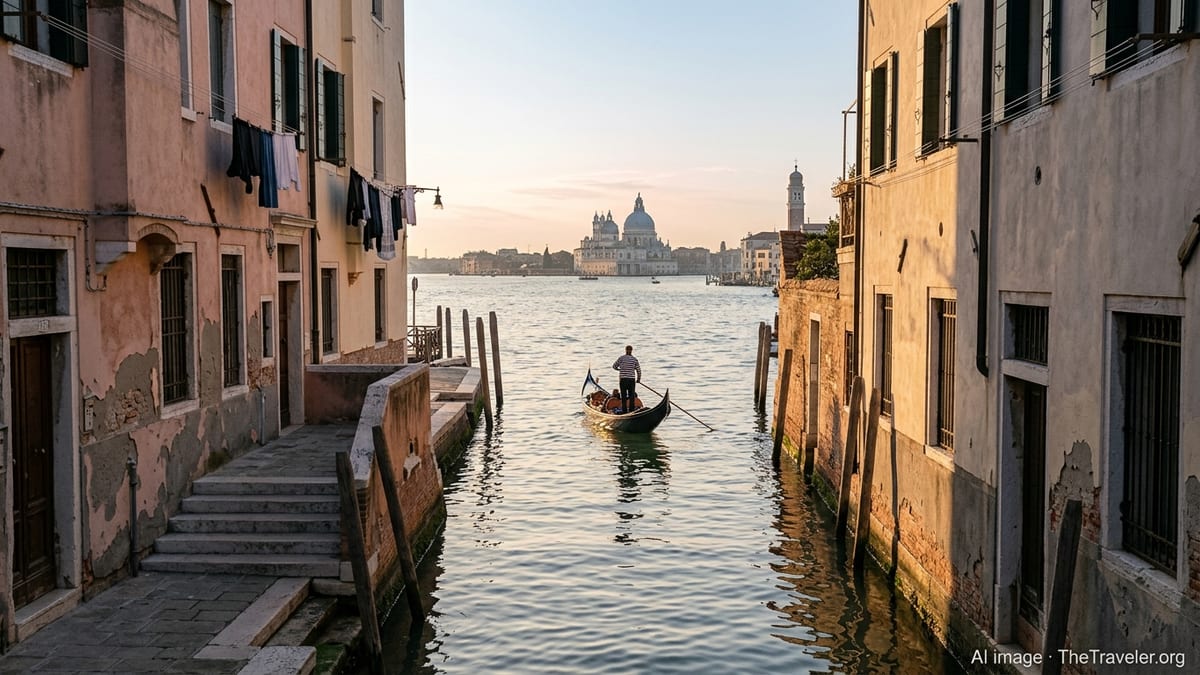
I almost joined them. At the main stand near St Mark’s, I was quoted a price at the upper end of the official range, with a shrug that implied there was a long line of people behind me who would not haggle. Instead, I walked ten minutes into a quieter part of Dorsoduro and found another gondolier who offered the official day rate without ceremony. The route wound through residential canals where laundry hung from windows and neighbors chatted across balconies. It was no less photogenic, but it felt connected to real lives instead of staged purely for visitors.
That ride, split with another solo traveler I met at the dock, came out to roughly 40 euros each. Still a splurge, but less punishing than the 100-plus euros I would have paid at the tourist choke points. Online, plenty of recent reviews echo the same advice: walk away from the biggest squares, agree clearly on price and length before stepping into the boat, and be prepared to say no if the number sounds inflated. A gondola can be a highlight if you treat it like a carefully chosen luxury, not an automatic requirement.
When Iconic Bridges Feel Like Outdoor Malls
There is a particular kind of disappointment that comes from visiting a place you have seen in art and cinema, only to find it smothered in souvenir stalls. The Rialto Bridge is a prime example. In paintings it arches gracefully over the Grand Canal; in person, much of the walkway is lined with stands selling identical magnets, T-shirts, and “Murano” glass trinkets that may or may not have seen the inside of an actual Venetian furnace. The view from the central arch is still beautiful, but you reach it by pushing through a dense shuffle of people, many equally underwhelmed.
Reviews of the Rialto often mention the same frustrations: too crowded, too many cheap shops, too little sense of history. On my first crossing, a selfie stick clipped my shoulder while someone else tried to maneuver a stroller through a packed knot of visitors. A slice of pizza from a nearby grab-and-go counter was nearly 7 euros, more than I paid for a sit-down margherita in a less central pizzeria two districts away. The bridge itself is free, of course, but everything around it is designed to convert foot traffic into cash.
The same pattern shows up near the Bridge of Sighs, where crowds press into a narrow waterfront strip for a photo of a small span that looks far more dramatic in edited travel posters. Street vendors weave through, selling roses and plastic toys that blink in neon colors. It is not that the structures lack beauty; it is that the experience of seeing them has been hollowed out by sheer volume and relentless selling. When a city’s most famous spots end up on lists of the world’s most overrated attractions, it is usually this clash between expectation and reality that pushes them there.
Where Venice Quietly Redeemed Itself
If I had only stayed around St Mark’s and the Rialto, I might have left convinced that Venice was little more than a beautifully painted trap. Instead, the city redeemed itself in the places that rarely make it into glossy ads. One afternoon I wandered north into Cannaregio, where the streets widened slightly and the souvenir stalls thinned out. Here, a spritz in a neighborhood bar cost about 3 to 4 euros, and I watched locals stop in for an unhurried chat with the bartender on their way home.
I walked past a schoolyard where children were playing soccer and found a bakery selling still-warm frittelle for around 2 euros. On the Fondamenta Misericordia, couples lingered over carafes of house wine at modest canal-side tables, and menus posted outside listed pasta dishes in the 12 to 16 euro range instead of the 20-plus I had seen around the square. None of it was cheap in an absolute sense, but it felt proportionate, aligned with the quality and the setting instead of inflated purely by fame.
On another day I took a vaporetto out to the island of Giudecca, where the crowds thinned dramatically. Here, laundry lines crisscross quiet courtyards, and you can sit on the fondamenta watching working boats pass without being asked every five minutes if you want a menu. My lunch of grilled fish and vegetables, about 24 euros including a glass of wine, rivaled meals on the main islands that cost much more. It reminded me that Venice is still a living city, not just a backdrop, as long as you are willing to step away from the most photographed corners.
How To See Famous Places Without Paying The “Disappointment Tax”
Coming home, I realized Venice had given me a crash course in avoiding what I have started to call the disappointment tax: the extra cost you pay when you follow the heaviest footpaths without questioning whether the experience matches the price. The pattern is not unique to Italy. Studies of overrated tourist attractions regularly name places like the Hollywood Walk of Fame, the Las Vegas Strip, and certain European theme parks as spots where visitors most often report poor value for money. Complaints cluster around the same themes: high admission fees, overpriced food, long lines, and a sense that the experience has been flattened into a sales funnel.
In Venice that meant learning to separate the symbol from the surroundings. Visiting St Mark’s Basilica early in the morning, when entry lines were shorter and the square still smelled of the sea rather than sunscreen, felt worthy of the hype. Paying near-premium prices for forgettable snacks and rushed drinks within sight of the same church did not. The same mindset applies elsewhere. You can walk the Las Vegas Strip once to absorb the spectacle, then spend your evenings in local neighborhoods where a cocktail does not cost the equivalent of a gondola tip, or visit the Hollywood sign viewpoint while skipping yet another expensive souvenir shop on Hollywood Boulevard.
Practical habits help. Check recent reviews not just for star ratings, but for specific complaints about cost and value. Look up typical local prices for everyday items like coffee or transport so you can recognize when you are being charged a “tourist rate.” Seek out second neighborhoods in major cities, where you are still close enough to see the big sights but can eat and sleep in areas shaped more by residents than tour groups. Venice, for all its flaws, taught me that you can hold both truths at once: some famous places are overcrowded and overpriced, and they are still worth seeing if you approach them on your own terms.
The Takeaway
Venice did not turn out to be a complete waste of money, but the parts of it that orbit around St Mark’s Square and the Rialto Bridge came dangerously close. The most touristy experiences, from 20-plus euro drinks with a music surcharge in the piazza to gondola rides sold at a premium in front of long queues, felt engineered less for wonder than for extraction. It is no accident that sections of the city now appear in global lists of overrated attractions, grouped with other places where travelers report that the math between cost and experience no longer adds up.
Yet in the quieter sestieri, in the backstreet bacari and on the less photographed canals, Venice was still luminous, still itself. The lesson I brought home has less to do with writing off entire destinations and more to do with how we navigate them. When you accept that the postcard version of a place often carries a built-in disappointment tax, you can choose when to pay it and when to step one street over and find the version locals actually live in.
If you are planning a trip to a famous city, take Venice as your case study. Budget for one or two big-ticket experiences you truly care about, then give yourself permission to skip the rest of the pricey clichés, no matter how often they appear on “must-do” lists. Let your most expensive purchase be a memory that feels specific and alive, not a vague recollection of an overpriced drink in a crowd. I visited this famous destination so you do not have to waste your money. With a bit of awareness, you can still go, still marvel, and still come home with your wallet and your sense of wonder largely intact.
FAQ
Q1. Is Venice really as overpriced as people say?
It depends where you go. Around St Mark’s Square, the Rialto Bridge, and the busiest gondola stands, prices for food, drinks, and experiences are noticeably higher than in residential districts like Cannaregio or on nearby islands such as Giudecca.
Q2. Are gondola rides in Venice worth the money?
A gondola ride can be memorable if you treat it as a special splurge, choose a quieter route away from the main squares, and clearly agree on price and duration beforehand so there are no surprises at the end.
Q3. How can I avoid tourist traps in Venice?
Step a few streets away from major landmarks before choosing where to eat or drink, compare menus and prices, and look for places with a mix of locals and visitors rather than only large tour groups.
Q4. When is the best time of year to visit Venice for fewer crowds?
Visiting in the shoulder seasons, such as late spring or early autumn, usually means slightly lower prices and fewer cruise ship crowds than peak summer, though weekends and holidays can still be busy.
Q5. Is it cheaper to stay outside the historic center?
Staying on the mainland in areas like Mestre or in less central Venetian districts often offers better-value accommodation, but you should factor in the cost and time of commuting by tram, bus, or vaporetto.
Q6. Are the cafés in St Mark’s Square ever worth the high prices?
If you value the atmosphere and live music, one drink there can feel like paying for an open-air show. Financially, however, you can get better coffee, food, and service a short walk away for a fraction of the cost.
Q7. What are some better-value alternatives to Venice’s most crowded areas?
Exploring neighborhoods like Cannaregio and Dorsoduro, or visiting outer islands such as Giudecca, Murano, or less touristed parts of Burano, often provides more authentic experiences at gentler prices.
Q8. How much should I budget per day in Venice to avoid feeling ripped off?
Budgets vary, but planning for modestly priced meals in residential areas, using public transport instead of private water taxis, and limiting big-ticket activities can keep daily costs more manageable.
Q9. Do recent visitor reviews support the idea that Venice is overrated?
Many recent reviews praise Venice’s beauty but criticize the heavy crowds and high prices around top sights, which is why parts of the city now appear in discussions of overrated global attractions.
Q10. Can I still enjoy Venice on a moderate budget?
Yes. By prioritizing walking, using vaporetti instead of private boats, eating in local bacari, and limiting expensive experiences to what truly matters to you, Venice can be rewarding without breaking your budget.