

Some places feel so famous that you almost doubt they are real until you stand in front of them. For me, that place was Paris. The Louvre, the Eiffel Tower, Notre Dame, the hills of Montmartre: these were images from postcards, textbooks and Instagram feeds long before I ever booked a ticket. So when I finally went to the world’s most visited region and its star city, I expected awe. What I did not expect was how often I would find myself standing in yet another line, checking yet another timed-entry ticket on my phone, and wondering who all this was really for.
Arriving in the City Everyone Wants to See
Paris is not just popular. It is a global benchmark for urban tourism, a city that consistently ranks among the world’s most visited and most attractive destinations, welcoming tens of millions of visitors each year. When I arrived at Gare du Nord on a gray spring morning, it felt as if all of them had decided to show up that same day. The taxi line wrapped around the forecourt. In the metro, rolling suitcases rattled over every step. Even the bakery around the corner from my budget hotel had a queue of people clutching printed “Top 10 croissants in Paris” lists on their phones.
I had chosen a small hotel near République, partly because anything closer to the river was either booked solid or asking eye-watering rates for a room the size of a train compartment. On the elevator wall, someone had taped a laminated card in English: “Welcome. Please be patient at breakfast: our capacity is 22 people, but most mornings we host around 40.” It felt like a quiet warning about the week ahead. In Europe’s most visited places, the everyday infrastructure of the city now has to stretch to cover a global audience.
Stepping out onto the boulevard, I walked toward the Seine with that jittery first-day energy. I passed a souvenir shop already open at 8 a.m., with Eiffel Tower keychains in 10 different colors and t-shirts printed with “I survived Paris traffic.” Delivery vans blocked bike lanes. A group tour leader raised a folded umbrella to rally a cluster of travelers who looked like they had landed only an hour earlier. This was the city I had longed to see, but the first thing I noticed was not the beauty. It was the volume.
The Louvre: Where the Line Is the Main Attraction
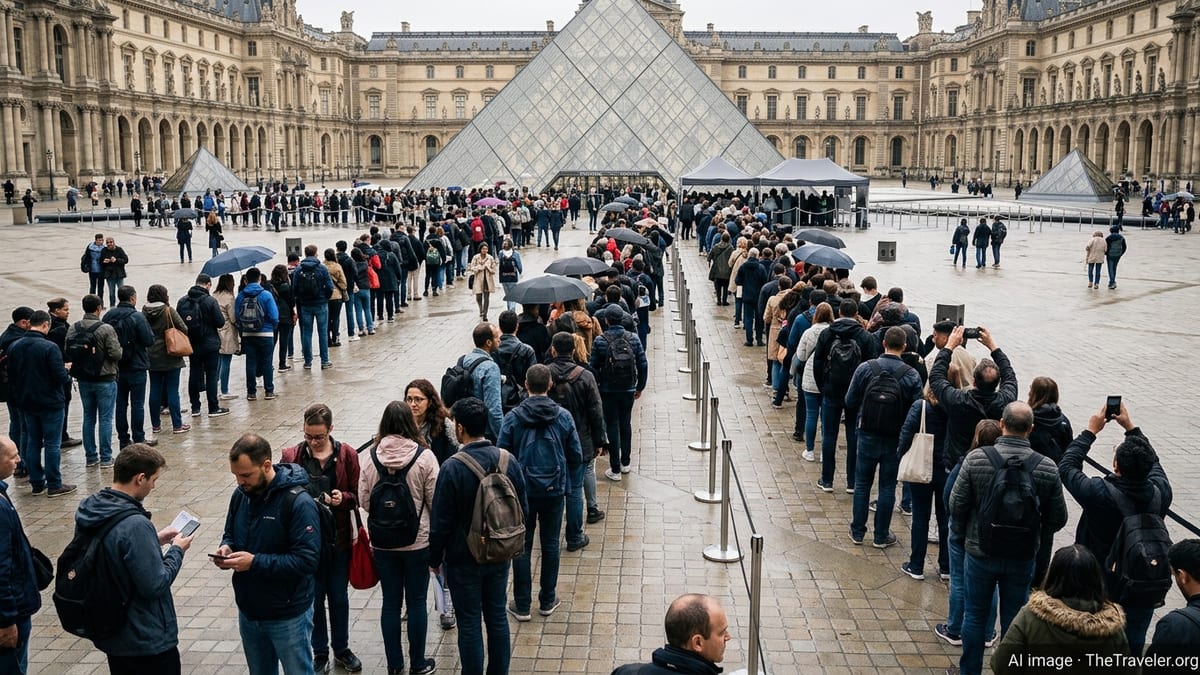
My first major stop was the Louvre, the world’s most visited museum and a symbol of how mass tourism is reshaping cultural spaces. Even on a weekday morning, with a pre-booked timed ticket in hand, I joined a crowd that snaked across the courtyard toward I. M. Pei’s glass pyramid. Security checks, bag scans and ticket validation formed a three-stage choreography that took nearly 40 minutes before I even caught sight of a painting.
Inside, the scale of the museum is staggering, but so is the crowd management. Electronic signs warned of “very high density” in certain wings. Staff members with radios directed flows of people as if they were managing a subway station at rush hour rather than an art collection. At the information desk, a weary-looking employee explained that daily visitor caps had been introduced in recent years to keep numbers within a range the building and staff could handle, yet it still felt close to breaking point.
Every famous work came with its own microclimate of chaos. At the Mona Lisa, a dense cluster of smartphones formed a shimmering wall in front of the painting. A metal barrier kept people several meters back. Security guards shouted instructions in French and English: “Keep moving, please. Take your photo and move.” I watched a couple from Asia push forward, each taking a two-second selfie before being gently nudged on. They walked away beaming, but I stood there, wondering if anyone had really seen the painting, or if we were all just confirming its existence for our cameras.
In another gallery, where a lesser-known 17th-century canvas hung in relative quiet, I finally found a bench. The room had perhaps ten visitors. No one raised a phone. I lingered there far longer than I had planned, partly because it felt like a rare luxury: space. It struck me that in one of Europe’s most celebrated cultural institutions, the best experience was not with the masterpieces that drew millions, but with the works just outside the spotlight’s glare.
Eiffel Tower: Icon of the Crowd, Not Just the City
The Eiffel Tower is both cliché and miracle, an iron lattice that anchors almost every visual story about Paris. It also receives millions of visitors each year, a reality that becomes evident even before you see the tower itself. As I approached the Champ de Mars, the first barrier I met was not symbolic, but literal: glass security walls surrounding the base, added in recent years as both a safety measure and a way to channel the constant flow of people.
To ride the elevator up, advance booking is now strongly encouraged. Same-day tickets are technically possible but practically scarce, especially in high season. On my second afternoon in the city, I opened the official app at 10 a.m. and found only a few available slots left for late evening, with adult prices that felt more like concert admission than urban viewpoint. I took a time I did not really want, because that is what you do when the alternative is not going at all.
That night, the line for the elevators wound through a maze of taped-off lanes. Anxious families counted children and passports. Solo travelers scrolled through social media, killing the wait. Vendors circled the edges selling warm beer and light-up plastic towers. When we finally packed into the elevator, phones shot up instantly as if on cue, recording the ascent through layered reflections of glass and steel.
The view from the top is genuinely astonishing: the river looping, the pale stone facades, the geometry of avenues radiating outward. Yet the platform itself felt less like a romantic perch and more like a moving bus at rush hour. Announcements reminded visitors not to lean too long against the railings. A small bar sold champagne at prices that made a bottle as much a status symbol as a drink. I found a quieter corner and looked down at the constant ant-like movement around Trocadéro, where yet another queue had already formed for the next light show. The tower was dazzling, yes, but it was also a monument to how thoroughly we have learned to stand in line for experiences we already know in advance.
Montmartre and Sacré-Cœur: A Neighborhood Under Siege
If the Louvre and the Eiffel Tower are prepared for heavy traffic by design, Montmartre feels like a place that never truly signed up for this destiny. The hilltop basilica of Sacré-Cœur has in recent years become one of France’s most visited monuments, receiving crowds that on peak days outnumber those at the Eiffel Tower. Walking up the stairs from the base of the hill, I quickly understood what that means for a residential neighborhood.
At the foot of the basilica, tuk-tuks and small tourist trains rattled by, their loudspeakers blaring recorded commentary in multiple languages. Around Place du Tertre, painters’ easels jostled for space with selfie-stick vendors and ice cream stands. Café menus were printed in four languages with prices that seemed to float several euros above what the same dishes cost in more ordinary parts of the city. A small grocer I stepped into for water had a handmade sign taped to the till: “No change for large bills, card preferred.” It was hard not to read it as a signal of fatigue.
Local residents have been increasingly vocal about what they describe as the “Disneyfication” of Montmartre. On a side street, a poster taped to a door read, in French, “Our quarter is not an amusement park.” Next to it, a newer notice from the city detailed restrictions on short-term rentals and tour bus access, part of a broader European push to tackle overtourism. Yet on the basilica steps that evening, none of that was visible. Music from street performers mixed with the sound of wheeled suitcases bounced down cobblestones. People drank supermarket wine from plastic cups as they waited for the nightly view of the city lighting up below.
As I sat on the steps, a young couple from Spain asked if I could take their photo, then immediately asked if I knew where they could find the café from the film “Amélie.” They had a list of Paris locations to recreate, printed from a social media guide, each with precise GPS coordinates. It was a reminder that what many visitors now seek is less an encounter with a real place and more a confirmation of an image they have been carrying for years.
Notre Dame and the New Reality of Sacred Sites
Notre Dame, scarred by the 2019 fire and then painstakingly restored, has returned as one of Paris’s biggest magnets. In the months after its reopening, the cathedral quickly drew visitor numbers that rivaled or surpassed those of other major monuments in the city. That popularity brings both financial lifeblood and intense logistical strain. Access is free, but the line curls across the square, a steady stream of people guided through security arches more commonly seen at airports.
When I visited, the queue moved steadily, but the sense of crowd control never faded. Loudspeakers alternated between liturgical music and practical instructions. Staff and volunteers in bright vests helped maintain a fragile balance between worshippers and tourists, explaining that certain areas would be roped off during mass and that photography would be limited at particular moments. The cathedral, for centuries a spiritual center, now functions as a complex hybrid: part active church, part global attraction, part security challenge.
Inside, the atmosphere was unlike any religious building I had known. A significant portion of the people around me held smartphones at chest height, filming stained-glass windows and vaulted ceilings. A priest’s voice floated through the nave, but it competed with the soft chime of notifications and the rustle of jackets as visitors shuffled forward. In one side chapel, a woman knelt in genuine prayer while behind her a guide gestured at the architecture for a tour group, laser pointer flicking along the stone.
On leaving, I paused in the square, where a cluster of souvenir stands sold miniature cathedrals and Paris snow globes. A nearby signboard outlined an ongoing debate about visitor limits and maintaining the building. It was another reminder that Europe’s most revered sites now live at the intersection of devotion, conservation and global tourism economics. As visitors, we are no longer just spectators; we are part of the stress test these places are undergoing.
Expectations, Algorithms and the Strange Flatness of Fame
What unsettled me most in Paris was not any single overcrowded sight, but how predictable my own path had become. Without quite planning it, I realized I was following an invisible route shaped by algorithms and rankings: the world’s most visited museum, the most photographed tower, the trending neighborhood, the newly reopened cathedral with record attendance. My days traced the same lines as millions of others, optimized by apps that suggested the “must see” places and warned of the “worst times to visit,” all using data drawn from fellow travelers.
In practice, this meant that much of my time unfolded in the company of people who had seen the same recommendations. Outside a popular boulangerie in the Marais, two Americans in line compared a TikTok food guide to their Google Maps list, each trying to confirm that they had not missed a more “authentic” croissant two streets away. On the Pont des Arts, a group of students from South America debated whether the bridge was “worth it” now that the famous love locks had been removed, their sense of value calibrated largely by older online photos.
There is a strange flatness that comes from arriving somewhere you already know too well in images. The wow moment is still there, but it is shorter and more fragile. Standing on the Trocadéro platform looking at the Eiffel Tower illuminated at night, I felt a brief rush of disbelief, followed quickly by a quiet question: “Is that it?” The scene matched the picture in my head almost exactly. There was no surprise, only verification.
This is not the fault of Paris alone. It is the new reality of any European hotspot that appears near the top of global city rankings. Long-haul travelers with limited vacation time and significant expenses increasingly rely on familiar lists and visuals. In doing so, we all compress an infinitely varied city into a handful of overburdened viewpoints, turning three or four locations into proof that we have “done” a place.
Stepping Aside: Finding a Different Paris
My confusion began to lift only when I stepped deliberately away from the orbit of the most visited sites. One afternoon, exhausted by the crowds at the Louvre and the intensity of the Seine’s central promenades, I took the metro east to the 20th arrondissement and climbed the quieter slopes near Père Lachaise cemetery. Here, the cafés were filled mostly with people speaking French, many of them alone with laptops or newspapers. The chalkboard of the day’s menu listed prices that made sense again: a coffee for a couple of euros, a lunch formule under fifteen.
In a small park, children played on swings while older neighbors chatted on benches. There were no tour groups, no audio guides, no one posing in front of a landmark to prove they had been there. The city felt suddenly three-dimensional again, textured and unpredictable. This, too, was Paris, just not the version optimized for international arrivals statistics and postcard views.
Later that evening, back near the canal in the 10th arrondissement, I watched local teenagers gather along the water with takeaway pizza and cheap wine, laughing and playing music from a portable speaker. A grocery store across the street sold everything from laundry detergent to fresh herbs, and its doorway buzzed with a constant flow of people popping in after work. It was utterly unremarkable and quietly beautiful, a reminder that real life carries on even in the most mythologized cities.
Those hours did not cancel out the frustrations of queue-filled mornings, but they reframed them. The problem, I realized, was not that Paris was overrated, or that Europe’s famous places had somehow lost their magic. It was that my approach had treated them like a checklist rather than a living environment. The more I chased the iconic, the more I joined a human traffic jam built from the same collective instinct.
The Takeaway
Leaving Paris, I felt both grateful and unsettled. I had finally seen places that had lived in my imagination for decades, from the glass pyramid of the Louvre to the iron lattices of the Eiffel Tower and the scarred yet resilient towers of Notre Dame. Yet I was also leaving with a sense that I had participated in something that is putting those very places under pressure: a global habit of concentrating our attention on a handful of hyper-famous sites in a continent full of alternatives.
What my trip clarified is that fame comes with a cost, both for destinations and for visitors. For cities like Paris, the challenge is managing historic crowds with infrastructure and policies that can keep cultural sites, residential neighborhoods and daily life from collapsing under their own popularity. For travelers, the challenge is more personal: resisting the urge to treat a place like a collection of proofs and instead granting ourselves the permission to wander, to step aside, to allow for experiences that no algorithm has already ranked.
If you go to one of Europe’s most visited places, go with clear eyes. Accept that the Louvre will be busy, that the Eiffel Tower will require planning, that Montmartre’s charm will be partly hidden behind souvenir stands and phone screens. But also build in time to exit the spotlight. Take a metro beyond the postcards. Sit in a café where the menu is only in the local language. Watch the city when it is not performing for you.
In the end, my confusion in Paris was less about the city itself and more about the kind of traveler I had become without noticing: one who mistook the widely shared image of a place for the place itself. The most valuable souvenir I brought home was not a miniature Eiffel Tower, but a new question to pack on every future trip: “What if I step two streets away from what everyone says I should see, and start there instead?”
FAQ
Q1. Is Paris still worth visiting despite the crowds?
Yes. The key is managing expectations and planning: book major sights like the Louvre and Eiffel Tower in advance, travel outside peak summer when possible, and balance famous landmarks with time in less central neighborhoods.
Q2. How can I avoid the worst queues at the Louvre?
Reserve a timed-entry ticket, choose the earliest or latest slots of the day, use alternative entrances where allowed, and focus on lesser-known wings after briefly seeing the star works.
Q3. Is it necessary to go up the Eiffel Tower, or is seeing it from below enough?
Going up offers a unique view but is not essential for everyone. Many travelers find that enjoying the tower from the Champ de Mars, Trocadéro or along the Seine can be just as satisfying without the long waits.
Q4. What areas of Paris feel less overrun by tourists?
Neighborhoods in the outer arrondissements, such as parts of the 19th and 20th, canalside areas near Bassin de la Villette, and local shopping streets away from the river can offer a calmer, more everyday atmosphere.
Q5. How far in advance should I book tickets for major Paris attractions?
In busy months, aim to book one to three weeks ahead for landmarks like the Eiffel Tower and popular museums. Outside peak periods, a few days’ notice is often enough, though last-minute slots can still sell out.
Q6. Are there alternatives to Paris if I want a European city with fewer crowds?
Cities such as Lyon, Strasbourg, Bordeaux, Turin, Bologna or Valencia offer rich culture, architecture and food with generally fewer visitors than Europe’s top-ranked capitals.
Q7. What is the best time of year to visit Paris to avoid peak overtourism?
Late autumn, winter (excluding Christmas and New Year) and early spring often bring fewer crowds, shorter queues and lower accommodation prices compared with school holidays and high summer.
Q8. How is overtourism affecting local residents in areas like Montmartre?
Locals report higher rents, pressure from short-term rentals, crowded streets, noise and a shift from everyday shops to tourist-oriented businesses, which can erode neighborhood life.
Q9. What etiquette should I follow when visiting popular religious sites like Notre Dame?
Dress modestly, keep noise low, avoid flash photography during services, follow staff instructions about restricted areas, and remember that these spaces function as active places of worship, not just attractions.
Q10. How can I be a more responsible traveler in Europe’s most visited places?
Travel outside peak season when possible, support local businesses beyond souvenir shops, respect residential areas, use public transport, follow site rules, and allow time for lesser-known neighborhoods so your visit puts less stress on the busiest spots.