

More news on this day
The International Air Transport Association is stepping up its artificial intelligence efforts in air cargo, linking new digital standards, facility blueprints and industry charters to a broader push for faster, smarter and more resilient global freight operations.
Get the latest news straight to your inbox!
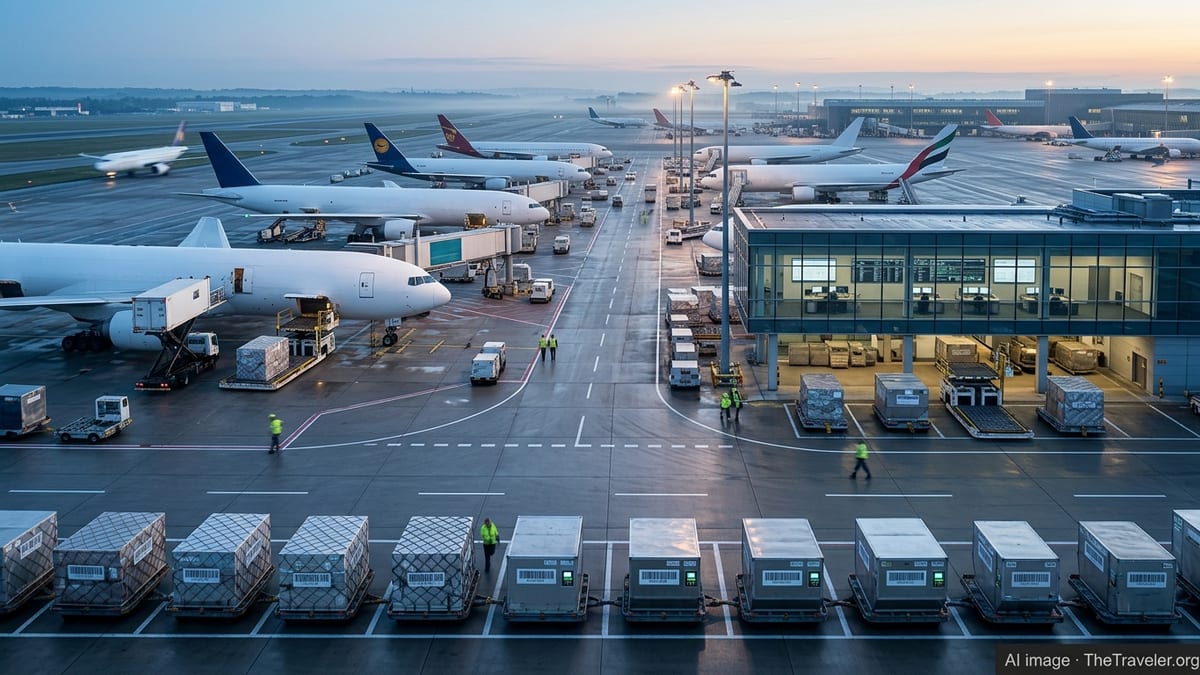
AI Moves From Concept to Concrete Cargo Programs
Recent publications and conference agendas from the International Air Transport Association indicate that artificial intelligence is moving from theory to practical application in air cargo. Industry sessions at IATA’s World Cargo Symposium have increasingly focused on using data driven strategies, generative AI and automation to cut costs, reduce delays and support more reliable shipment flows.
Publicly available information shows that these initiatives are being framed as an extension of air cargo’s long running digitalization drive rather than a standalone technology project. AI tools are being aligned with existing standards for data sharing and messaging so that airlines, handlers, freight forwarders and customs authorities can plug into common processes instead of building isolated solutions.
Reports also highlight that the growth of AI intensive sectors, including cloud computing and advanced manufacturing, is reshaping the cargo mix itself. A recent IATA analysis of 2025 trade activity found that air cargo played a central role in moving high value servers, storage units and memory chips needed to expand AI infrastructure, reinforcing the link between digital technologies and physical freight capacity.
Analysts note that this dual role of AI, as both a user of and an enabler for smarter cargo operations, is strengthening the business case for investment. As airlines seek to capture new high tech traffic, they are also adopting AI tools to better forecast demand, manage capacity and protect time critical shipments.
Digitalization Charter Builds Governance for Generative AI
A cornerstone of the current push is the IATA Digitalization Leadership Charter, launched with early signatories from airlines, handlers and technology providers. According to industry coverage, the charter commits participants to shared principles around data standards, sustainability and secure technology deployment, including the responsible use of generative AI in cargo processes.
The charter places strong emphasis on the use of unified data formats and platforms, notably IATA’s ONE Record framework for shipment information. By promoting machine readable, end to end records for each consignment, the initiative is intended to give AI systems reliable inputs for applications such as anomaly detection, service prediction and automated document checks.
Public explanations of the charter also underline the importance of cybersecurity and ethical technology use. As cargo operators experiment with AI for decision support and process automation, the framework encourages careful oversight of algorithms and clear accountability when human supervisors interact with automated recommendations.
Observers suggest that this governance layer is emerging at a critical time, as generative AI models become easier to deploy across contact centers, booking portals and operational control rooms. With a formal charter in place, early adopters are expected to share lessons learned and demonstrate measurable improvements in efficiency and reliability.
New Facility Vision Highlights AI Enabled Operations
IATA’s latest vision document for the future of air cargo facilities outlines how AI could reshape the design and daily operation of terminals. The paper describes a shift toward data rich environments in which sensors, connected handling equipment and digital twins feed algorithms that continuously optimize flows from truck dock to aircraft hold.
According to the published blueprint, AI is expected to support predictive maintenance of ground equipment, reducing unplanned downtime and congestion in busy hubs. By analyzing usage patterns and performance data, systems can schedule inspections and repairs at low impact times, helping terminals maintain throughput during peak volumes.
The document also highlights opportunities for AI to refine workforce and equipment scheduling. Instead of relying solely on static rosters, facility managers could draw on forecasts generated from historical movements, booking trends and external factors such as weather or public holidays. This is intended to reduce bottlenecks, overtime costs and shipment dwell times.
Another focus area is the optimization of cargo space in unit load devices and aircraft holds. AI based load planning tools can test thousands of stowage configurations in seconds, balancing density, weight and special handling requirements to improve asset utilization while respecting safety constraints and regulatory limits.
Regulators and Trade Partners Push Data Centric Models
AI’s growing role in air cargo is closely tied to regulatory digitalization. IATA progress reports describe how customs and border agencies in several regions are adopting advanced data exchange systems, including pre loading advance cargo information, to screen shipments earlier in the journey. These schemes rely heavily on accurate electronic data that can be analyzed automatically.
Examples cited in public materials include reductions in cargo release times when digital standards are applied to documentation and risk assessment. Faster clearance can free up capacity in warehouses and shorten door to door transit times, making air freight more competitive against other modes. AI tools are increasingly viewed as essential for scaling these risk based approaches as trade volumes grow.
Industry groups argue that harmonized digital requirements also create a more favorable environment for AI experimentation. When airlines and logistics providers can submit consistent datasets to multiple agencies, they are better able to train models that predict inspection outcomes, identify data gaps and flag anomalies before shipments are tendered.
Observers note that alignment between trade facilitation reforms and industry standards such as ONE Record helps to prevent fragmentation. This in turn reduces the risk of AI systems having to navigate conflicting data formats or overlapping reporting obligations.
Balancing Efficiency Gains With Sustainability Pressure
Alongside operational efficiency, IATA’s cargo agenda places AI within a broader sustainability context. Recent communications highlight the planned roll out of tools such as CO2 Connect for Cargo, which are designed to give shippers and carriers more precise emissions calculations for individual shipments and routes.
Publicly available descriptions indicate that AI and advanced analytics will be used to combine operational data, aircraft performance information and routing details to build more accurate carbon estimates. This could allow logistics planners to compare options and prioritize routings, equipment choices or sustainable aviation fuel usage that minimize emissions for time critical goods.
Industry commentary also points to AI’s potential in reducing waste across cargo operations, from smarter packaging choices to improved forecasting that cuts the number of repositioning flights or empty legs. By aligning AI initiatives with environmental targets, airlines aim to show that digital transformation can support both commercial performance and climate objectives.
Analysts caution, however, that realizing these benefits will depend on continued collaboration across airlines, airports, handlers, freight forwarders and regulators. AI systems are only as strong as the data they receive, and IATA’s current initiatives are framed around building the shared digital foundations needed for the technology to deliver tangible, system wide improvements in air cargo.