

More news on this day
Spain’s busiest airport, Adolfo Suárez Madrid-Barajas, is facing fresh disruption as Iberia cancels three flights and delays many more, snarling connections for domestic and international travelers on one of the winter’s busiest travel days.
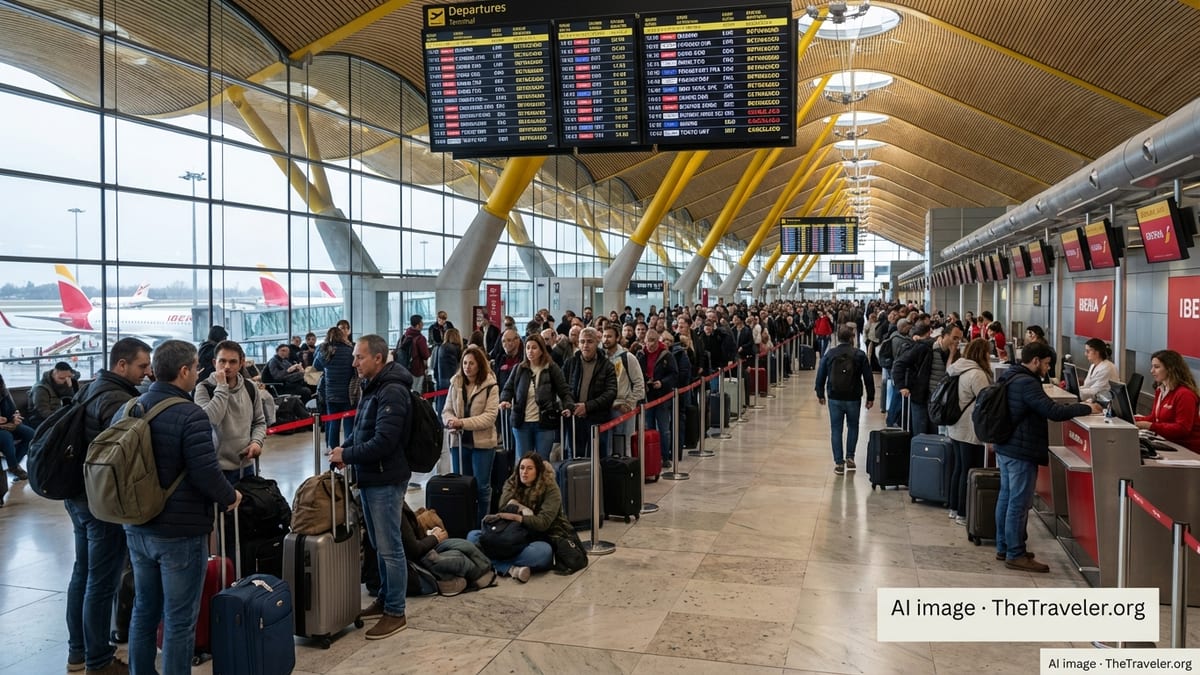
Fresh Wave of Disruption at Spain’s Main Aviation Hub
The latest round of disruption at Madrid-Barajas comes amid a broader spell of travel instability across Spain and Europe, where weather systems and operational bottlenecks have repeatedly tested airlines and airports in recent weeks. While the three Iberia cancellations at Madrid might appear modest in isolation, their impact has rippled across an already stretched network, compounding missed connections and crowding key transfer banks throughout the day.
Industry trackers report that Madrid-Barajas has recorded well over one hundred delays today, with Iberia, Spain’s flag carrier and the airport’s dominant airline, bearing a significant share of the knock-on effects. Domestic routes to Barcelona, Seville and Valencia, as well as European services to hubs such as London, Paris and Frankfurt, have experienced rolling delays as aircraft and crews fall out of position.
Airport officials say operations remain safe and fundamentally stable, but acknowledge that punctuality has deteriorated sharply. Long lines at check in and security, along with last minute gate changes, have left passengers scrambling for information and alternatives, reinforcing a sense that Spain’s aviation system is under strain at the height of the winter travel period.
The situation in Madrid follows several days of heightened disruption at Spanish airports, where hundreds of delays and more than a dozen cancellations were recorded over the weekend, affecting carriers including Iberia, Vueling and Ryanair at both Madrid-Barajas and Barcelona-El Prat.
Three Cancellations, Dozens of Delays and a Network Knock-On
According to operational data compiled from airline and airport sources, Iberia’s three cancellations at Madrid-Barajas today primarily affected short and medium haul routes, where aircraft are scheduled to perform multiple rotations in a single day. When one of these sectors is cancelled, the aircraft and crew cascade out of sync, often forcing schedule adjustments on later flights that might otherwise appear unrelated.
In parallel, multiple Iberia services have left Madrid significantly behind schedule, adding pressure to connection windows at this key European hub. For transfer passengers aiming to reach long haul departures to the Americas or Africa, even a delay of 45 to 60 minutes on an inbound flight can mean missed flights and an unplanned overnight stay. Iberia has attempted to protect long haul operations by holding some connections and reallocating aircraft where possible, but capacity to recover once the system is disrupted is limited on busy days.
Real time monitoring platforms show a pattern of knock on delays radiating from Madrid to other major airports, including Barcelona, Lisbon and several northern European hubs. This network effect means the consequences of the three initial cancellations are magnified far beyond the original flight numbers, as schedule buffers built into winter timetables are progressively used up.
For point to point passengers starting or ending their journeys in Madrid, the experience has translated into extended waiting times in the terminal, late arrivals to Spanish regional cities, and in some cases missed onward rail or bus connections. Travel agents in the city report elevated demand for last minute tickets on alternative carriers and modes, particularly on the high demand Madrid Barcelona corridor.
Operational Pressures Behind Iberia’s Latest Setback
The immediate triggers for today’s Iberia cancellations and delays at Madrid-Barajas appear to be a mix of weather related disruption in parts of Europe, residual congestion from a difficult previous travel weekend in Spain, and tight aircraft and crew availability during the peak winter timetable. Industry observers note that when operating margins are this slim, relatively minor external shocks can precipitate the kind of cascading disruption travelers are now experiencing.
In recent days, European aviation has been hit by strong winds, localized storms and winter conditions, which have forced air traffic control to reduce arrival and departure rates at several key hubs. When holding patterns and extended routings become commonplace, aircraft cycle times lengthen and turnarounds tighten, leaving little room for late inbound flights to be turned around on schedule.
At the same time, Spanish airports have been absorbing a surge in demand, as travelers opt for air travel amid intermittent problems on parts of the rail network and a busy calendar of winter tourism and business events. Airlines like Iberia have scheduled dense waves of departures at peak times to meet this demand, maximizing aircraft utilization but leaving less operational slack when something goes wrong.
While Iberia’s long term punctuality metrics remain better than many European peers, today’s events underscore how even relatively resilient carriers can struggle when weather, airspace capacity and high demand converge. Analysts say the airline’s performance will be closely watched in the coming days, as it works to stabilize operations at its Madrid hub.
Scenes Inside Madrid-Barajas: Long Queues and Frayed Nerves
Inside the terminals at Adolfo Suárez Madrid-Barajas, the disruption has been plainly visible. Travelers arrived to find departure boards lit with orange and red delay notices, alongside a smaller but conspicuous cluster of cancellations, including three Iberia flights that became focal points for confusion and frustration. Passengers on those services queued at airline desks seeking rebooking options, meal vouchers and hotel accommodation where required.
Families returning from winter holidays, business travelers on tight schedules, and students heading back to universities formed snaking lines at customer service counters. Some passengers reported waiting more than an hour to speak with an agent, while others turned to self service tools and airline apps in search of faster solutions. Crowded seating areas and busy charging stations reflected the number of people forced to spend far longer in the terminal than they had planned.
Ground staff at Madrid-Barajas faced the dual challenge of managing irate customers and implementing the rolling changes dictated by operations control. Frequent loudspeaker announcements about updated departure times, gate reallocations and boarding procedures added to the ambient stress. Despite these pressures, core services such as security screening and baggage handling continued to function, preventing additional bottlenecks from forming.
For many travelers, the greatest source of anxiety was uncertainty. With weather and airspace related constraints often evolving hour by hour, Iberia and other airlines were cautious about providing firm estimates for new departure times until they had confirmation from air traffic control. This meant some passengers were informed of further delays only minutes before a previously announced boarding time, intensifying frustration.
Impact on Key Domestic and International Routes
Madrid-Barajas serves as Spain’s primary hub for both domestic and long haul international travel, so even modest operational setbacks can reverberate widely. Today’s Iberia cancellations and delays have been felt across some of the country’s busiest internal routes, including services linking Madrid with Barcelona, Bilbao, Malaga and Seville, where frequency is high and many travelers rely on tight turnaround schedules for same day business trips.
Internationally, the disruptions have affected flights to major European capitals and connecting hubs, including London, Paris, Frankfurt and Amsterdam. Late departures from Madrid can trigger missed onward connections on partner airlines’ networks, multiplying the number of people whose journeys are altered beyond the original three cancelled flights and a cluster of delayed departures.
Long haul routes have so far been relatively protected, with airlines prioritizing these flights because of their higher passenger loads and the greater complexity of reaccommodating affected customers. However, when feeder services into Madrid run late or are cancelled, some long haul planes have been forced to leave with empty seats reserved for missed connections, eroding revenue and frustrating travelers whose trips had been carefully coordinated.
Travel industry consultants note that Madrid’s role as a bridge between Europe and Latin America makes any significant disruption particularly sensitive, as itineraries often involve multiple legs and tight transfer windows. Even a small number of schedule changes can reorder entire days of connecting traffic between the two regions.
What Stranded Passengers Can Expect in Terms of Assistance
For passengers caught up in today’s disruption at Madrid-Barajas, the level of support and compensation available depends on a combination of airline policies and European passenger rights rules. Under European Union regulations, travelers whose flights are cancelled or suffer long delays may be entitled to meals, refreshments, hotel accommodation and transport between the airport and city, as well as financial compensation in certain circumstances.
Iberia has published guidance outlining passengers’ rights in the event of cancellations and significant delays, including the option to request care such as food vouchers, phone access and hotel stays where an overnight wait becomes necessary. Where the cancellation or delay is deemed to be within the airline’s control and not the result of extraordinary circumstances like severe weather or air traffic control strikes, travelers may also be eligible for financial compensation, the amount of which is linked to the length of the journey and the severity of the delay on arrival.
Passengers whose Iberia flights were among the three cancelled services at Madrid today are being offered rebooking on the next available departures, subject to seat availability, or, in some cases, alternative routings via other Spanish or European airports. Travel agents advise affected customers to keep all receipts for meals, accommodation and ground transport, and to document the duration and cause of their delay, in case they need to pursue claims later.
Consumer advocates remind travelers that they do not have to accept travel vouchers if they prefer cash compensation where it is legally owed, and that they should review their travel insurance policies, which may offer supplemental coverage for disruption related costs not fully covered by the airline.
Spain’s Wider Travel Challenges This Winter
The Iberia setback at Madrid-Barajas fits into a broader pattern of travel turbulence across Spain and Europe this winter. In the past fortnight, Spanish airports have recorded hundreds of delays and dozens of cancellations in single days, as storms and operational strains have tested the resilience of airline schedules. Barcelona-El Prat, Spain’s second busiest airport, has also seen a high volume of disruptions, affecting carriers such as Vueling, Ryanair and international partners.
Beyond aviation, parts of Spain’s rail network have faced incident driven interruptions, which in turn funnel more travelers toward air options between key cities like Madrid and Barcelona. Carriers have responded by adding capacity or, in some cases, reinstating shuttle style air services to capture demand, creating a tightly stretched system with little margin for error.
Internationally, Europe’s air traffic control system has been under pressure from both weather events and industrial action in recent months, resulting in flow restrictions that often surface first as delays at hub airports. Spain’s position at the crossroads between northern Europe, the Mediterranean and transatlantic lanes means that its airports are highly exposed to disruptions originating elsewhere in the network.
Analysts say that while today’s Iberia issues at Madrid-Barajas are significant for travelers, they are unlikely to signal a systemic failure. Instead, they highlight the need for greater operational buffers, better real time communication tools for passengers, and stronger coordination between airlines, airports and air navigation authorities when conditions begin to deteriorate.
How Travelers Can Navigate Ongoing Uncertainty
As operations gradually stabilize at Madrid-Barajas, travel experts are urging passengers with upcoming flights to and from Spain to remain vigilant and proactive. Checking flight status frequently, enrolling in airline notification services, and allowing extra time for connections are among the key recommendations for coping with a fluid situation.
Passengers booked on Iberia services are encouraged to use the carrier’s digital tools to manage their bookings, select alternative flights where permitted, or register contact details to receive updates on last minute schedule changes. Those connecting through Madrid to long haul destinations may wish to build in longer layovers if possible, reducing the risk that a relatively small delay on an inbound leg will jeopardize their onward journey.
Travel planners also suggest that passengers consider keeping essential items such as medication, chargers and a change of clothes in their carry on luggage, in case checked bags are delayed or overnight stays become unavoidable. Flexible accommodation bookings and transport arrangements at destination can further reduce the stress associated with unpredictable arrival times.
For Spain, the latest setback at Madrid-Barajas is a reminder of how quickly travel conditions can shift during the winter season. For travelers, it underscores the value of preparation, patience and up to date information as they navigate one of Europe’s most important and, at times, most pressured aviation hubs.