

More news on this day
Spain’s winter travel season has suffered a fresh setback after Spanish flag carrier Iberia cancelled three flights and delayed multiple others on a busy operational day at Madrid-Barajas Adolfo Suárez Airport, triggering missed connections, long queues and renewed questions over the resilience of Europe’s fourth-busiest air hub.
Cancellations at Madrid-Barajas Ripple Across Spain’s Network
The latest disruption centers on Madrid-Barajas, Iberia’s primary hub and the nerve centre of its domestic and long-haul operations. According to operational data compiled by European disruption trackers and Spanish media monitoring services, Iberia scrubbed three scheduled departures and delayed several dozen more, primarily short- and medium-haul services linking the capital with other major Spanish and European cities.
While three cancellations may appear modest against Madrid’s daily schedule of hundreds of flights, their impact is magnified in a tightly timed hub-and-spoke system where aircraft rotations and crew duties are interlinked. The affected flights, combined with knock-on delays, left passengers facing missed onward connections, extended time on the ground and last-minute rebookings at already congested gates and customer service desks.
The disruption comes on the heels of a difficult winter for Spanish aviation, marked by adverse weather, air traffic congestion and broader European delays. Earlier in January, Spanish airports collectively logged hundreds of late departures and several dozen cancellations in a single day, with Iberia among the carriers experiencing significant schedule pressure. The latest issues at Madrid reinforce the sense that Spain’s aviation system is operating with limited margin for error during peak periods.
At Madrid-Barajas, where punctuality is typically higher than at many Spanish holiday airports, even a relatively small cluster of cancellations can cascade quickly through Iberia’s tightly choreographed wave of departures and arrivals. As aircraft and crews slip out of position, subsequent flights are pushed back, amplifying the disruption far beyond the original three cancelled services.
Weather, Congestion and Operational Strain Behind the Setback
The immediate causes of the latest cancellations and delays include a familiar mix of winter weather challenges, airspace congestion and the fragile recovery of airline schedules after years of volatility. Storm systems crossing the Iberian Peninsula and neighboring regions in recent weeks have repeatedly slowed operations, forcing airlines and air traffic controllers to space out departures and arrivals and occasionally divert aircraft to alternate airports.
For Iberia, which relies heavily on Madrid as a hub linking Spain to Europe, Latin America and beyond, any constraint in airspace capacity or ground handling can quickly translate into schedule disruption. Reduced arrival rates, temporary runway restrictions or longer taxi times eat into the buffer airlines build into their timetables, leaving less room to recover when an earlier flight arrives late or an aircraft needs additional servicing.
Industry analysts note that the wider European environment is also a factor. On several days this winter, more than a thousand flights across the continent have been disrupted by a combination of storms, labor actions and lingering bottlenecks in air traffic control. Spain’s major airports, including Madrid-Barajas and Barcelona-El Prat, have frequently appeared on lists of hubs with the highest numbers of daily delays, reflecting both their importance and their vulnerability to upstream issues.
Aviation observers say that while Iberia has generally maintained its long-haul schedule, especially on key routes to Latin America and the Caribbean, the strain often shows first on short-haul sectors. These flights are crucial for feeding international services, yet they are also the easiest to delay or cancel when conditions deteriorate, because passengers can sometimes be re-accommodated on later flights the same day.
Passengers Face Missed Connections and Overnight Disruptions
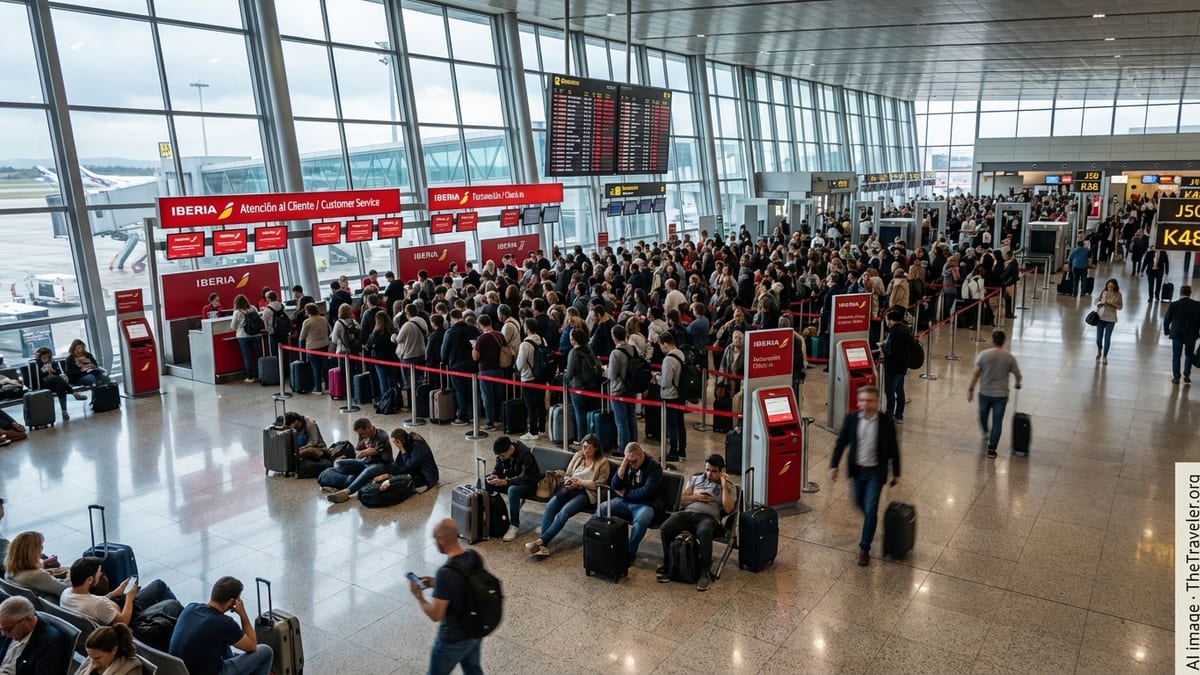
For travelers caught in the latest wave of disruption, the human consequences were immediate. Long lines formed at Iberia service counters in Madrid as passengers sought rebookings and hotel vouchers, while others clustered around departure boards that flashed rolling delays. Social media posts from affected travelers described hours-long waits for updates and confusion over whether connecting flights would be held for late-arriving passengers from the canceled or delayed services.
Madrid-Barajas’ role as a transfer hub exacerbated the disruption. Many passengers on the canceled Iberia flights were not ending their journeys in Madrid, but rather connecting onward to destinations in Spain, the rest of Europe and the Americas. When a feeder flight is removed from the schedule, travelers can find themselves stranded between sectors, forced to replan complex itineraries on the spot and compete for limited alternative seats during an already busy period.
Travel agents and passenger rights organizations reported a spike in inquiries from customers seeking to understand their options for compensation, refunds or alternative transport. For some travelers, especially those on tightly scheduled business trips or short breaks, the time lost to delays meant missed meetings, unused hotel nights and, in a few cases, holidays cut short or abandoned altogether.
Families traveling with children, elderly passengers and those with reduced mobility were among the hardest hit, often needing additional assistance to navigate rebookings and last-minute hotel arrangements. Airport staff and Iberia ground teams worked to triage the most urgent cases, but the volume of disrupted passengers once again highlighted how quickly major hubs can become overstretched when a handful of critical flights drop out of the schedule.
What Impact Means for Madrid and Spain’s Wider Air Travel Network
Madrid-Barajas is not only Spain’s busiest airport but also one of Europe’s key long-haul gateways, particularly for traffic between Europe and Latin America. When its operations are compromised, even modestly, the effects can be felt well beyond Spanish borders. Iberia’s latest cancellations came on a day when airports across Spain were already dealing with a high baseline of delays, and they contributed to a wider pattern of travel instability that has defined the winter season.
Domestic routes linking Madrid with cities such as Barcelona, Valencia, Bilbao and Palma de Mallorca are especially important in maintaining the integrity of the national network. If aircraft or crews are delayed out of Madrid, the reverberations can quickly reach these secondary hubs, forcing timetable adjustments and creating localized bottlenecks. Passengers on point-to-point routes may find that their flights are not directly impacted, yet they still experience delays caused by late-arriving aircraft whose earlier rotations were caught up in the disruption at Madrid.
Spain’s coastal and island airports, many of which depend heavily on leisure traffic and low-cost carriers, are also indirectly affected. When storms or congestion in central Spain and neighboring countries slow operations, carriers sometimes prioritize key trunk routes at the expense of less frequent services to tourist destinations, which can result in longer delays for travelers heading to or from holiday hotspots.
In recent months, statistics compiled by Spanish and European aviation monitors have shown that millions of passengers in Spain endured some form of flight disruption in 2025, with certain airports suffering particularly high rates of delays. Madrid and Barcelona, while better performing than some seasonal hubs, have nevertheless seen their on-time performance eroded during peaks, underscoring the challenges of operating close to capacity during periods of volatile weather and constrained airspace.
How Iberia Is Responding and What Flexibility Passengers Have
Iberia has emphasized in recent public statements and advisories that it is working to manage disruption through a combination of schedule adjustments, fare flexibility and reinforced customer service. In other recent cases, where adverse weather or external operational constraints were anticipated, the airline has offered passengers greater leeway to change travel dates without penalty, particularly on routes in and out of affected regions.
In the Madrid disruptions, Iberia’s standard procedures for operational cancellations have been activated for the three canceled flights. Passengers eligible under the airline’s policies are being offered rebooking on the next available services, alternative routings via partner carriers where possible, or refunds if the journey no longer serves its original purpose. For delayed flights, Iberia is providing meal vouchers and, in cases of overnight disruption, hotel accommodation in line with its obligations.
In parallel, the airline is continuing to monitor potential flashpoints elsewhere in its network, from fuel supply concerns on certain long-haul routes to weather-related risks in regions such as Andalusia. Recent advisories for flights to and from southern Spain, for example, have outlined temporary flexibility for customers wishing to adjust their plans ahead of forecast storms, indicating a more proactive approach to managing operational risk.
For passengers, the key message from Iberia and Spain’s aviation authorities is to engage early with airline communication channels, including mobile apps and direct notifications, rather than relying solely on airport departure boards. Early awareness of possible changes can give travelers more options, from switching to earlier flights before weather deteriorates to adjusting connecting itineraries in a way that avoids overnight stays.
Understanding Passenger Rights Under European Regulation
The latest disruptions at Madrid-Barajas have once again focused attention on the protections available to air travelers under European Union law. Regulation EC 261/2004, often referred to as the Air Passengers Rights Regulation, sets out common rules on compensation and assistance in cases of denied boarding, cancellation and long delay for flights departing from EU airports or operated by EU carriers.
Under the regulation, passengers on canceled flights may be entitled to financial compensation, re-routing or refunds, depending on the reason for the disruption and the notice given. For delays of several hours, airlines must provide care and assistance in the form of meals, refreshments and, when necessary, hotel accommodation and transfers. The exact entitlements vary by flight distance and length of delay, but the framework is designed to ensure that passengers are not left to shoulder the full burden of operational failures.
Crucially, however, compensation is not automatically owed in every instance. Airlines can invoke extraordinary circumstances, such as severe weather or air traffic control restrictions, to argue that they are exempt from paying compensation even though they must still offer care and support. In the Madrid disruptions, the precise eligibility of affected passengers will depend on whether the root causes are deemed within Iberia’s control or the result of external factors.
Consumer advocates advise passengers to keep all travel documentation, including boarding passes, booking confirmations and any written notifications from the airline, as these are essential when making a claim. Travelers are also encouraged to file requests directly with the carrier as a first step, and to escalate to national enforcement bodies or specialist claims services if disputes over eligibility arise.
What Travelers Should Do If Their Flight Is Affected
For travelers planning to pass through Madrid-Barajas or other major Spanish airports in the coming days, practical preparation can help mitigate the impact of any further disruptions. Airlines and airports alike stress the importance of checking flight status frequently, especially on days when storms, strikes or known capacity constraints are in play. Using airline apps and signing up for real-time alerts can give passengers crucial minutes of advance notice to adjust their plans.
Experts recommend arriving at the airport earlier than usual during periods of instability, particularly for international flights and those requiring security checks at peak times. Extra time can be vital if check-in or security queues lengthen unexpectedly or if gate changes occur at short notice. Where feasible, traveling with hand luggage only can increase flexibility, making it easier to accept last-minute rebookings or alternate routings without the complication of checked bags.
Passengers connecting through Madrid should pay particular attention to minimum connection times, as even moderate delays on inbound flights can put tight transfers at risk. When booking, choosing slightly longer layovers during the winter season can provide a buffer against typical weather or congestion-related delays, reducing the likelihood of overnight disruption.
Despite the frustrations of cancellations and delays, industry analysts note that Spanish airports and airlines have become more experienced in handling irregular operations after several turbulent years. While the three Iberia cancellations and associated delays at Madrid-Barajas have once again highlighted the fragility of busy hubs, they have also underlined the importance of clear communication, robust passenger protections and practical planning for anyone flying into or out of Spain this winter.