

More news on this day
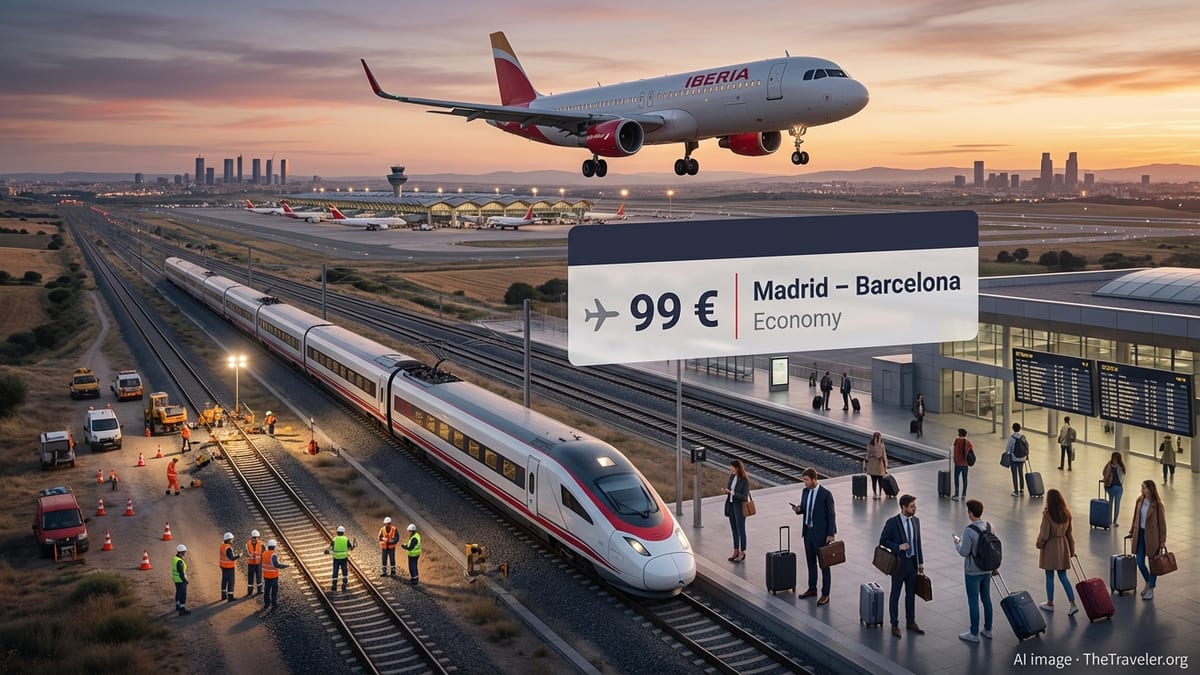
Iberia has moved to cap economy fares on its flagship Madrid–Barcelona shuttle at 99 euros per one-way ticket, offering air travelers a measure of price certainty just as rail maintenance works and safety measures trigger delays and cancellations on Spain’s busiest high-speed line.
The temporary ceiling, in force through 19 February, is the clearest sign yet of how the country’s aviation sector is responding to disruption on the tracks that has upended winter travel plans for commuters and leisure passengers alike.
More News
- TSA Rolls Out $45 ConfirmID Fee for Travelers Without REAL ID at Security
- Flying Blue Launches February 25% Promo Rewards on Transatlantic and Regional Routes
- United Fast-Tracks Starlink Wi‑Fi Across Fleet, Free for MileagePlus Members
A price ceiling on Spain’s busiest air corridor
The new fare cap applies to economy tickets on Iberia’s Puente Aéreo shuttle between Madrid and Barcelona, one of Europe’s most heavily traveled domestic routes. The airline has set a maximum of 99 euros per one-way journey in standard economy, regardless of demand, for travel up to and including 19 February. The measure is framed as an exceptional response to an exceptional situation on the high-speed rail corridor linking the Spanish capital with Catalonia’s largest city.
Iberia has stressed that the limitation covers the core economy cabin that attracts a mix of business travelers, students, and city breakers. It does not extend to its higher “Puente Aéreo Flexible” and “Puente Aéreo Confort” products, which are designed for frequent flyers who need fully flexible conditions, priority services, and extras. Those premium shuttle fares will continue to fluctuate according to normal pricing rules and booking conditions.
The company operates up to 14 frequencies per day in each direction between Madrid and Barcelona, spanning departures from about 6.45 in the morning until 21.35 at night. That density of service, combined with the temporary ceiling on economy fares, means that passengers who are willing to travel in standard class should be able to find seats that are both available and price-capped across the main business and leisure time bands.
Rail maintenance and delays push travellers to the skies
The decision by Iberia comes as Adif, the infrastructure manager for Spain’s rail network, is carrying out intensive maintenance and review work on the high-speed line between Madrid and Barcelona. In recent days, those works have forced the suppression of some services and the imposition of speed restrictions, lengthening journey times and, in some cases, pushing late-running trains into the nightly maintenance window. The result has been a noticeable increase in delays, as well as targeted cancellations at the margins of the timetable.
Operators Renfe, Ouigo and Iryo have all revamped their schedules to accommodate the new constraints. Some of the latest trains of the day are being removed from the timetable entirely, while other departures are being brought forward by between 30 and 60 minutes. Journey times for the flagship Barcelona–Madrid high-speed services are expected to increase by around 25 minutes on average during the most intensive phase of the works, which run over the coming days.
Rail passengers caught up in the disruption have reported longer-than-expected travel times, altered departure slots and, for those on the canceled services, a scramble to be rebooked on earlier or later trains. While operators are offering refunds and alternatives under their contingency plans, the constraints on track access mean capacity is finite. That in turn has pushed some travelers to look for air options, particularly for last-minute business trips or time-sensitive connections at Madrid Barajas and Barcelona El Prat airports.
Extra capacity and capped fares on southern routes
The Madrid–Barcelona shuttle is not the only domestic market where Iberia has intervened on pricing during this period of rail disruption. The carrier previously applied the same 99 euro ceiling to economy fares on flights between Madrid and several Andalusian cities, including Seville, Malaga, Jerez and Granada. Those measures followed the serious rail accident near Adamuz in the province of Córdoba, which left the high-speed line in that corridor out of service and severed a key north–south rail link.
With trains suspended on that stretch, Iberia has reinforced its Andalusian network with thousands of additional seats. The airline has signalled that more than 27,000 extra seats are being deployed initially through 15 February on routes connecting Madrid with affected cities in the south. These services are intended to provide a bridge for residents, tourists and business travellers who would normally rely on fast rail connections but are now constrained to slower or less direct journeys by track closures.
By aligning the Andalusian price caps with the new 99 euro limit on the Madrid–Barcelona shuttle, Iberia is attempting to present a consistent message to the domestic market: that during periods of acute rail disruption, air fares on key trunk routes will not be allowed to spike in response to sudden surges in demand, at least in standard economy. That stance may bolster the airline’s image with consumers even as it navigates the operational challenges of adding short-notice flights and adjusting fleet deployment.
Government pressure and the debate over emergency price controls
The move by Iberia coincides with a political debate in Spain over how to prevent transport companies from profiting excessively during crises that disrupt normal mobility. The Minister of Consumer Affairs, Pablo Bustinduy, has announced plans for a regulatory mechanism that would cap prices on alternative transport options whenever accidents or infrastructure failures shut down essential routes and leave passengers with few choices.
Under the proposal outlined by the minister, caps would be calculated using the average price for a given service in the month preceding the incident that triggers the emergency. In practice, that benchmark would serve to freeze fares at something close to their pre-crisis norm, making it harder for operators to raise prices sharply at a moment when passengers have limited flexibility. The government argues that such a rule would help ensure that no company can benefit disproportionately from a situation of sudden need.
Any formal scheme would need approval from economic and cabinet colleagues, and questions remain about how it might be applied in a liberalized market with multiple rail and air operators. For now, however, Iberia’s voluntary cap aligns closely with the tenor of the government’s messaging. By capping fares on its own initiative, the flag carrier may be positioning itself ahead of potential regulatory changes while signaling solidarity with affected travellers in both the northeast and the south of the country.
What the 99 euro cap means for travellers
For passengers weighing their options between train and plane this month, the 99 euro cap provides a clear reference point for what they can expect to pay for a standard one-way seat between Madrid and Barcelona on Iberia. In normal market conditions, last-minute fares on the shuttle can rise significantly above that level on busy days, particularly at peak morning and late-afternoon times. With the temporary limit in place, the price difference between booking several days ahead and reserving at short notice on Iberia’s economy product should narrow during the capped period.
Travel planners note that the availability of seats at or below the ceiling will still depend on load factors, as aircraft have finite capacity and Iberia has not announced an unlimited seat guarantee. However, the combination of up to 14 daily flights per direction and the introduction of the cap suggests that most time slots will offer at least some capped economy inventory as long as bookings are not completely saturated by displaced rail passengers.
Journey-time comparisons between air and rail are also shifting under current conditions. Even with the added buffer imposed by rail maintenance, the high-speed train remains a time-competitive option for city-center to city-center travel when punctual. But for travellers who are starting or ending their journeys in the vicinity of Madrid Barajas or Barcelona El Prat, especially those with onward connections, the reliability of a dense shuttle schedule and a guaranteed maximum fare could tip the balance toward flying while rail disruptions persist.
Rail operators respond to infrastructure constraints
On the rail side, operators and infrastructure managers are tying the current turbulence on the Madrid–Barcelona high-speed line to the need for intensive safety checks and maintenance on a corridor that has carried tens of millions of passengers since opening. Adif has argued that scheduling a concentrated period of works, even at the cost of short-term disruption, is preferable to risking more serious incidents on one of the country’s flagship lines.
Renfe, Ouigo and Iryo have been working with Adif to re-time services so that passenger trains do not intrude into the overnight window reserved for inspection and repairs. That has meant pruning back some of the last departures of the day, shifting a number of services into earlier slots, and in certain cases relaxing journey-time targets to allow for lower speeds through work zones. Passenger rights frameworks oblige operators to offer refunds or rebookings when services are canceled or significantly delayed, but there is no easy substitute for the sheer train paths that become unavailable when maintenance accelerates.
Industry observers say the episode underscores both the strengths and vulnerabilities of Spain’s high-speed rail revolution. The network has transformed domestic travel over the past two decades, providing rapid, low-emission links between large cities and reshaping demand patterns on domestic air routes. At the same time, concentrated flows along a small number of high-capacity corridors mean that when those lines are disrupted, knock-on effects are felt widely across regions and sectors, from tourism to commuting.
Broader implications for Spain’s air–rail balance
The temporary capping of fares on the Madrid–Barcelona shuttle and key Andalusian links comes at a delicate moment in the debate over the balance between air and rail travel in Spain and across Europe. Environmental groups have long argued that on short and medium-haul corridors, high-speed rail should be the default mode, citing lower emissions and the convenience of city-center stations. Policymakers in several countries have floated or adopted restrictions on short domestic flights where a fast rail alternative exists.
In Spain, the expansion of high-speed services has already led airlines to reduce or reconfigure some domestic routes, focusing air capacity on international links and domestic feeders for long-haul networks. The current rail disruptions and Iberia’s response illustrate how, in practice, the two modes continue to operate as both competitors and backstops for one another. When rail falters, air capacity can help absorb displaced demand, particularly during temporary crises caused by accidents or infrastructure works.
Looking ahead, travel analysts suggest that more formal coordination mechanisms between rail and air could be needed to manage such episodes. That might include structured contingency plans that define how quickly airlines can add capacity, what fare rules will apply, and how passengers are informed of their options when a disruption in one mode spills into another. Iberia’s 99 euro cap may be an early template, but whether similar measures become standard practice will depend on the regulatory framework that emerges from the government’s ongoing discussions.
FAQ
Q1. What exactly has Iberia announced for the Madrid–Barcelona route?
Iberia has introduced a temporary cap of 99 euros per one-way ticket in standard economy on its Puente Aéreo flights between Madrid and Barcelona, in response to disruption on the high-speed rail line linking the two cities.
Q2. How long will the 99 euro fare cap remain in place?
The airline has indicated that the ceiling will apply to eligible economy tickets for travel up to and including 19 February 2026, although it reserves the right to revisit the policy as conditions evolve.
Q3. Does the cap apply to all fare types on the shuttle?
No. The 99 euro limit is restricted to standard economy tickets. Iberia’s higher-tier Puente Aéreo Flexible and Puente Aéreo Confort fares, aimed at frequent travelers needing maximum flexibility and extra services, remain outside the cap.
Q4. How many daily flights does Iberia operate between Madrid and Barcelona?
Iberia operates up to 14 flights per day in each direction on the Madrid–Barcelona route, with departures typically spread from early morning around 6.45 to late evening around 21.35.
Q5. Why is the high-speed rail service between Madrid and Barcelona being disrupted?
The high-speed line is undergoing intensive maintenance and safety-related works managed by Adif, leading to speed restrictions, extended journey times, and the cancellation or retiming of some services operated by Renfe, Ouigo and Iryo.
Q6. Are other routes affected by similar price caps from Iberia?
Yes. Iberia has also applied a 99 euro economy fare ceiling on flights between Madrid and several Andalusian cities, including Seville, Malaga, Jerez and Granada, after a serious rail accident near Adamuz interrupted high-speed services in that corridor.
Q7. Will there be enough seats for passengers switching from train to plane?
The airline has increased capacity on affected routes and offers a dense shuttle schedule between Madrid and Barcelona, but seat availability still depends on demand levels and aircraft capacity, so popular flights may fill up quickly.
Q8. How does the government view these voluntary fare caps?
The government has welcomed measures that protect consumers and is separately working on a broader framework that would formalize price ceilings on alternative transport options in declared emergency situations.
Q9. Is it still worth considering the train during this period?
Despite disruptions and slightly longer journey times, high-speed rail remains a viable option, especially for city-center journeys, but travelers should check updated timetables, allow extra time, and be prepared for possible changes to departure times.
Q10. What should travelers do if their high-speed train is canceled?
Passengers whose trains are canceled or significantly delayed are generally entitled to rebooking or refunds from their rail operator, and they can also explore capped-fare Iberia flights as an alternative, particularly if they need to reach Madrid or Barcelona on a specific day.