

More news on this day
Iberia is preparing to launch a new nonstop route between Madrid and Monterrey on June 2, 2026, a move widely seen as a major boost for business travel and connectivity between Spain and northern Mexico.
Get the latest news straight to your inbox!
New Route Strengthens Iberia’s Mexico Strategy
Publicly available information from Iberia and industry publications shows that the Spanish carrier will begin operating direct flights between Madrid and Monterrey from June 2, 2026. The route will initially offer three weekly frequencies and is scheduled as a summer-season launch, with capacity estimates indicating more than 36,000 seats between June and late October 2026.
The service positions Monterrey as Iberia’s second destination in Mexico after Mexico City, where the airline already operates three daily flights. With the addition of Monterrey, Iberia’s total capacity between Spain and Mexico in 2026 is projected to exceed 800,000 seats, described in aviation trade coverage as the highest level in the airline’s history on this corridor.
Industry analysis notes that the Madrid–Monterrey route forms part of Iberia’s broader long-haul expansion strategy in the Americas, which also includes new or strengthened links to destinations such as Fortaleza, Recife and Toronto. Monterrey has been highlighted as a key business hub within this plan, offering access to one of Mexico’s most industrially dynamic regions.
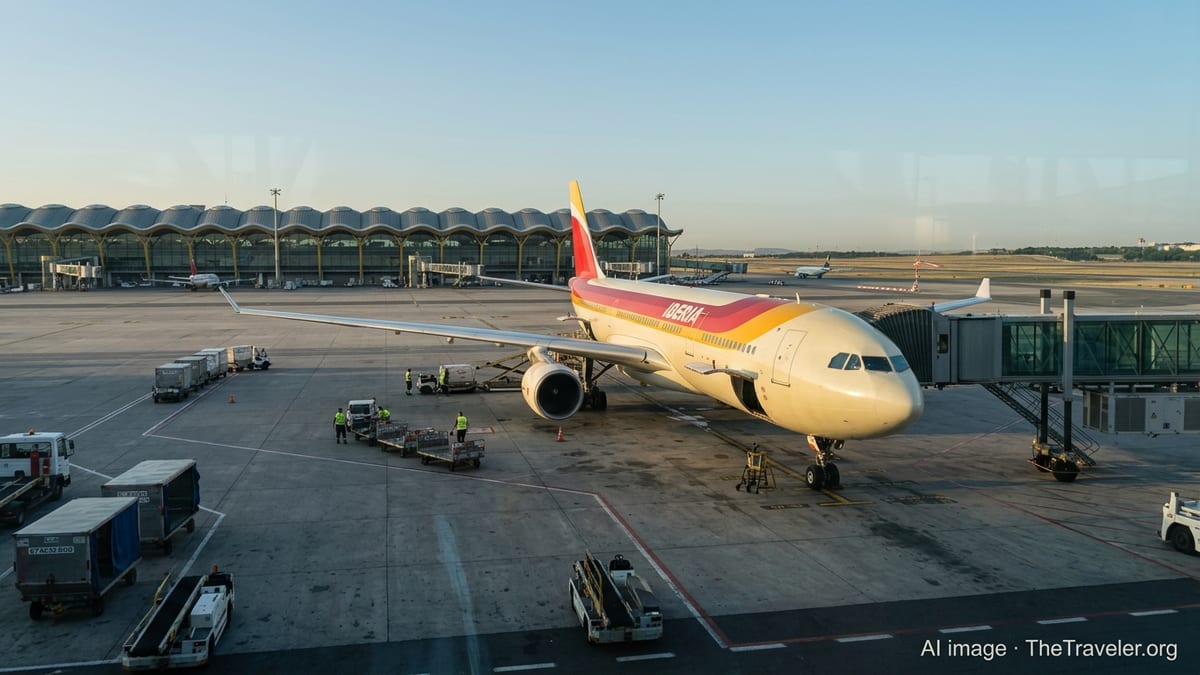
Aeronautical data and airport schedules indicate that the flights will be operated by Airbus A330-200 aircraft, giving Iberia the ability to offer a full-service long-haul product with lie-flat business class seating as well as premium economy and economy cabins on the new route.
Madrid–Monterrey as a New Business Corridor
Monterrey, capital of the state of Nuevo León, is home to some of Mexico’s most significant industrial and financial groups, particularly in manufacturing, automotive, steel, technology and logistics. Business travel analysts point out that the region has, until now, relied heavily on indirect European connections via Mexico City, the United States or other Latin American hubs.
The launch of nonstop service from Madrid, Iberia’s primary hub, introduces a new transatlantic business corridor aimed at corporate travelers who prioritize schedule reliability and reduced total journey time. Timetables published to date show departure and arrival patterns designed to feed Iberia’s extensive European and North African network, which connects Madrid to major commercial centers such as Paris, Frankfurt, Milan and Rome.
For Monterrey-based companies with interests in Spain and the wider European Union, the new route is expected to shorten connection times and simplify itineraries that previously required at least one stop. Travel consultancies covering the announcement note that direct connectivity can translate into lower travel fatigue, improved trip productivity and more attractive options for frequent travelers managing tight schedules.
On the Spanish side, the service opens a streamlined gateway to northern Mexico’s clusters of advanced manufacturing and nearshoring activity, which have drawn increasing attention from European investors. Economic commentary surrounding the route has linked the decision to broader trade and investment flows between the European Union and Mexico, particularly in sectors such as automotive components, renewable energy and technology services.
Boost for Tourism and 2026 World Cup Travel
The new Madrid–Monterrey flights are also expected to play a role in leisure and event-driven travel, especially in the context of the 2026 FIFA World Cup, for which Monterrey is one of the designated host cities. Tourism-focused coverage highlights that the timing of the route launch in June 2026 coincides with the start of the tournament, offering travelers from Spain and other European markets a one-stop option to reach northern Mexico.
Monterrey’s surrounding natural attractions, including the Sierra Madre Oriental and nearby national parks, have been increasingly promoted within Spanish-language travel media. Direct air service from Madrid is anticipated to raise the city’s profile as a standalone destination for cultural, culinary and outdoor tourism, rather than serving solely as a business gateway.
For Spanish travelers, the new route provides an additional entry point into Mexico beyond the more established leisure flows to Mexico City, Cancún and the Riviera Maya. Travel agencies tracking booking trends suggest that combining Monterrey with multi-city itineraries across northeastern Mexico and the U.S. border region could become more common once the route matures.
From Mexico to Europe, the flights are likely to appeal to leisure travelers from Nuevo León and neighboring states seeking direct access to Spain’s major urban and coastal destinations. Thanks to Iberia’s hub structure in Madrid, passengers from Monterrey will be able to connect in a single stop to popular European holiday cities, including Barcelona, Lisbon and Paris, using a unified ticket and coordinated schedules.
Enhanced Connectivity Through Madrid’s Global Hub
Madrid–Barajas Adolfo Suárez Airport serves as Iberia’s primary long-haul hub, with an extensive network of European, African and Middle Eastern connections. Airport and schedule data show Iberia operating flights from Madrid to dozens of destinations across Europe and beyond, allowing the new Monterrey service to integrate into an already dense bank of arrivals and departures.
Industry observers underline that this hub structure is central to the route’s potential. Passengers traveling between Monterrey and cities such as Berlin, Prague, Geneva or Vienna, which lack nonstop links to Mexico, will be able to complete their journeys with a single connection in Madrid. This is expected to strengthen the role of Madrid as a preferred gateway for Latin American traffic into continental Europe.
For cargo, the widebody Airbus A330-200 used on the route offers belly-hold capacity that can support high-value exports and imports between northern Mexico and Europe. Trade publications covering the announcement point to sectors such as automotive components, precision machinery, pharmaceuticals and perishables as likely beneficiaries of shorter transit times and fewer intermediate stops.
Aviation analysts also note that the Monterrey service reinforces Iberia’s positioning within the oneworld alliance and its joint-business partnerships on transatlantic routes, allowing coordinated scheduling and through-ticketing with partner airlines that feed additional European and intercontinental markets.
Strategic Timing in a Growing Transatlantic Market
The timing of Iberia’s entry into the Madrid–Monterrey market reflects a broader upswing in transatlantic demand, particularly on routes linking Europe with Latin America and the Caribbean. Forecasts from airline groups and airport operators suggest that 2026 will see record capacity on several Spain–Americas corridors, with Iberia playing a central role.
Within Mexico, the decision to select Monterrey for new European service aligns with public policy initiatives in Nuevo León aimed at improving connectivity ahead of the 2026 World Cup and capitalizing on nearshoring trends. Local infrastructure projects, including upgrades at Monterrey International Airport, are framed by regional authorities as part of a wider effort to attract foreign investment and visitors.
For business travelers and travel managers, the new route adds a further non-U.S. option for crossing the Atlantic, reducing exposure to additional visa requirements and potential congestion at major U.S. hubs. Industry commentary indicates that this type of point-to-point European connectivity is increasingly valued by corporations looking to streamline travel logistics for teams operating between Mexico and Europe.
As airlines continue to adjust their networks in response to shifting demand, Iberia’s Madrid–Monterrey launch in June 2026 illustrates how carriers are targeting high-growth, high-yield city pairs that combine strong corporate demand with rising tourism potential. For Spain and Mexico, the route is expected to deepen economic, cultural and people-to-people ties along one of the most dynamic axes of the transatlantic market.