

More news on this day
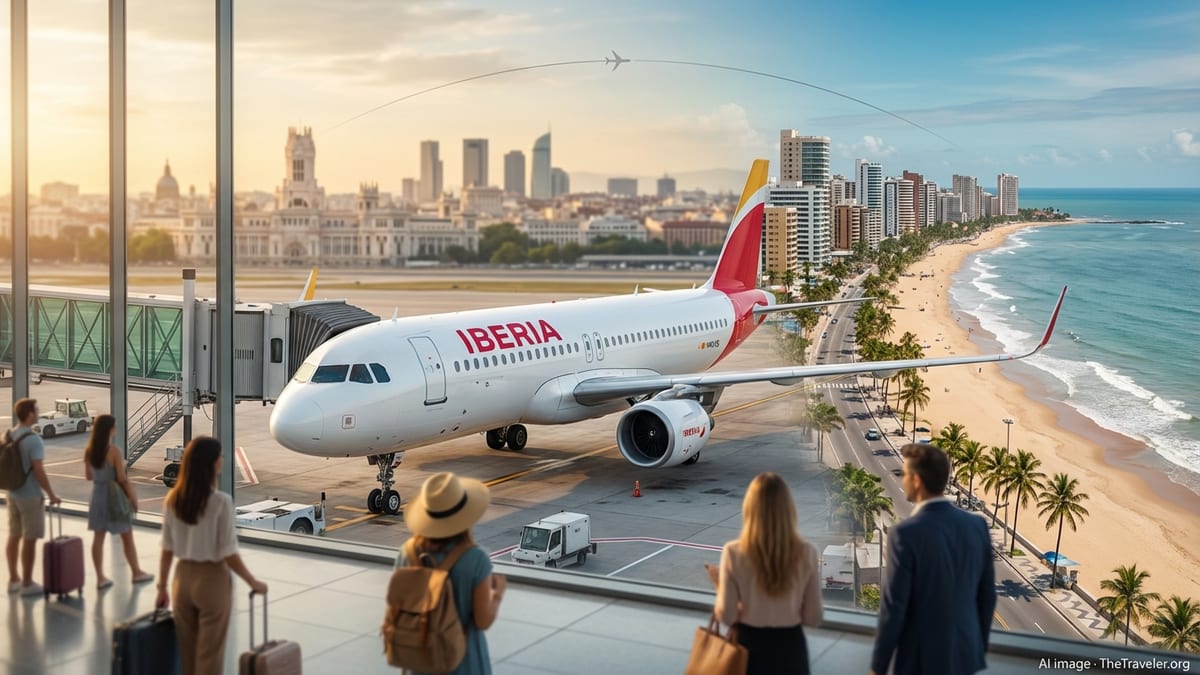
Iberia is deepening ties between Europe and Brazil with the launch of a new nonstop route linking Madrid and Fortaleza, a major gateway to Brazil's northeastern coast.
The direct service, starting on 19 January 2026, positions Madrid as a key hub for flows between Spain, the wider European market and one of Brazil’s fastest-growing tourism regions, while giving Brazilian travelers streamlined one-stop access to dozens of destinations throughout Europe, the Middle East and parts of Asia.
More News
- TSA Rolls Out $45 ConfirmID Fee for Travelers Without REAL ID at Security
- Flying Blue Launches February 25% Promo Rewards on Transatlantic and Regional Routes
- United Fast-Tracks Starlink Wi‑Fi Across Fleet, Free for MileagePlus Members
Details of the New Madrid–Fortaleza Route
The new Iberia service between Madrid and Fortaleza is scheduled to begin on 19 January 2026, initially operating three times per week. According to announcements from the airline and supporting schedule data, flights will launch with frequencies on core weekdays, designed to cater both to leisure travelers heading for Brazil’s northeast beaches and to passengers connecting through Madrid from elsewhere in Europe.
From mid-February 2026, Iberia plans to increase the route to four weekly frequencies, reflecting the carrier’s confidence in demand on this new transatlantic corridor. Further capacity growth is already on the horizon: planning data for the northern summer 2026 season indicates that Iberia aims to move to five weekly flights from April, progressively building Fortaleza into a regular feature of its long-haul schedule.
The flights will operate from Iberia’s main base at Adolfo Suárez Madrid-Barajas Airport, feeding into its bank of long-haul and medium-haul connections. In Fortaleza, services will use Pinto Martins – Fortaleza International Airport, the key aviation gateway for the state of Ceará and an emerging tourism and investment hub for Brazil’s northeast.
A New Chapter in Spain–Brazil Connectivity
The Madrid–Fortaleza launch is part of a broader expansion that will see Iberia serving four Brazilian cities during the 2025–2026 winter season: São Paulo, Rio de Janeiro, Recife and now Fortaleza. With the addition of Recife in December 2025 and Fortaleza in January 2026, the airline will offer close to 284,000 seats between Spain and Brazil across the winter period, a record level of capacity on this strategic corridor.
For Brazil, the new link further diversifies its long-haul map by strengthening connectivity beyond the dominant hubs in São Paulo and Rio de Janeiro. Travelers from Spain and the rest of Europe will be able to fly directly into Brazil’s northeast without the need for domestic connections from the country’s southeast, cutting travel times and reducing complexity for both tourists and business visitors.
For Spain, the route consolidates Madrid’s role as a leading European gateway to Latin America. Iberia has long marketed its capital-city hub as a convenient bridge between Europe and the Americas, and the new Fortaleza operation sits squarely within this strategy, channeling passengers from across the continent onto transatlantic flights operated under the Iberia brand.
A321XLR: Long-Range Single-Aisle at the Heart of the Strategy
One of the defining features of the Madrid–Fortaleza route is Iberia’s use of the Airbus A321XLR, the long-range single-aisle aircraft the airline introduced to its fleet in late 2024. Configured with 182 seats across Business and Economy cabins, the A321XLR has a range of up to around 7,500 kilometers in Iberia’s layout, enabling point-to-point transatlantic services that previously required larger widebody aircraft.
The aircraft’s economics are a central reason why Fortaleza and Recife have become viable long-haul additions to Iberia’s network. Operating costs are significantly lower than those of many widebody jets, and the more modest seat count allows Iberia to open new routes and build demand gradually rather than committing immediately to daily widebody service. For passengers, the A321XLR is fitted with Airbus’s Airspace cabin, which offers larger overhead bins, improved lighting and updated seating and entertainment features that bring it closer to the experience travelers associate with the airline’s A350 fleet.
In practical terms, the choice of the A321XLR is likely to translate into more consistent service and a greater probability of incremental frequency increases if demand materializes as expected. Iberia has framed the aircraft as a tool to explore new Atlantic markets and fine-tune capacity, and Fortaleza is one of the most prominent test cases for that strategy in South America.
Fortaleza’s Growing Appeal as a Tourism and Investment Hub
Fortaleza, capital of the state of Ceará, has emerged over the past decade as a key tourism and services center in Brazil’s northeast. Its coastline, including the beaches of Iracema, Meireles and Praia do Futuro, draws domestic and international visitors year-round, helped by a consistently warm climate and extensive hotel and resort infrastructure. For European travelers seeking sun in the northern winter, direct flights to Fortaleza offer an attractive alternative to established Caribbean or Canary Islands packages.
The city’s appeal goes beyond leisure. Local authorities have emphasized Fortaleza’s growing profile as a destination for investment in sectors such as renewable energy, logistics and technology services. The state of Ceará has positioned itself as a hub for offshore wind projects and transmission infrastructure, and improved air connectivity is viewed by regional leaders as a key ingredient in attracting European corporate interest and facilitating executive travel.
In comments released alongside Iberia’s announcement, Ceará’s governor described the Madrid route as a milestone for the state, underscoring that the connection would not only bring Spain and Ceará closer together, but would also open access to wider European, Middle Eastern and Asian markets via Iberia’s network. Tourism officials in northeastern Brazil similarly expect the new air link to support higher visitor numbers, with a focus on promoting multi-destination itineraries that combine Fortaleza with other regional highlights.
Madrid as a One-Stop Gateway for Brazilian Travelers
While much attention focuses on Europeans flying to Brazil’s beaches, the new route is equally significant for outbound Brazilian travelers. Through Iberia’s Madrid hub, passengers from Fortaleza will have one-stop access to a wide selection of destinations in Spain and across Europe, as well as onward flights operated in partnership with other oneworld carriers and partners into the Middle East and parts of Asia.
For residents of Ceará and neighboring states, this can reduce total travel times to European capitals and secondary cities, particularly for journeys that might otherwise require connections via São Paulo or Rio de Janeiro followed by another European hub. Direct access to Madrid also creates opportunities for more competitive fares and better schedule options for VFR (visiting friends and relatives), student travel, and emerging business links between northeastern Brazil and European markets.
The route is expected to support bidirectional flows: Spanish and European tourists heading toward Fortaleza, and Brazilian travelers connecting through Madrid to destinations such as Barcelona, Lisbon, Paris, Rome, London and beyond. In the context of Iberia’s broader Flight Plan 2030, which prioritizes building out its transatlantic platform, Fortaleza becomes another spoke in a hub-and-spoke system designed to maximize connectivity with efficient aircraft and coordinated schedules.
Part of Iberia’s Wider Transatlantic Growth Plan
The Madrid–Fortaleza launch does not occur in isolation. Over the 2025–2026 winter season, Iberia is rolling out several new long-haul destinations and boosting capacity across existing routes in the Americas. The carrier is introducing Orlando as a fresh U.S. destination, adding new service to Toronto in Canada, and planning a new route to Monterrey in Mexico for 2026. At the same time, it is lifting frequencies to traditional strongholds such as São Paulo, Rio de Janeiro, Santo Domingo and San Juan.
This expansion is framed within Iberia’s Flight Plan 2030, a long-term roadmap that includes fleet renewal, network diversification and increased focus on profitable long-range markets, particularly across the Atlantic. The A321XLR plays a pivotal role in that strategy, enabling thinner routes such as Recife and Fortaleza and giving Iberia additional flexibility to experiment with seasonal schedules and adjust capacity to demand.
The Brazilian market occupies a central place in this plan. With four destinations and a projected 25 percent increase in capacity to Brazil in 2026 driven by new aircraft deliveries, Iberia is positioning itself as a key European carrier for travelers to and from the country. The new Fortaleza flights thus represent a tangible expression of that ambition and a signal that northeastern Brazil is firmly on the radar of European airlines seeking growth beyond saturated traditional markets.
Implications for Tourism, Trade and Regional Development
For tourism stakeholders on both sides of the Atlantic, the direct Madrid–Fortaleza route is expected to stimulate new itineraries and packaged offerings. European tour operators already present in Brazil are likely to add Fortaleza-based holidays to their winter portfolios, while Spanish agencies will be able to promote multi-city trips that combine time in Madrid or Barcelona with beach stays in Ceará. Brazilian inbound operators, in turn, can target Spanish and European visitors with cultural, gastronomic and eco-tourism experiences across the northeast.
Trade and investment flows may also benefit. Faster and more convenient connections can support business travel related to energy projects, infrastructure, technology and services, particularly as Ceará pursues its agenda as a logistics and renewable energy hub. The route could also aid academic and cultural exchanges, with universities and cultural institutions in Spain and Brazil finding it easier to organize exchanges, conferences and joint projects anchored in Fortaleza and Madrid.
Local authorities in Ceará have already signaled their intention to invest in destination promotion in Spain and other European markets to consolidate the route’s performance. From Iberia’s perspective, strong load factors and growing demand could pave the way for further increases in frequency or seasonal adjustments to match peak holiday periods in Europe and Brazil, such as the European summer and Brazil’s carnival season.
FAQ
Q1. When do Iberia’s direct flights between Madrid and Fortaleza begin?
The inaugural Iberia flight from Madrid to Fortaleza is scheduled for 19 January 2026, marking the start of regular nonstop service between the two cities.
Q2. How often will Iberia operate the Madrid–Fortaleza route?
The route will start with three weekly flights and is planned to increase to four weekly frequencies from February 2026, with schedule data indicating a further rise to five weekly flights from April as demand grows.
Q3. What type of aircraft will Iberia use on the Madrid–Fortaleza flights?
Iberia will operate the route with the Airbus A321XLR, a next-generation long-range single-aisle aircraft configured with 182 seats across Business and Economy cabins and designed to offer comfort levels comparable to larger long-haul jets.
Q4. Why is the new route significant for Spain–Brazil connectivity?
The new service strengthens Madrid’s role as a European hub to Latin America and gives Iberia four destinations in Brazil, while allowing travelers to reach Brazil’s northeast directly without transiting through São Paulo or Rio de Janeiro.
Q5. How does the route benefit travelers from Fortaleza and Brazil’s northeast?
Passengers in Fortaleza and surrounding regions gain one-stop access to a wide range of destinations in Spain, Europe, and beyond through Madrid, often with shorter total travel times and more convenient schedules than itineraries requiring multiple domestic and international connections.
Q6. What is special about the Airbus A321XLR for this kind of route?
The A321XLR combines long range with lower operating costs and a smaller seat count, allowing airlines like Iberia to open new transatlantic routes that may not initially sustain daily widebody service while still offering a modern cabin experience.
Q7. How many destinations in Brazil will Iberia serve once Fortaleza flights begin?
During the 2025–2026 winter season, Iberia will serve four Brazilian cities directly from Madrid: São Paulo, Rio de Janeiro, Recife and Fortaleza, with increased overall capacity compared with previous years.
Q8. Will the new route help boost tourism in Fortaleza and Ceará?
Regional authorities and tourism boards expect the direct connection to increase visitor numbers, particularly from Spain and other European countries, supporting hotels, restaurants, tour operators and related services in Fortaleza and across Ceará.
Q9. How does this route fit into Iberia’s broader growth strategy?
The Madrid–Fortaleza service is part of Iberia’s Flight Plan 2030, which focuses on growing transatlantic connectivity, renewing the fleet with efficient aircraft like the A321XLR and expanding in key markets across Latin America and North America.
Q10. Can passengers connect beyond Madrid when flying from Fortaleza on Iberia?
Yes. The flights are timed to feed into Iberia’s broader network from Madrid, enabling same-day connections to numerous destinations throughout Spain and Europe, as well as to other long-haul routes operated by Iberia and its partners.