

More news on this day
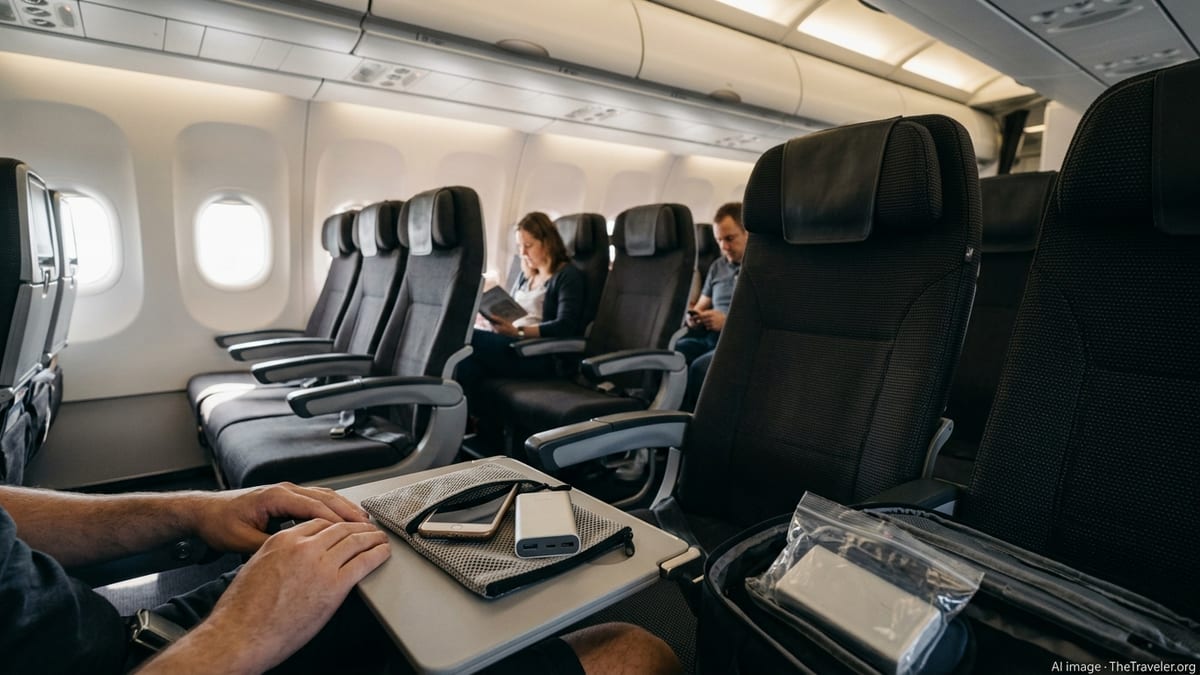
International aviation regulators are moving to sharply restrict how travelers bring and use portable power banks on commercial flights, with new guidance from the International Civil Aviation Organization (ICAO) setting a two-device limit per passenger and calling for a blanket ban on inflight recharging amid mounting safety concerns over lithium battery fires.
Get the latest news straight to your inbox!
From Quiet Technical Talks to Global Cabin Rules
The latest shift stems from detailed discussions within ICAO’s Dangerous Goods Panel, which has been reviewing how lithium battery risks are managed in passenger cabins. Working papers and the panel’s recent report describe growing unease over the number of spare lithium batteries and power banks now routinely carried on board and the difficulty of monitoring how they are used during a flight.
Panel documentation shows that experts examined two distinct issues: how many power banks a single traveler should be allowed to carry, and whether passengers should be able to recharge devices using those power banks while the aircraft is in the air. The group weighed operational needs, such as keeping airline-issued devices powered, against the heightened fire risk when multiple batteries and charging cables are active at the same time.
According to publicly available ICAO records, panel members ultimately agreed that a limit of two power banks per passenger offered a clearer, more enforceable boundary than the previous patchwork of national and airline-level rules. At the same time, a proposed new provision advises that spare batteries, including power banks, should not be used to recharge other devices during any phase of flight, effectively urging a global end to inflight power bank use.
The outcome is not a new consumer law, but an international standard and recommended practice that national regulators and airlines are expected to adopt into their own rulebooks and operating procedures over the coming months.
What the New ICAO Guidance Actually Says
Recent ICAO papers outline two key elements that matter to travelers: a numerical cap and a usage ban. First, passengers are to be limited to a maximum of two lithium-ion power banks, each typically capped at 100 watt-hours, carried in cabin baggage only. Larger spare batteries between 101 and 160 watt-hours remain subject to airline approval and are already tightly controlled in most jurisdictions.
Second, the documents specify that spare batteries and power banks should not be used to charge personal electronic devices during flight. The language distinguishes this from charging equipment that is necessary for airline operations, such as crew tablets, recognizing that operators may need to power critical devices under controlled conditions while still discouraging casual passenger use.
The guidance builds on long-standing principles already reflected in many national rules: spare lithium batteries must stay out of checked luggage, terminals must be protected against short circuits, and damaged or recalled batteries should never travel on board. Where ICAO is now going further is in explicitly targeting the act of charging from a power bank in the cabin, treating it as an avoidable risk at a time when reported incidents involving overheating batteries are rising.
In parallel, industry materials circulated to passengers by the International Air Transport Association reflect the same direction of travel, advising that recharging power banks and similar devices on board is not permitted and underscoring the new two-unit limit for standard-size power banks.
Airlines Begin Tightening Policies Ahead of Implementation
Although ICAO sets the global framework, individual airlines and regulators ultimately determine how quickly changes reach passengers. In practice, carriers in several regions have already moved ahead of the latest guidance, either capping the number of power banks or banning their use on board before the new standard is formally embedded.
Across Asia and the Middle East, a wave of carriers has announced restrictions on inflight power bank use following a series of cabin smoke and fire events attributed to lithium batteries in recent years. Publicly available airline advisories now commonly state that power banks must remain switched off throughout the flight and may not be used to charge phones, laptops, or other electronics, even when seat power is available.
Some operators have also introduced more granular rules about where power banks may be stored, prohibiting them from overhead bins and requiring passengers to keep them on their person or under the seat in front. These measures mirror national directives in markets that have reacted to high-profile incidents by limiting both power bank numbers and storage locations.
In Australia and parts of the Gulf, carriers have already adopted numerical limits that closely resemble the ICAO position, typically allowing only one or two approved power banks per traveler, while explicitly prohibiting their use on board. Industry observers expect that these early adopters will be joined by more airlines as regulators begin transposing the latest ICAO decisions into binding national regulations.
What Travelers Need to Know Before Flying With Power Banks
For passengers, the most immediate consequence of the ICAO shift is a tightening of what was once a relatively permissive regime. Travelers who routinely carried several small power banks to keep multiple devices charged may find themselves restricted to just two units and subject to checks at the gate or during boarding, particularly on carriers that decide to enforce the new guidance strictly.
Under the evolving framework, power banks must continue to travel only in carry-on baggage, with their terminals protected against short circuits by cases, caps, or tape. Labels showing capacity in watt-hours, or sufficient information to calculate it, are increasingly important as airlines and security staff seek to verify that devices fall within accepted limits.
The emerging prohibition on inflight recharging from power banks means that passengers will need to plan differently for long-haul journeys. Instead of plugging phones or laptops into a portable battery during cruise, travelers may have to rely on seat power where available, dim screens, and use battery-saver modes. For some, particularly those carrying older devices with degraded batteries, this could influence how they choose flights and seats.
Travel industry briefings suggest that passengers should expect more pre-travel messaging about lithium battery rules, including power bank limits, on airline websites, booking confirmations, and mobile apps. Airport signage and onboard announcements are also likely to become more explicit as operators seek to align passenger behavior with the new safety expectations.
Safety Rationale and the Road Ahead for Regulation
The push to curb inflight power bank use is rooted in the difficulty of managing even a small battery fire inside a pressurized cabin. Investigations into past incidents have highlighted how quickly smoke can spread from an overheating device in an overhead compartment or seat pocket, prompting evacuations, diversions, and, in some cases, injuries to passengers and crew.
Aviation safety analyses emphasize that while individual lithium batteries are small, their energy density and the possibility of thermal runaway present a unique hazard when hundreds of them are concentrated in a confined space. Power banks, which contain multiple cells and are specifically designed to discharge energy into other devices, are considered particularly sensitive when used simultaneously across the cabin.
By capping the number of power banks per passenger and discouraging their active use, ICAO and partner organizations aim to lower the overall energy load at risk and simplify cabin crews’ response in the event of a malfunction. A smaller number of idle, properly stowed batteries is easier to monitor and isolate than a tangle of charging cables and devices scattered around the cabin.
Looking ahead, regulators and airlines are expected to refine their policies as more data becomes available on how the new restrictions affect incident rates and passenger compliance. Additional guidance could emerge around labeling, design standards, and the integration of safety features within power banks themselves, but for now, travelers can anticipate stricter limits, clearer rules, and far less tolerance for using portable chargers in the air.