

More news on this day
A new generation of ICE 4 trains is tightening rail links between Germany and southern Austria, promising quicker journeys through the Alps while raising the bar on comfort and sustainability for cross-border travelers.
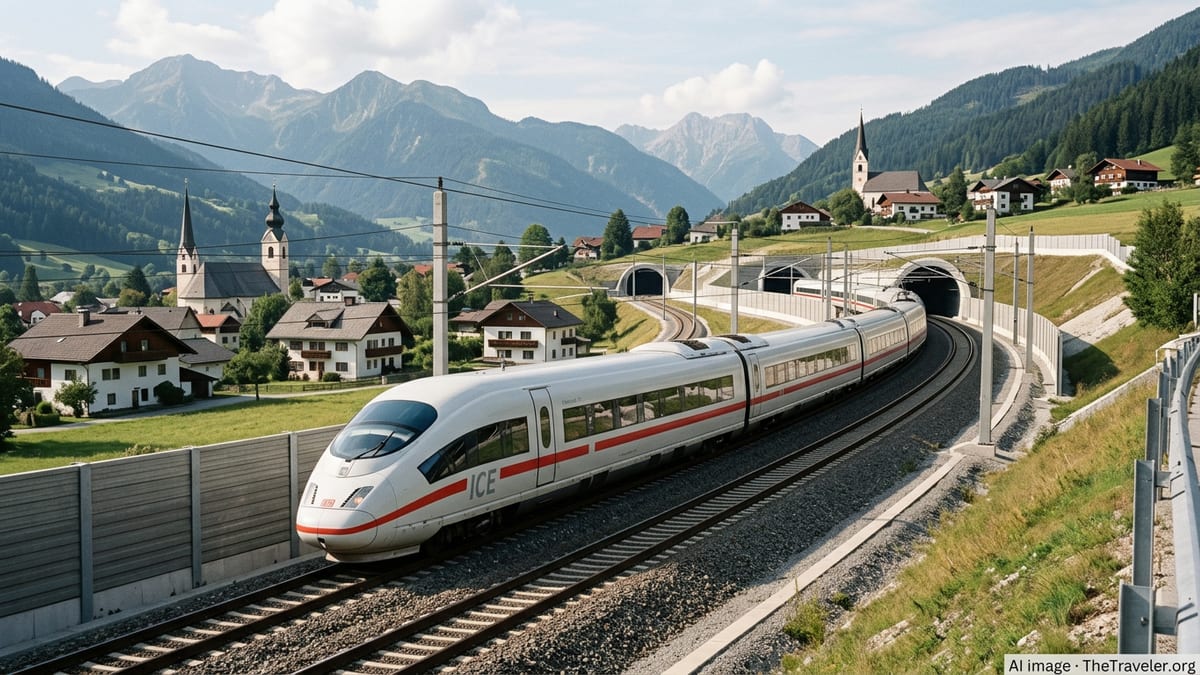
Faster Cross-Border Links via Austria’s Upgraded Southern Route
The rollout of ICE 4 services on routes connecting Germany with southern Austria coincides with major infrastructure upgrades on Austria’s Southern Line, including the Koralm and Semmering base tunnels. These projects are steadily transforming journeys between Vienna, Graz, Klagenfurt and onward to Germany into high-speed, largely tunnel-based runs designed to cut journey times across the eastern Alps.
On the freshly upgraded corridor between Graz and Klagenfurt, ICE 4 units are now reaching commercial speeds of up to 250 kilometers per hour, aligning with the maximum speeds available on much of Germany’s modern high-speed network. This allows German long-distance services to plug directly into Austria’s fastest north–south axes without passengers having to change to separate domestic high-speed trains.
The effect for travelers heading between Germany and southern Austria is more than just headline top speed. Timetables are being tightened as the new tunnels bypass winding mountain sections and older, slower alignments. Typical journeys that once required circuitous detours and lengthy climbs over traditional passes are gradually being replaced by more direct, base-tunnel routes that favor sustained high-speed running.
These improvements dovetail with plans in both countries to make rail the default mode for medium-distance international trips. By boosting frequencies and shaving significant minutes off cross-border services, ICE 4 operations on the southern axis are positioned as a practical alternative to short-haul flights between German hubs and Austrian cities such as Graz and Klagenfurt.
Onboard Comfort: Quieter Cabins, Smarter Interiors
The ICE 4 fleet was conceived to be the workhorse of Germany’s long-distance system, but its deployment into Austria means international travelers are now experiencing a consistent standard of comfort across borders. The train’s interior design focuses on wide, open saloons, generous luggage space and quieter cabins, with improved sound insulation that reduces ambient noise compared to earlier generations.
Quiet zones, family areas and dedicated spaces for bicycles and prams are configured to accommodate different passenger needs on trips that can range from short hops to long international journeys. In cooperation with the German federal government, Deutsche Bahn is also rolling out a comfort program in 2026 that targets cleaner interiors, more frequent deep cleaning of carpets and sanitary areas, and faster repairs of interior fittings, all of which directly benefit ICE 4 passengers on cross-border runs.
Digital connectivity is another pillar of the onboard experience. ICE 4 trains offer comprehensive Wi‑Fi coverage, power outlets at most seats and improved mobile reception through signal-optimizing windows and onboard repeaters. For business travelers moving between German financial hubs and Austria’s regional capitals, this turns the train into a rolling office, with a more predictable work environment than many short-haul flights.
Seating layouts are designed to balance capacity and comfort. Standard-class coaches feature ergonomically contoured seats with folding tables and coat hooks, while first-class sections provide extra legroom, upgraded upholstery and more individual space. Combined with smooth acceleration and modern suspension systems, the ride quality at 230 to 250 kilometers per hour is engineered to feel calm rather than adrenaline-fueled, helping passengers arrive in better shape for meetings, holidays or onward connections.
Sustainability at the Core of the ICE 4 Concept
The arrival of ICE 4 services into southern Austria underscores a broader shift in central Europe toward lower-carbon, electrified mobility. Deutsche Bahn powers its long-distance fleet with a rapidly growing share of renewable electricity, and each high-speed train that replaces a short-haul flight between Germany and Austria significantly reduces per-passenger emissions.
The trains themselves are designed with energy efficiency in mind. Lightweight car bodies, regenerative braking systems and distributed traction equipment help minimize power consumption while recovering energy during deceleration. The modular design allows operators to adjust train length to match demand, avoiding the inefficiencies of running unnecessarily long formations on quieter services.
On the infrastructure side, Austria is investing heavily in tunnels and upgraded track that allow longer stretches of constant-speed running. This operating profile is inherently more efficient than repeated cycles of braking and acceleration on older mountain lines. Combined with efforts in both countries to source more electricity from hydro, wind and solar, the new ICE 4 corridor is intended to be one of Europe’s cleaner high-speed options.
For travelers, the sustainability story is becoming part of the value proposition. Marketing materials increasingly highlight the emissions savings of taking a high-speed train instead of flying, and corporate travel policies across Europe are shifting to favor rail on routes where journey times are competitive. The expanding ICE 4 footprint into southern Austria gives companies and individual passengers another tangible way to cut travel-related emissions without sacrificing convenience.
Timetables, Routes and Who Benefits Most
While exact timings vary by service and season, the integration of ICE 4 trains with Austria’s upgraded Southern Line is already reshaping typical journeys. Connections from German cities such as Munich and Nuremberg can now feed directly into fast services toward Graz and Klagenfurt, often with a single cross-platform change in Vienna or at key junctions. As more sections of the Koralm and Semmering projects are fully integrated into the timetable, further cuts to end-to-end travel times are expected.
Business travelers are among the early winners. Direct or near-direct links between Germany’s industrial regions and southern Austrian cities are shortening day-return trips and making rail more attractive for cross-border meetings. Universities and research centers along the route also stand to benefit from more frequent, faster connections that make collaboration and student mobility easier.
Tourism is another clear beneficiary. Southern Austria’s lakes, ski resorts and historic towns have long attracted visitors from Germany, but access has often involved either a short-haul flight plus transfers or a slower, scenic rail journey. With ICE 4 trains now reaching higher speeds across much of the north–south axis, city-break itineraries that combine German cultural hubs with Austrian alpine landscapes become more viable within a long weekend.
Looking ahead, operators on both sides of the border are signaling that the current services are a starting point rather than the final word. As new rolling stock is introduced, infrastructure projects are completed and demand patterns become clearer, the ICE 4 link between Germany and southern Austria is expected to evolve further, offering more departures, better connections and a refined balance between speed, comfort and environmental performance.