

More news on this day
U.S. immigration agents are being deployed to Hartsfield-Jackson Atlanta International Airport to support Transportation Security Administration operations after days of punishing security delays that have left some travelers waiting hours to clear checkpoints at the world’s busiest passenger hub.
Get the latest news straight to your inbox!
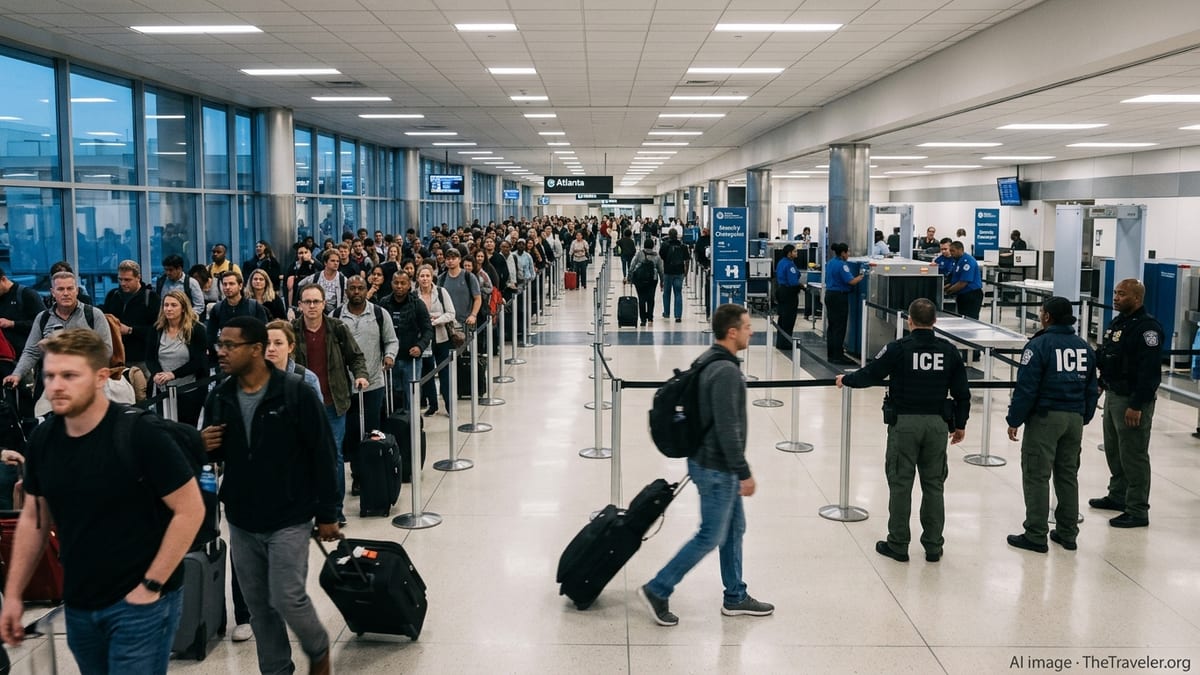
Record Wait Times Test World’s Busiest Airport
Reports from Atlanta over recent days describe uncharacteristically long security lines at Hartsfield-Jackson, with wait times stretching from several hours to nearly the length of a transcontinental flight. Social media posts, local coverage and traveler accounts describe lines snaking through the domestic terminals, wrapping around baggage claim areas and prompting some passengers to arrive four to five hours before departure.
Publicly available information connects the disruption to a partial federal government shutdown that has curtailed pay for Transportation Security Administration staff nationwide. Outages in staffing have been particularly acute at major hubs such as Atlanta, where even modest increases in absenteeism can cascade into significant delays for tens of thousands of passengers moving through security each morning.
On Sunday, local reporting indicated that at times only a handful of TSA officers were available to check identification at the main domestic checkpoint, creating bottlenecks at the very start of the screening process. Some travelers recounted waits of more than five hours and missed departures, while others described comparatively swift experiences after rerouting through the international terminal, where lines have generally been shorter and more predictable.
National data released regularly by the TSA shows that overall checkpoint throughput at large U.S. airports has remained high in recent months, reflecting resilient passenger volumes. However, the Atlanta experience in recent days highlights how localized staffing challenges can quickly translate into record wait times when layered onto already busy schedules and full flights.
ICE Deployment Aimed at Relieving TSA Bottlenecks
Against this backdrop, the federal government has begun deploying personnel from U.S. Immigration and Customs Enforcement to select airports, including Atlanta, in an effort to stabilize operations. According to published coverage from national outlets, the directive came from the White House, which framed the move as a way to support TSA teams strained by the shutdown and to help manage long lines at major hubs.
Statements summarized in news reports and local announcements indicate that at Hartsfield-Jackson, ICE officers assigned to Enforcement and Removal Operations and related units are being positioned in domestic terminals. City-level communications describe their role as providing support for TSA, with responsibilities that include line management, crowd flow and general assistance around checkpoints rather than direct passenger screening.
Accounts from travelers and airport observers on March 23 and March 24 describe ICE personnel in tactical-style uniforms moving through terminal areas, standing near security lines and occasionally assisting with directing passengers. These reports generally suggest that TSA officers continue to handle all regulatory screening functions, while ICE personnel remain outside the lanes, focused on keeping queues orderly and moving.
National reporting notes that similar deployments are occurring at other large U.S. airports experiencing extended delays, although the scale and visibility of the ICE presence varies by location. Atlanta’s role as the nation’s primary connecting hub, coupled with some of the longest documented wait times during the shutdown, has made the airport a focal point of the broader experiment.
Travelers Weigh Confusion, Security Concerns and Practical Advice
The sudden appearance of immigration agents at airport checkpoints has generated a mix of confusion, concern and pragmatic advice among travelers. Commenters in public forums dedicated to Atlanta travel have questioned whether the agents’ presence could lead to on-the-spot immigration enforcement or additional document checks beyond standard TSA procedures, while others have focused on how to navigate the changed environment as efficiently as possible.
Publicly available statements from city leaders and airport communications stress that the ICE deployment at Hartsfield-Jackson is intended to augment TSA and airport staff rather than to conduct routine immigration checks on passengers moving through security. According to those summaries, federal officials have indicated that the agents are not being positioned to check passports or visas at the domestic checkpoints.
Meanwhile, traveler reports from early Tuesday suggest that wait times, while still elevated, may be somewhat shorter than during the worst of the weekend disruptions. Some domestic passengers have described clearing security in roughly 90 minutes or less during off-peak hours, while others continue to report lines longer than two hours during the morning rush, underscoring the unevenness of the situation from one terminal and timeslot to another.
Experienced Atlanta flyers sharing their experiences in public forums have highlighted a handful of emerging strategies, including arriving significantly earlier than usual, considering the international terminal for certain domestic departures where permitted, and closely monitoring day-of reports from other travelers to better gauge current conditions before heading to the airport.
Questions Over Training, Mission and Long-Term Impact
The use of immigration enforcement personnel to support airport security operations has prompted broader questions beyond immediate wait times. National coverage notes that ICE officers are not trained as aviation security screeners and do not carry the same certifications as TSA officers who operate scanners, conduct pat-downs and make security clearance decisions at checkpoints.
Security analysts cited in recent reporting have raised questions about how effectively ICE personnel can contribute in non-screening roles, such as crowd control and line management, and whether their presence might inadvertently heighten traveler anxiety, particularly among immigrant communities and international visitors. Some commentary also points to the risk of confusion if passengers conflate TSA procedures with immigration checks in areas where the two functions are ordinarily distinct.
For the travel industry, the situation in Atlanta is being viewed as an important test of how federal agencies respond when routine airport operations are disrupted by political impasses. Airlines and airport operators rely on predictable passenger flows to maintain on-time performance, and extended security delays can ripple through the network, leading to missed connections, crew scheduling challenges and customer-service strains even at airports that are not directly affected by the shutdown.
In the longer term, policy analysts are watching whether the Atlanta deployment signals a new template for staffing flexibility during crises or remains a short-lived measure tied specifically to the current budget standoff. The outcome may influence future discussions about how to resource airport security, the appropriate role of immigration agencies in domestic travel infrastructure and how to safeguard both efficiency and civil liberties when federal operations are under stress.
What Passengers Can Expect in the Days Ahead
As of Tuesday, March 24, travelers planning to pass through Hartsfield-Jackson are being urged by airlines and local media outlets to allow substantially more time than usual for security screening, particularly during early morning and late afternoon peaks. Reports indicate that guidance to arrive four hours ahead for domestic flights and even earlier for certain international departures, while conservative, reflects the recent reality for many passengers.
Transportation updates suggest that airport management and city officials are working to soften the impact on both frontline workers and passengers. Local coverage notes efforts such as meal vouchers, transit passes and complimentary parking for TSA staff during shifts, aimed at supporting an unpaid workforce that has nonetheless continued to report for critical security duties throughout the shutdown.
For travelers, the experience at Atlanta currently appears highly variable by terminal, time of day and screening category. Some passengers continue to report relatively smooth passage through less crowded checkpoints, especially later in the day or via the international terminal, while others describe lines that stretch more than a mile and require careful planning around food, water and family needs while queuing.
While there is no clear timeline for when federal funding negotiations will resolve and TSA operations will fully normalize, the Atlanta deployment of ICE agents underscores how quickly a political dispute in Washington can manifest as a tangible obstacle for people simply trying to catch a flight. For the moment, publicly available information points to a travel environment in which flexibility, patience and extra time at the airport have become essential parts of any itinerary that passes through the country’s busiest hub.