

More news on this day
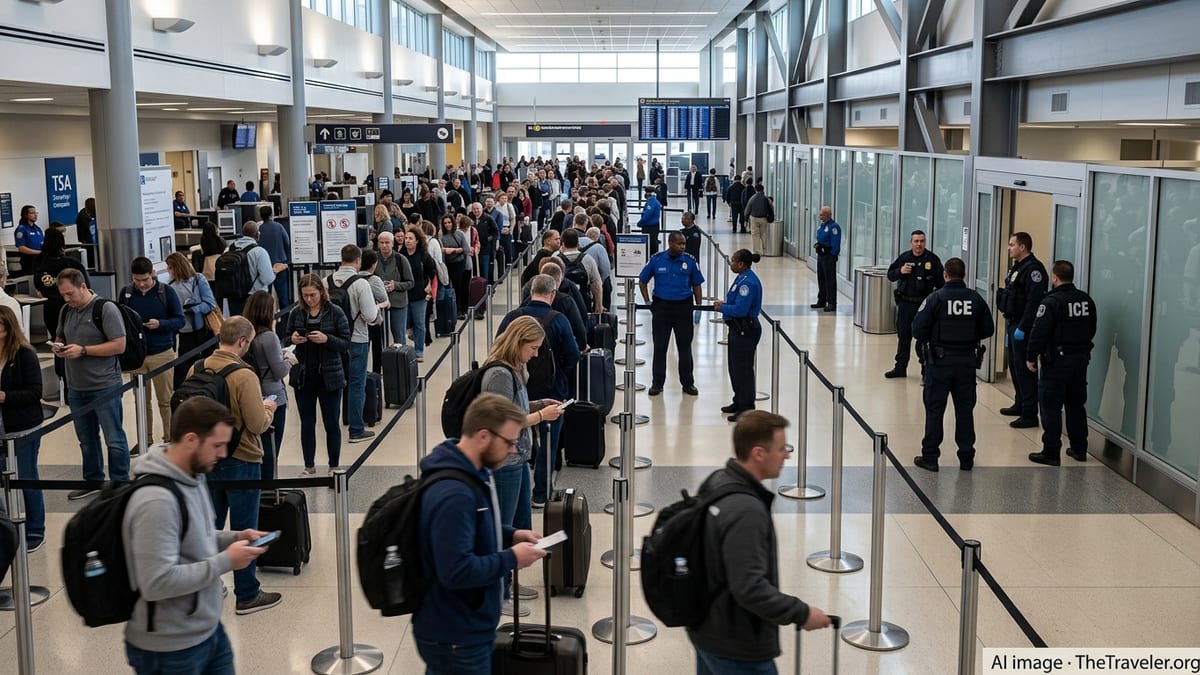
Immigration and Customs Enforcement personnel are being deployed to major U.S. airports to help manage operations as Transportation Security Administration staffing shortages fuel hourslong security lines and growing concern among travelers and worker unions.
Get the latest news straight to your inbox!
Shutdown Pressures Push Airports to the Brink
The deployment of Immigration and Customs Enforcement staff comes as a prolonged Department of Homeland Security funding lapse strains aviation infrastructure nationwide. Publicly available information indicates that TSA officers, designated as essential workers, have been required to report for duty without pay, prompting spikes in sick calls and resignations. At some airports, callouts have risen well above typical levels, reducing the number of open lanes and squeezing remaining screeners.
Reports from major hubs such as Houston, New Orleans and Atlanta describe security lines stretching for hours, with travelers warned to arrive significantly earlier than usual. Local broadcast coverage and passenger accounts on social media describe scenes of crowded checkpoints, closed lanes and improvised queuing areas extending into ticketing halls during peak morning and evening banks.
Analysts note that the current disruption follows years of warnings about fragile staffing pipelines at both TSA and the Federal Aviation Administration. Inspector general testimony and recent union statements have highlighted the risk that any extended funding crisis or pay disruption could quickly ripple into the air travel system, particularly during high-demand periods such as spring break.
Airport operators, facing surging passenger volumes and limited control over federal staffing, have turned to contingency measures ranging from consolidating checkpoints to redirecting passengers between terminals. The arrival of ICE officers is emerging as one of the most visible federal responses to keep traffic moving, even as questions mount about their training and authority in the aviation environment.
ICE Moves into Terminals as Role Questions Mount
According to published coverage and widely shared internal communications, ICE agents are being assigned to airports in at least a dozen metropolitan areas, including New York, Los Angeles, Miami, Chicago, Houston and Atlanta. Federal officials have indicated in public remarks that these officers are intended to perform support functions so that TSA screeners can remain focused on primary security responsibilities.
Reports indicate that ICE personnel are being placed in non-screening roles such as directing passengers in queues, monitoring exits from the secure area, assisting with crowd control and handling some document checks under TSA supervision. In some locations, they are also present near secondary inspection points and baggage recheck areas where international and domestic flows intersect.
However, the exact scope of their authority at checkpoints remains contested in public discussion. Immigration enforcement operations traditionally fall under a separate mandate from aviation security, and there is no indication in publicly available policy documents that ICE agents are being certified to conduct full passenger screening. Analysts note that any shift toward enforcement activity in the checkpoint environment could change the legal landscape for travelers, especially noncitizens.
Early accounts from affected airports suggest that passengers are encountering a mix of uniforms and agencies in the same spaces, sometimes without clear signage explaining each role. Advocacy groups and legal commentators have urged travelers to familiarize themselves with identification requirements, secondary screening procedures and their rights during encounters with federal officers in the terminal.
Unions and Advocates Warn of Training and Rights Concerns
The largest federal workers union representing TSA personnel has publicly criticized the airport deployment of ICE officers, arguing in statements reported by national outlets that immigration agents lack the specialized training required for aviation screening operations. Union leaders contend that placing non-TSA staff at or near checkpoints risks confusing both passengers and workers while failing to address the root cause of the staffing crunch, which they identify as pay, retention and working conditions.
Civil liberties organizations and immigrant rights advocates have also raised alarms about the prospect of immigration enforcement officers operating inside security zones. Commentators note that airports already function as high-surveillance spaces where travelers, particularly foreign nationals and mixed-status families, may feel pressure to comply with any request from a uniformed federal agent, regardless of legal obligation.
Legal blogs and practitioner alerts circulating in recent days advise noncitizen travelers to carry required documentation, be prepared for additional questioning and understand that certain interactions with immigration officials may have implications for future status or admissibility. Some immigration attorneys warn that the symbolic presence of ICE near checkpoints, even in nominally non-enforcement roles, could discourage lawful travel by those wary of scrutiny.
For TSA workers, the arrival of ICE agents has prompted mixed reactions in online forums and union channels. Some officers describe modest relief when support staff take over crowd management and exit monitoring, while others express concern that the move shifts public anger over delays toward front-line personnel without resolving chronic understaffing.
Travelers Confront Long Lines and New Uncertainty
For passengers, the most immediate impact of the TSA staffing crunch and ICE deployment is visible in extended wait times and a more complex security experience. Travelers transiting major hubs in recent days have reported queuing for up to three or four hours in extreme cases, with some missing flights despite arriving earlier than standard recommendations.
Airlines have begun issuing their own advisories urging customers to arrive well in advance of departure and to monitor airport-specific guidance. Industry analysts suggest that carriers face a difficult balance between protecting schedules and adjusting to unpredictable checkpoint throughput, particularly at hub airports where missed connections can cascade across the network.
Business travel groups and tourism stakeholders worry that the perception of chaos and uncertainty at U.S. airports could dampen demand, especially among international visitors planning discretionary trips. Travel planners report an uptick in questions about which airports are most affected, whether certain times of day are less risky and how the presence of ICE might influence the experience of dual nationals or travelers with pending immigration matters.
Some airports have responded by pushing real-time wait-time data to terminal displays and mobile apps, while others have increased their own customer-service staffing in public areas leading to security. Yet the core constraint remains the number of trained federal screeners available, a factor that local initiatives can only partially offset.
What Air Travelers Should Expect in the Coming Weeks
With no immediate resolution to the underlying funding dispute, analysts anticipate that TSA staffing pressures and the associated ICE deployment could persist into the early summer travel season. Aviation experts note that even if funding were restored promptly, rebuilding staffing levels would take time due to training pipelines and background checks required for new hires.
In the near term, travel specialists recommend that passengers allow extra time for check-in and security, travel with carry-on luggage when possible to reduce complications after missed connections, and stay alert for airport-specific advisories about checkpoint closures or rerouting. Those with tight connections may wish to seek longer layovers than usual when booking through heavily affected hubs.
Immigration attorneys and civil liberties advocates advise noncitizen travelers to keep documentation organized, be aware that ICE officers may be present in or near security areas, and seek legal counsel in advance if they have unresolved status questions. Families traveling with mixed immigration status or recent asylum applicants may face additional stress in environments where immigration enforcement and security functions appear to overlap.
For airports and airlines, the coming weeks will test contingency plans developed after earlier shutdowns and staffing crises. Observers are watching to see whether the presence of ICE personnel meaningfully eases passenger flow or primarily reshapes the security landscape in ways that will influence how travelers experience U.S. airports long after the immediate staffing crunch has passed.