

More news on this day
A severe winter storm in New Hampshire forced a chartered U.S. Immigration and Customs Enforcement deportation flight to remain on the ground for roughly 24 hours this week, leaving about 100 detainees and crew unexpectedly stranded at Portsmouth International Airport and prompting fresh scrutiny of how federal authorities manage migrant transport operations in extreme weather.
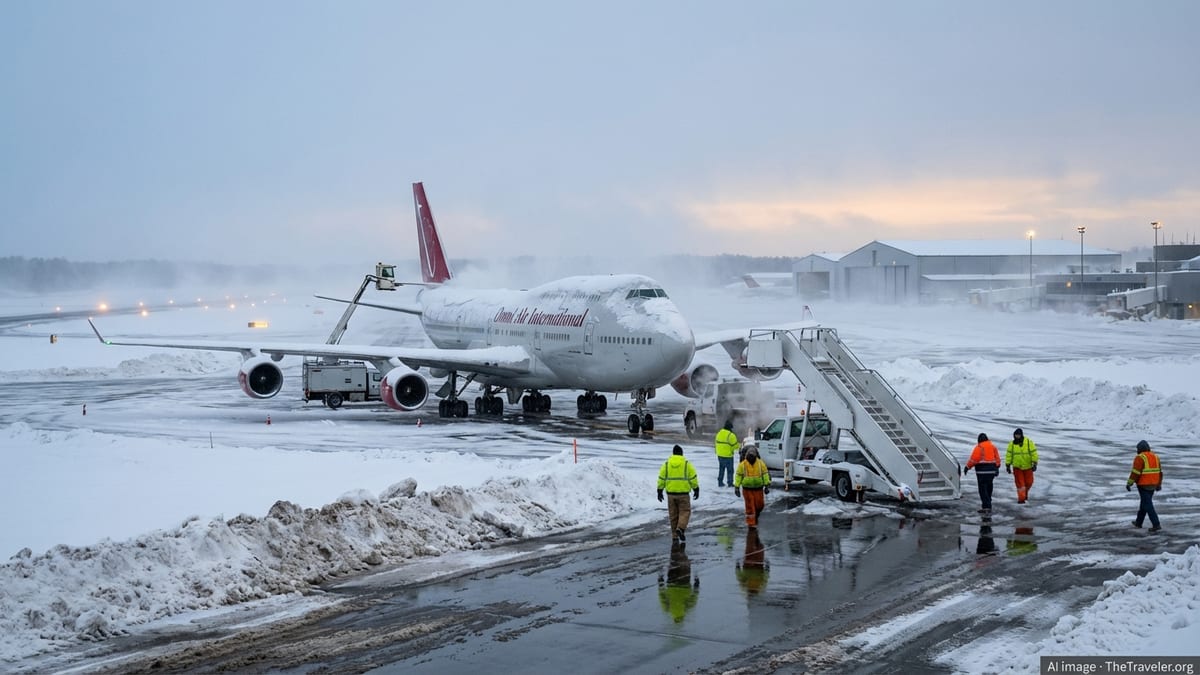
Blizzard Turns Routine Refueling Stop Into 24-Hour Ordeal
The flight, operated by Oklahoma-based Omni Air International on behalf of the Department of Homeland Security, departed Harlingen, Texas, on Sunday evening and landed at Portsmouth International Airport at Pease shortly after 1 a.m. Monday as part of a planned refueling and crew change en route to Europe. What was supposed to be a brief technical stop instead unfolded into a daylong disruption as a fast-moving snowstorm swept across the New Hampshire Seacoast.
Airport officials said they received only about 15 minutes’ notice that the aircraft, reported to be a widebody jet configured for long-haul charter operations, was inbound to Portsmouth while the region was under a winter storm warning. With more lead time, airport representatives said they would have advised federal officials to divert the flight to a less affected airport farther south or west, where crosswinds, visibility and deicing capacity were less constrained.
High winds, heavy snowfall and freezing temperatures quickly made conditions on the ground unsafe for turnaround operations. For hours, the aircraft remained parked on the apron while snowplows and deicing crews struggled to keep taxiways passable. Flight tracking data and local reports indicate that detainees and crew were confined on board until early afternoon Monday, when authorities allowed passengers to disembark into a closed terminal area.
In total, the plane remained in Portsmouth for close to 31 hours, with the deportation flight not departing again until around 8 a.m. Tuesday. The extended stopover rippled through the broader deportation itinerary, delaying onward travel to Bulgaria and other European destinations and forcing last-minute logistical adjustments by immigration and consular officials on both sides of the Atlantic.
Detainees Confined for Hours as Weather and Crew Limits Collide
According to statements from the Department of Homeland Security, roughly 100 detainees in ICE custody were aboard the flight, destined for removal from the United States under existing deportation orders. Once on the ground in Portsmouth, the combination of deteriorating weather and federal duty-time rules effectively trapped the aircraft and its passengers in place.
Initially, blizzard conditions and restricted ground access kept detainees on the plane for more than 12 hours, with sources and advocacy groups placing the time on board at about 13 hours before passengers were allowed into the terminal. During that period, the aircraft’s crew eventually exceeded maximum duty limits, triggering a mandatory rest period that extended the delay well beyond the window needed to clear the runways and restore safe operating conditions.
Homeland Security officials said detainees were given catered meals, drinking water and access to onboard lavatories during the on-tarmac confinement. Once moved into the terminal, they were housed in a secure, climate-controlled space overnight, with access to restrooms and medical checks. Authorities emphasized that prescription medications continued to be administered and that ICE officers conducted regular welfare checks until the flight was cleared to depart.
Nonetheless, the image of a planeload of migrants immobilized on a snowy tarmac for hours in the middle of the night has reignited long-standing concerns about transparency and oversight of deportation flights, which typically operate away from public view and depend heavily on charter carriers and lightly used regional airports.
Local Officials and Activists Demand Answers on Risk and Transparency
The unexpected arrival of the deportation flight during a significant winter storm quickly drew attention from local leaders and community groups in New Hampshire, many of whom said they learned of the situation through social media posts and calls from advocates, rather than from federal briefings. Portsmouth city officials, including members of the city council, went to the airport seeking information about detainee welfare and the decision to land in the storm.
Activists with the grassroots group No ICE New Hampshire, which has tracked immigration flights through Portsmouth for several years, documented the plane on the tarmac and criticized the lack of prior notification to local authorities. The organization described the decision to press ahead into a blizzard as a dangerous gamble with the safety of detainees, flight crew and airport ground staff, and as emblematic of what they see as systemic disregard for migrant welfare within federal enforcement operations.
Airport management and the ground services provider, Port City Air, stressed that they are obligated to safely receive and service any aircraft that arrives, including federal charters. They said their teams worked throughout the storm to ensure the detainees had food, shelter and basic amenities once they were allowed off the plane, even as the closed terminal and surrounding airfield remained partially shut to other traffic.
The incident also unfolded against the backdrop of a broader statewide debate over immigration enforcement infrastructure. Just days earlier, New Hampshire officials confirmed that a controversial plan for a large ICE processing and detention facility in Merrimack would not move forward, following months of public pushback. For critics of the deportation system, the snowbound aircraft at Portsmouth became a stark visual symbol of what they argue is an overly secretive and inherently high-risk transport network.
Operational Fallout for Airports, Airlines and Travelers
While the flight itself carried detainees rather than commercial passengers, the disruption underscored how specialized federal operations can intersect with the wider travel ecosystem in New England during severe weather. Portsmouth International, a small joint civil-military facility, typically sees modest scheduled traffic compared with larger regional hubs in Boston, Manchester and Portland. The overnight arrival of a widebody deportation charter in blizzard conditions demanded significant attention and resources from airport staff at a time when they were already managing snow removal and safety checks.
Ground crews had to coordinate deicing, fuel logistics and secure transport of detainees to and from the terminal amid blowing snow and low visibility. These efforts took place while many commercial flights elsewhere in the region were being preemptively canceled or diverted, highlighting the additional strain that unscheduled federal movements can place on limited airport capacity during storms.
For Omni Air International, the delay added fuel and crew costs to an already complex charter route, which likely included multiple international segments and coordinating handoffs with foreign authorities. Industry analysts note that such charter contracts typically account for weather-related disruptions, but a full-day ground hold with duty-time resets can still erode profit margins and complicate scheduling for aircraft that operate on tight rotations.
Travelers passing through the Seacoast region may not have felt the direct impact of the stranded deportation flight, but the episode serves as a reminder of how quickly winter weather can reshape aviation plans across the Northeast. As climate variability brings more frequent intense storms, both commercial airlines and government agencies are under pressure to refine their contingency planning and to balance operational urgency with safety and humanitarian considerations.
Renewed Questions About Deportation Logistics in Extreme Weather
The Portsmouth incident is already prompting calls from immigrant rights groups, aviation safety advocates and some local officials for clearer protocols on when and how deportation flights should proceed during forecasted extreme weather. Critics argue that federal planners had ample warning of the approaching storm and should have routed the flight through an airport with more robust deicing infrastructure and less exposure to coastal winds.
Supporters of the current system counter that deportation flights follow tight legal and diplomatic timetables, often coordinated with receiving countries and multiple agencies, and that delaying or rerouting operations can have cascading effects on detention capacity and removal schedules. They maintain that, in this case, safety ultimately prevailed, with the aircraft grounded until conditions improved and crews were fully rested, even at the cost of a full day’s delay.
For now, the episode stands as one of the most visible recent disruptions of a U.S. deportation flight due to weather, and it may influence how future routes through smaller regional airports are evaluated when major storms are in the forecast. In New Hampshire, where debate continues over the extent of federal immigration enforcement infrastructure, images of a snowbound deportation plane at a coastal airfield are likely to linger long after the runways are clear and the passengers have reached their destinations overseas.