

More news on this day
New York is joining airports in Arizona, Ohio, New Jersey, Texas, Florida and several other states in receiving deployments of Immigration and Customs Enforcement and other Homeland Security personnel, as the United States contends with a nationwide Transportation Security Administration staffing shortage that is driving hours long security lines and widespread flight disruptions.
Get the latest news straight to your inbox!
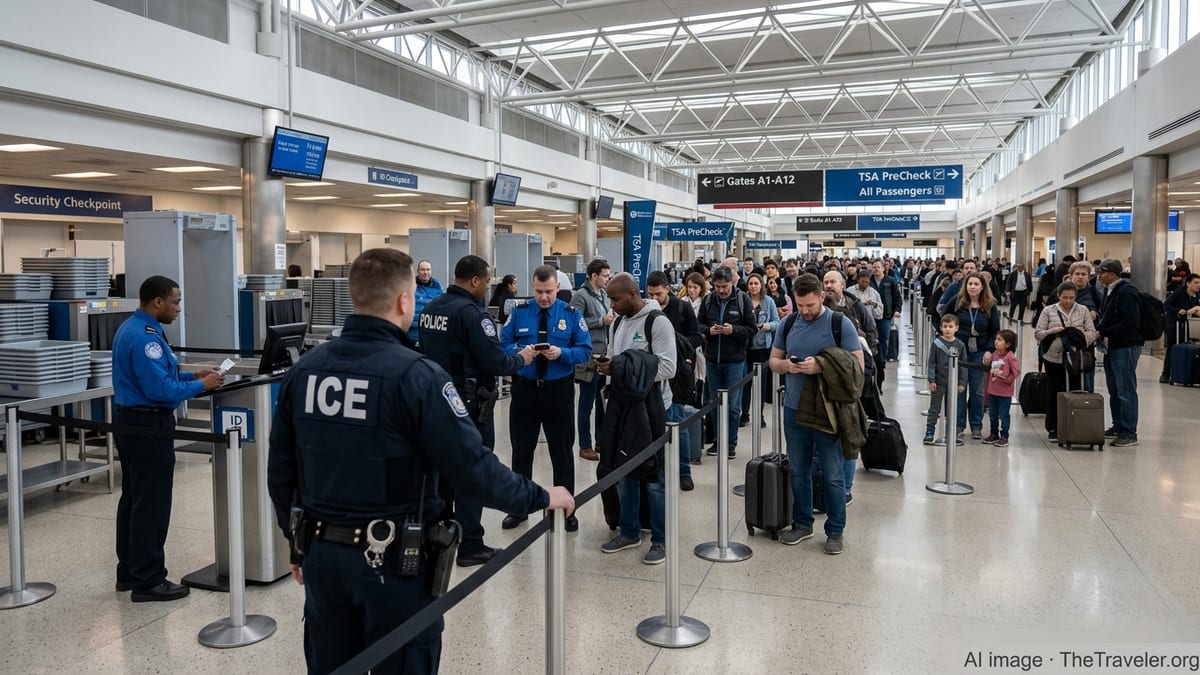
ICE and Homeland Security Move From Border Posts to Terminals
According to recent coverage of the ongoing Department of Homeland Security funding lapse that began on February 14, 2026, the Biden administration’s successor has authorized Immigration and Customs Enforcement officers and other Homeland Security staff to be reassigned from immigration and border duties to major airports. The stated intent is to support strained TSA operations rather than replace airport screeners.
Reports indicate that ICE officers started appearing at airports around the country the week of March 23, including at New York’s John F. Kennedy International Airport and LaGuardia Airport. Similar deployments have been noted at airports in Arizona, Ohio, New Jersey, Texas, Florida and Pennsylvania, creating a visible new federal law enforcement presence near security lanes and boarding areas.
Publicly available information shows that these officers are not certified checkpoint screeners and are not conducting primary passenger or baggage screening. Instead, they are being positioned near identification checks, security queues and choke points where their presence could, in theory, free up TSA staff for frontline screening tasks.
The shift highlights the extraordinary pressures facing Homeland Security during the prolonged shutdown, with one branch of the department, TSA, operating with shrinking paid staff, while another, ICE, is being asked to fill operational gaps at some of the nation’s busiest travel hubs.
TSA Shortages Trigger Hours Long Delays Nationwide
The redeployment of ICE and other Homeland Security officers comes after weeks of mounting travel disruption attributed to the DHS shutdown. TSA employees have been working without pay since mid February, and a growing number have resigned, transferred or called out from scheduled shifts, leaving fewer screeners available just as spring break travel builds.
Airports from Houston Hobby and George Bush Intercontinental to New York’s JFK, New Orleans and New Haven have reported security lines stretching to two or three hours at peak times. Some terminals have urged passengers to arrive four to five hours before departure, and in a few cases checkpoints have been consolidated or temporarily closed due to insufficient staffing.
Industry analyses note that TSA had already been under strain before the shutdown, with rising passenger volumes after the pandemic era and difficulty retaining workers amid lower pay compared with other security jobs. The pay interruption has intensified those challenges, accelerating attrition and making it harder to maintain full staffing at every lane.
Travel advocates warn that prolonged staffing gaps can ripple across the air system. Lengthy screening lines lead to missed flights, aircraft departing with empty seats, knock on delays for later departures and added stress for travelers and airport employees alike.
What ICE Officers Are Expected to Do at Airports
Coverage by national outlets and aviation focused publications indicates that ICE personnel are being directed to assist TSA in limited, noncertified capacities. That typically includes crowd management near queues, monitoring entrances to secure areas, verifying documents under TSA supervision and handling some secondary support tasks away from X ray machines and body scanners.
Guidance summarized in public reporting explains that checkpoint screening jobs require specific qualifications and recurring certifications that ICE officers do not hold. As a result, they cannot legally make final security screening decisions or operate some types of equipment without additional training and authorization.
In New York and other large markets, eyewitness accounts described ICE officers standing near TSA identification podiums and at the periphery of checkpoints, while TSA officers continued to operate scanners and conduct pat downs. Similar arrangements have been described at airports in Texas and Florida, where passenger volumes are especially heavy during spring travel season.
Aviation analysts suggest that the most immediate operational value of the deployments may be indirect, by enabling TSA to reassign some of its own staff from lower priority support tasks back onto front line screening lanes. However, early reports from some hubs say the improvements in wait times have been modest so far, given the depth of the underlying staffing shortfall.
Patchwork Responses Across States and Airports
While New York’s major airports are welcoming additional Homeland Security personnel, other states have pursued different strategies to address TSA shortages. Several Florida airports, including those that joined the federal Screening Partnership Program in prior years, rely on private screening contractors that are funded and overseen by TSA but staffed by nonfederal employees. Those locations have reported somewhat shorter lines than comparable airports using only federal screeners.
In states such as Arizona, Ohio, New Jersey and Texas, responses have varied by airport. Larger hubs have leaned on overtime, temporary reassignments and the new ICE deployments, while some smaller or mid sized facilities have consolidated security checkpoints to concentrate limited staff. Local officials in a number of cities have encouraged travelers to enroll in trusted traveler programs like TSA PreCheck and Global Entry, which remain in operation, to ease congestion in standard lanes.
The result is a patchwork of passenger experiences. At one airport within a state, waits might still average under 30 minutes, while another facility a short flight away advises travelers to budget several hours for screening. For airlines and passengers planning multi leg itineraries, this variability complicates connections and increases the risk of misaligned schedules.
Observers also note that not every airport has received ICE or broader Homeland Security reinforcements. Some facilities reported no change in staffing beyond the local TSA workforce, either because they have not requested additional help or because DHS has prioritized larger, more congested nodes in the national network.
Travelers Adjust as Policy Debate Continues
As federal agencies juggle personnel between border posts and boarding gates, travelers are adapting in real time. Social media posts and travel forums in the second half of March have been filled with advice on arriving earlier than usual, packing more efficiently for screening and monitoring airport specific updates on checkpoint wait times before heading to the terminal.
Airlines have responded by issuing more frequent alerts urging early arrival and, in some cases, offering flexible rebooking or waivers when airport delays make it impossible for passengers to reach their flights on time. Travel insurers and passenger rights groups are drawing attention to contract terms that define when long lines or missed connections may qualify for assistance or compensation.
At the policy level, the use of ICE and other Homeland Security staff in airports has drawn scrutiny from lawmakers and civil liberties organizations. Some argue that the deployments blur the line between immigration enforcement and aviation security, while others maintain that the extraordinary pressures on the system justify temporary, tightly circumscribed support roles.
For now, New York’s participation in the broader deployment effort underscores how far reaching the TSA staffing crisis has become. With the DHS shutdown still unresolved as of late March, travelers across Arizona, Ohio, New Jersey, Texas, Florida and beyond are likely to continue encountering both longer waits and a more complex mix of federal uniforms at checkpoints as spring travel season unfolds.