

More news on this day
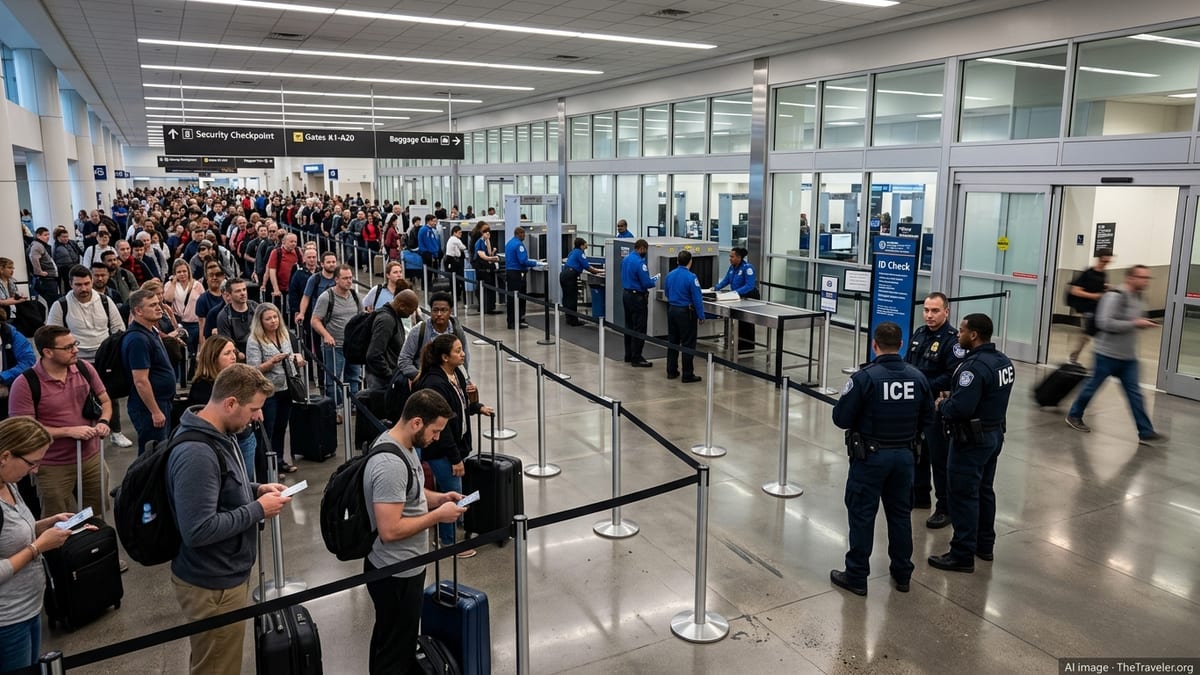
Airports across the United States are confronting a new layer of turmoil as Immigration and Customs Enforcement agents arrive at security checkpoints to backfill unpaid Transportation Security Administration staff during the latest partial government shutdown, stoking confusion among travelers and intensifying a legal and political fight over civil liberties in the air travel system.
Get the latest news straight to your inbox!
Shutdown Fallout Pushes TSA To Breaking Point
The current government funding lapse, which has forced most TSA officers to work without pay, is rippling through some of the nation’s busiest hubs. Reports from major outlets describe hourslong security lines in cities including Atlanta, Houston and Phoenix, with some airlines urging passengers to arrive four to five hours before departure to avoid missing flights. Unpredictable wait times have become a defining feature of this shutdown, as staffing levels fluctuate daily and local airport operations scramble to adjust.
Publicly available information shows that this is not the first time air travel has been tested by a funding crisis, but the present disruption is notable for its duration and intensity. News coverage indicates that multiple shutdowns in recent years have eroded morale among front-line screeners, many of whom already contend with low pay and high stress. Union statements and recent reporting point to growing numbers of resignations and sick calls, leaving checkpoints even thinner at a moment of elevated demand for air travel.
Industry groups and travel advisers have warned that these conditions are undermining confidence in the reliability of the U.S. aviation system. Guidance circulated to travel agents during the shutdown urges clients to build in substantial extra time, consider lounge access to cope with delays, and understand that even trusted traveler programs may not insulate them from the knock-on effects of staffing shortfalls. For many passengers, routine domestic trips now involve contingency planning more typical of extreme weather events.
ICE Agents Step Into Airport Security Vacuum
Against this backdrop, the White House and the Department of Homeland Security have turned to Immigration and Customs Enforcement to shore up airport operations. According to published coverage from national and local outlets, ICE officers are being deployed to several large airports, including Hartsfield-Jackson Atlanta International Airport, Phoenix Sky Harbor International Airport and Pittsburgh International Airport, with additional locations expected as delays mount. Local officials describe the deployment as focused on line management, crowd control and other support tasks designed to free TSA specialists for baggage screening and checkpoint duties.
Reports underscore that ICE personnel are not certified in aviation security, and current plans circulated in media accounts indicate that they are not expected to perform core screening work such as operating X-ray machines or conducting advanced explosives detection. Instead, the agents are positioned near checkpoint queues, exit lanes and identification checkpoints, often in coordination with airport police and TSA supervisors. The stated goal, as reflected in public statements from federal and local leaders, is to stabilize passenger throughput without compromising formal security protocols.
The sight of ICE uniforms inside domestic terminals, however, is transforming the atmosphere of many airports. Travel forums and social media posts collected by news organizations describe heightened anxiety among passengers who worry that a routine trip could become an immigration encounter. Civil rights advocates quoted in recent coverage argue that even if ICE agents are formally constrained to non-screening roles, their enforcement mandate follows them into the terminal and may effectively chill the willingness of some communities to fly.
Legal Fault Lines Around Traveler Rights
The sudden overlap between immigration enforcement and aviation security is sharpening longstanding legal questions about traveler rights in airports. Legal analysts cited in national coverage note that while TSA’s mission is focused on transportation security, ICE officers are tasked with enforcing immigration and customs laws, including the power to detain individuals and initiate removal proceedings. When those roles converge at a checkpoint, it becomes harder for passengers to distinguish between routine security screening and potential immigration enforcement.
Constitutional advocates have raised concerns that individuals, particularly noncitizens and dual nationals, may feel compelled to answer questions or present documents that go beyond what is normally required to clear TSA. Commentaries in legal publications point out that airport encounters occupy an uneasy space in Fourth Amendment jurisprudence, where courts have granted wider latitude for searches tied to aviation safety. The involvement of ICE, they argue, risks blurring that safety rationale with broader law enforcement objectives.
Several immigrant rights organizations and civil liberties groups have begun circulating updated know-your-rights materials specific to air travel during the shutdown. These public resources emphasize that passengers typically must comply with TSA screening to board a flight, but may have more discretion about engaging with other federal officers once cleared through security, depending on the circumstances. Advocates also stress the importance of documenting interactions and seeking legal counsel if an encounter at the airport appears to shift from security screening to immigration questioning.
Labor Unions Warn of New Security Risks
The largest federal workers union representing TSA officers has publicly criticized the ICE deployment, arguing that substituting untrained personnel into airport operations introduces new vulnerabilities rather than resolving existing ones. Statements highlighted in recent news coverage stress that TSA screeners undergo months of specialized instruction in detecting weapons, explosives and other threats engineered to evade checkpoint technology, along with ongoing recertification and covert testing. By contrast, union leaders say, ICE agents are trained primarily for field enforcement, not aviation-specific risk assessment.
Analysts following transportation security policy have echoed these concerns, noting that the U.S. aviation system was deliberately restructured after the September 11 attacks to centralize security functions under a single agency with standardized training and oversight. Introducing a second federal law enforcement body into that environment, they contend, could complicate chains of command and dilute the clear lines of accountability that current regulations are designed to preserve. A recent inspector general report on coordination among DHS components also pointed to gaps in interagency risk assessment related to travel, underscoring the stakes of improvised arrangements.
Union representatives further warn that reliance on ICE as a stopgap may delay more sustainable solutions to chronic understaffing at TSA, such as improved pay scales, hiring incentives and stable funding. By framing the crisis as a problem that can be addressed with temporary personnel shifts, critics argue, policymakers risk normalizing emergency measures that were never contemplated when the post-9/11 security architecture was created.
Travelers Navigate Uncertainty at the Checkpoint
For passengers moving through affected airports, the practical challenge remains basic: getting to the gate on time while navigating an increasingly confusing security landscape. Travel advisories compiled by industry groups and consumer publications now routinely recommend arriving hours earlier than usual, monitoring airport and airline alerts closely, and preparing for rapid changes in wait times from one day to the next. Some travelers with flexibility are rebooking flights through less congested hubs or shifting to off-peak departure times in the hope of shorter lines.
At the same time, legal and advocacy organizations are urging travelers, especially noncitizens and mixed-status families, to educate themselves about what to expect when encountering different types of federal personnel in terminals. Guidance distributed online encourages individuals to remain calm, verify which agency an officer represents, and distinguish between required TSA screening procedures and additional questioning that may be optional. Passengers are also advised to keep travel documents organized and consider consulting an attorney before international trips if they have unresolved immigration issues.
With no immediate resolution to the shutdown in sight, the convergence of TSA staffing shortages, ICE deployments and mounting traveler frustration is likely to remain a defining feature of U.S. air travel in the near term. How policymakers ultimately redraw the lines between aviation security and immigration enforcement may shape not only the airport experience, but broader public trust in the safety and fairness of the nation’s transportation system.