

More news on this day
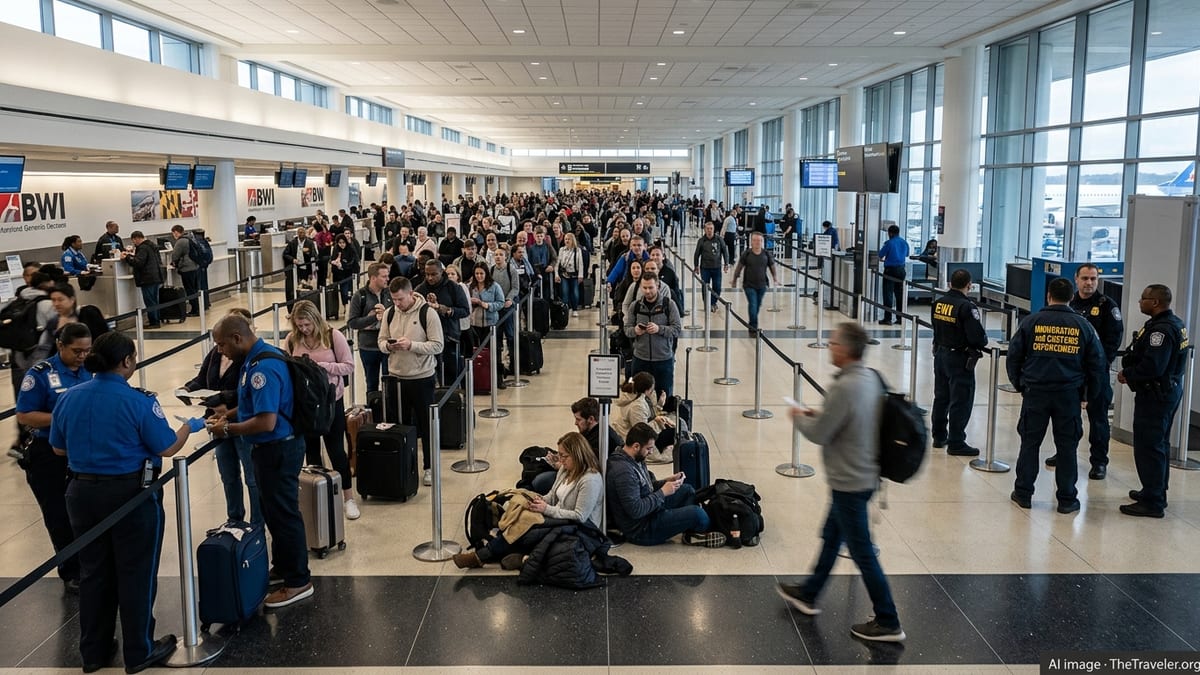
Travelers at Baltimore/Washington International Thurgood Marshall Airport are facing hourslong security lines and widespread delays as a partial Homeland Security shutdown ripples through the region and federal immigration agents begin appearing at major U.S. airports to support strained screening operations.
Get the latest news straight to your inbox!
Shutdown Fallout Converges With Peak Spring Travel
The latest wave of disruption at BWI is unfolding against the backdrop of an extended funding standoff in Washington that has left significant portions of the Department of Homeland Security operating without a full budget. Transportation Security Administration workers have continued to report for duty, but many are working without pay, contributing to increased sick calls, low morale and reduced staffing at checkpoints.
Published coverage indicates that travel delays have been building for days at major hubs across the country, with federal statistics and airline data showing elevated rates of late departures and missed connections. BWI, a key gateway for low-cost carriers and domestic connections along the East Coast, has been particularly hard hit, with wait times stretching well beyond the usual peak-period surges. Passengers have reported arriving more than three hours before departure and still risking missed flights as security lines snake through the terminal concourses.
The pressure has coincided with heavy spring-break demand and recent disruptive weather across parts of the United States. While flight operations at BWI have largely continued, the combination of full planes, ground delays elsewhere in the network and slower security processing has created a fragile system in which even small interruptions can cascade into widespread disruption for travelers.
ICE Agents Shifted Into Support Roles At Airports
As the shutdown has dragged on, publicly available information shows the federal government turning to Immigration and Customs Enforcement officers to reinforce TSA at a growing list of airports. Reports over the past week describe ICE personnel deployed in support roles at major hubs including airports in the Washington region, New York and Atlanta. The assignments focus on tasks such as guarding exit lanes, monitoring secure doors and assisting with identification checks, rather than conducting traditional immigration enforcement at checkpoints.
Homeland Security officials have presented the move as a practical response to staffing gaps, noting that ICE officers already hold federal law enforcement credentials and routinely work in and around transportation facilities. However, ICE officers do not receive the same specialized training as TSA screeners, and they are not certified to operate checkpoint scanning equipment or carry out routine baggage inspections. Their presence is therefore geared toward freeing up trained TSA personnel for front-line screening rather than replacing them.
Published analysis has raised questions about how much relief this strategy can realistically provide. Even with ICE support, checkpoint throughput ultimately depends on the number of trained screeners on duty, the availability of inspection lanes and the configuration of each terminal. At BWI, where security checkpoints feed multiple concourses and rely on carefully choreographed staffing patterns, incremental help from ICE agents may alleviate some pressure but is unlikely to eliminate long lines during the busiest periods.
Traveler Anxiety Rises As Enforcement Optics Change
The arrival of ICE officers at airports has added a new layer of tension for some travelers already frustrated by delays and uncertainty. Advocacy groups and civil-liberties organizations have expressed concern in recent days that increased visibility of immigration enforcement personnel in civilian travel spaces could deter some passengers from flying or visiting family, especially those from mixed-status households or communities with strained relationships with federal immigration agencies.
According to recent reporting, federal agencies have emphasized that ICE officers assigned to airport support are expected to concentrate on non-enforcement duties tied to security operations, with no broad mandate to increase immigration checks on ordinary travelers moving through TSA lines. Even so, images of uniformed ICE personnel near security checkpoints have circulated widely on social media, fueling debate over whether the move blurs the line between aviation security and immigration enforcement.
At BWI, a diverse mix of domestic and international travelers typically pass through the terminal, including students, temporary workers and visitors connecting through the region. Travel forums and community discussions in Maryland in recent days reflect both practical concerns about missed flights and deeper unease about how a visible ICE presence could affect traveler behavior. Some passengers say they are adjusting plans by carrying passports even on domestic routes, budgeting extra time to navigate security and, in some cases, considering alternative airports until the situation stabilizes.
Operational Strain And Uneven Recovery Across The Region
Regional coverage indicates that BWI is contending with more acute delays than some neighboring airports as the shutdown and staffing crunch continue. Washington-area airports have experienced a mix of intermittent ground stops and localized staffing issues, but in several cases security lines and wait times have recovered more quickly than at BWI. This uneven picture has prompted some Maryland travelers to reroute through Dulles International or Ronald Reagan Washington National when possible, seeking shorter waits even if that means longer drives or higher fares.
Aviation analysts note that BWI’s role as a major base for high-frequency domestic carriers can magnify the impact of even modest slowdowns in security processing. Rapid aircraft turnarounds, tight connection windows and densely scheduled banked departures mean that delays at early-morning checkpoints can ripple throughout the day, compressing available capacity and complicating efforts to rebook disrupted passengers.
Flight data and anecdotal accounts suggest that while some of the most extreme lines may ebb during off-peak hours, irregular operations are likely to persist as long as TSA staffing remains constrained and broader Homeland Security funding questions are unresolved. Airlines have begun issuing more proactive advisories for BWI departures, urging customers to arrive significantly earlier than usual and to make use of mobile check-in and carry-on baggage whenever possible.
What Passengers Through BWI Should Expect Now
For travelers planning to pass through BWI in the coming days, publicly available information from airlines, airport officials and passenger accounts points to a challenging but navigable environment. Security lines during morning and late-afternoon peaks may extend well beyond checkpoint entrances, and posted wait times can fluctuate rapidly as additional lanes open or close. Even passengers with PreCheck or other expedited screening programs have reported longer-than-normal waits when staffing is stretched.
Industry guidance suggests allowing considerably more time than usual to reach departure gates, particularly for those checking bags or traveling with young children. Passengers are also encouraged to monitor their flight status frequently and to be prepared for gate changes or last-minute schedule adjustments as airlines work around staffing constraints. For connections involving BWI, longer layovers may reduce the risk of misconnecting when inbound flights are delayed by security bottlenecks at origin airports.
As the Homeland Security budget dispute continues and ICE deployments expand to additional airports, the situation at BWI is expected to remain fluid. While the presence of immigration officers may provide some operational relief for TSA, the combined effect of political uncertainty, labor strain and heightened public scrutiny is likely to keep the airport in a period of elevated disruption. For now, patience, extra time and close attention to airline communications appear to be the most practical tools available to travelers navigating BWI’s terminals.