

More news on this day
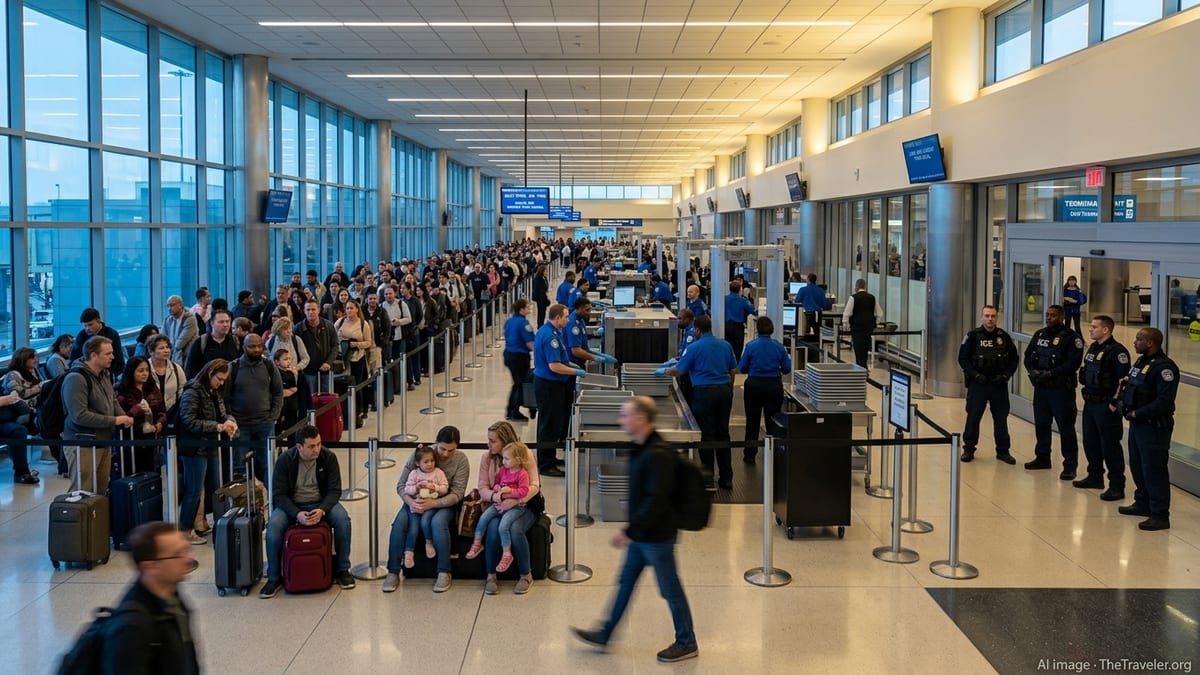
Armed Immigration and Customs Enforcement officers are stepping into the nation’s airport security queues as a partial Department of Homeland Security shutdown pushes Transportation Security Administration staffing to a breaking point, creating a visibly tense new layer in the already fraught experience of flying in the United States.
Get the latest news straight to your inbox!
A Shutdown That Lands in the Security Line
The latest government funding lapse for the Department of Homeland Security has moved from congressional gridlock into everyday travel, with impacts now measured in hours-long waits at airport checkpoints. Publicly available information shows that TSA officers have been working without pay for weeks, and attrition and sick calls are rising, particularly at busy hubs such as Atlanta, Houston and New York.
Reports from national outlets indicate that some checkpoints at Hartsfield-Jackson Atlanta International Airport and other major hubs saw wait times stretching well beyond two hours over the weekend, with early-morning peaks spilling down terminal corridors. Travelers have posted images of snaking lines, closed lanes and “expect delays” signage as the shutdown drags on.
According to widely circulated coverage of the Homeland Security funding standoff, TSA is among the components required to keep core operations running despite the lapse, but without paychecks morale has steadily eroded. DHS data summarized in recent reporting points to hundreds of screeners quitting since the shutdown began and callout rates surging at some locations, leaving managers scrambling to keep security lanes staffed.
It is against this backdrop that the administration has turned to Immigration and Customs Enforcement, one of the few Homeland Security branches that remains fully funded under a separate spending law, to plug visible gaps on the front lines of airport security.
ICE in the Blue Lanes: What Is Actually Changing
Published accounts from the Associated Press and other outlets describe ICE personnel in tactical gear moving through terminals at major airports including Atlanta, Phoenix, Pittsburgh and New York on March 23. Photos show officers posted near TSA checkpoints, at the ends of security lines and by exit lanes, rather than directly operating X-ray machines or pat-down stations.
Statements from senior administration figures over the weekend, summarized in national news coverage, emphasize that ICE officers are not being assigned to specialized screening tasks such as reading X-ray scans or conducting advanced explosives checks. Instead, the officers are described as taking on perimeter roles: guarding secured doors, monitoring queue flow, checking boarding documents at chokepoints and freeing up certified TSA screeners to focus on aviation-specific security duties.
Union leaders representing TSA workers, quoted in multiple public statements, argue that the presence of armed immigration officers at security lines may do little to address the core problem of too few trained screeners on duty. They stress that TSA officers undergo months of targeted training in aviation threats and must pass recurring tests and certifications that ICE personnel do not hold.
Airport authorities in several cities have issued their own public-facing updates describing the ICE deployment as supplementary and time-limited. At some airports, local officials report that port authority staff and airport police are also being shifted into non-screening roles, creating a patchwork of security personnel around the federally operated checkpoints.
Traveler Experience: Longer Lines and a Heavier Atmosphere
For travelers, the most immediate impact has been a combination of longer waits and a markedly heavier security atmosphere. Passenger accounts shared with news organizations and across social platforms describe pre-dawn lines curling through ticketing halls, with TSA officers working overtime and ICE agents standing watch in ballistic vests nearby.
Published coverage from outlets tracking aviation operations notes that the deployment has not yet produced a clear, systemwide reduction in wait times. In Atlanta, Phoenix and Houston, early data and on-the-ground reports still point to peak delays of 90 minutes or more at standard screening lanes, with slightly shorter waits for PreCheck where those lanes remain fully staffed.
Some airports, including Seattle-Tacoma and Sacramento, have released public statements indicating they do not expect ICE personnel to perform TSA roles and that wait times remain near normal. That divergence has created a patchwork map for domestic travelers: relatively routine screening at some mid-sized facilities, and shutdown-driven gridlock at the nation’s busiest hubs.
Travel industry analysts quoted in recent coverage recommend that passengers build in substantially more buffer time, especially when connecting through major hubs where ICE has been visibly deployed. Airlines are publicly advising customers to arrive earlier than usual and to watch for day-of-travel alerts as checkpoint conditions can shift within hours.
Security, Civil Liberties and the Blurring of Missions
The decision to insert ICE into the airport security environment is prompting a wider debate over the role of immigration enforcement in domestic travel spaces. Advocacy groups and legal commentators, drawing on the agency’s recent track record of aggressive operations in cities such as Minneapolis and Chicago, warn that putting ICE in close proximity to travelers may chill lawful movement and heighten anxiety for immigrant communities.
Policy experts cited in explanatory reporting point out that TSA and ICE were designed with distinct missions: one focused narrowly on transportation security, the other on immigration enforcement and interior arrests. Blurring these lines at the checkpoint, critics argue, risks turning routine air travel into a de facto enforcement arena, particularly if officers begin to request identification or immigration status beyond what is required for boarding.
At the same time, supporters of the move highlighted in several opinion pieces contend that ICE officers bring transferable skills in crowd control, document inspection and threat response that can enhance overall security in a period of unusual strain. They argue that utilizing a funded DHS component to stabilize another, at least temporarily, is preferable to allowing critical chokepoints like airport checkpoints to buckle.
For now, publicly available information suggests that ICE activities at airports are formally limited to supporting roles. However, civil liberties organizations are closely monitoring reports from affected airports, and any shift toward active immigration checks in the secure area could trigger fresh legal challenges and travel disruptions.
What Travelers Should Expect in the Days Ahead
With Congress still deadlocked over Homeland Security funding as of March 24, there is little indication that TSA’s staffing and pay issues will be resolved in the immediate term. News outlets tracking the negotiations report that lawmakers have discussed various short-term fixes, but none have yet cleared both chambers in a way that would restore normal pay and operations for TSA workers.
Airports and airlines are adjusting in real time. Some are consolidating checkpoints during off-peak periods to concentrate limited TSA personnel, while others are temporarily closing less-used lanes to maintain throughput at primary security entrances. ICE deployments may expand or contract based on shifting demand, leaving different airports with different mixes of blue-uniformed TSA officers, ICE tactical teams and local police visible in the same space.
For travelers planning domestic trips, the emerging pattern suggests arriving significantly earlier than pre-shutdown norms, favoring mid-day flights where possible, and being prepared for a more conspicuous federal presence in and around security lines. Families traveling with children, passengers with disabilities and those connecting through the largest hubs may face particular challenges as the shutdown’s effects ripple through the system.
How long the blue lines remain blurred will depend less on airport managers or ICE field offices than on negotiations in Washington. Until a new Homeland Security funding agreement is reached and TSA’s workforce is stabilized, the country’s airport checkpoints will remain the most visible front line of a political standoff that began far from the departure board.