

More news on this day
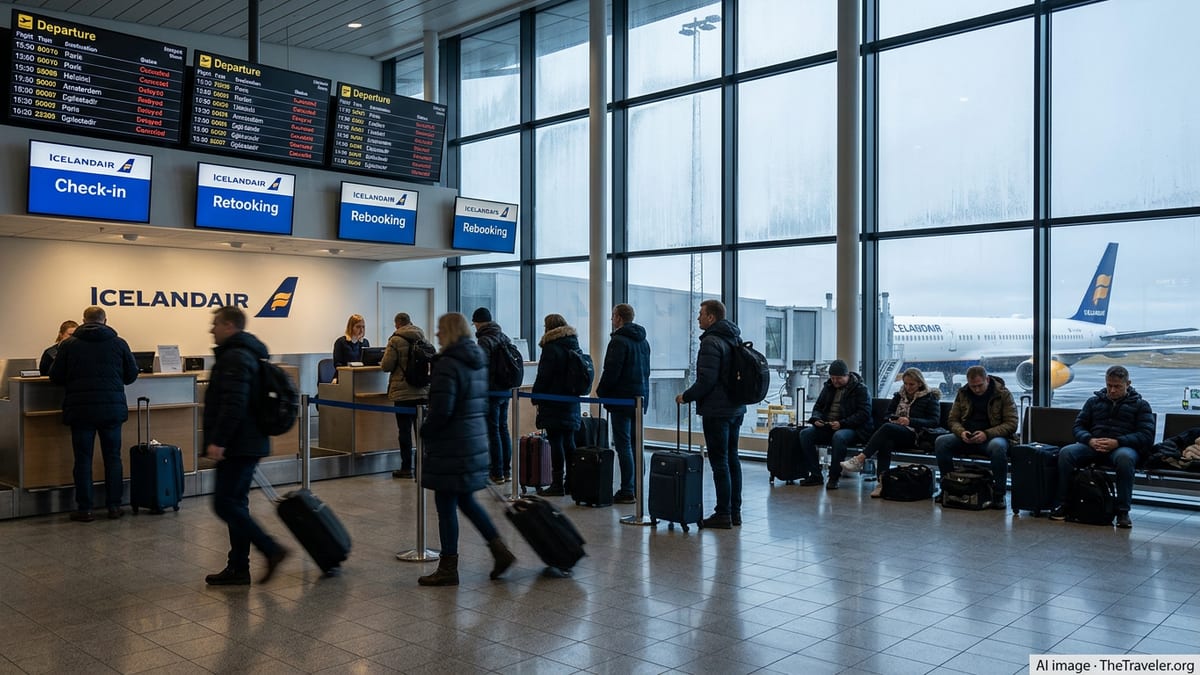
Hundreds of passengers traveling through Iceland on Friday faced unexpected disruption after seven Icelandair and Air Iceland Connect flights were canceled, affecting international routes to Paris, Helsinki and Amsterdam, as well as vital domestic and regional links including Egilsstadir.
Get the latest news straight to your inbox!
Network Disruption Hits Keflavik and Domestic Links
The cancellations, announced over the course of the morning, rippled through Iceland’s tightly timed hub at Keflavik International Airport, where many travelers from North America and Europe connect on same-day itineraries. With several departures removed from the schedule, knock-on delays and missed connections quickly mounted, according to operational data and passenger reports.
Among the affected services were departures to Paris Charles de Gaulle, Helsinki and Amsterdam, three of Icelandair’s most important European gateways. At the same time, at least one Air Iceland Connect-operated service to Egilsstadir in East Iceland was grounded, reducing capacity on a route that functions as a lifeline for residents and visitors heading into the country’s remote eastern fjords.
Airline staff at Keflavik worked to consolidate passengers onto later flights and reroute others via alternative European hubs. However, with winter schedules already relatively tight and many services operating near capacity, options for same-day rebooking were limited for a portion of affected travelers.
The disruption underscored the vulnerability of Iceland’s hub-and-spoke model, in which a small number of daily flights are timed to feed short connection windows. When several of those flights are canceled in quick succession, the result can be a cascade of missed onward connections both within Iceland and across the wider transatlantic network.
Passengers Report Long Queues, Unclear Information
At Keflavik, passengers described long queues at service desks and difficulty getting real-time information on revised departure times or hotel arrangements. Some travelers reported receiving initial cancellation notices via airline apps or text messages before gate staff made any public announcements in the terminal.
For passengers booked onward to Paris, Helsinki and Amsterdam, the lost flights meant rebookings that, in some cases, extended journeys by 12 hours or more. Travelers facing tight schedules for cruises, tours or work commitments reported scrambling to rearrange plans and notify hotels, tour operators and ground transport providers.
Domestic and regional passengers also felt the impact. Those heading to Egilsstadir and other Icelandic destinations from overseas often rely on a single daily connection to make the journey in one travel day. When that link disappears, the only alternative may be an overnight stay near Keflavik or in Reykjavik, followed by a morning departure on the next available flight.
Some travelers shared their frustration about unclear guidance on accommodation and meal vouchers, saying they were passed between desks or advised to “keep receipts” with the promise of later reimbursement. Others noted that phone hotlines and chat services were quickly overwhelmed, leaving airport counters as the only practical way to make new arrangements.
Airlines Cite Operational Pressures as Investigation Continues
Icelandair and Air Iceland Connect did not immediately provide a detailed breakdown of the causes behind each cancellation but pointed to a combination of operational pressures, including weather-related constraints, crew rostering issues and aircraft rotation challenges common in the late winter period.
Industry analysts note that even small schedule disruptions can be amplified in Iceland, where the national carrier operates a relatively lean fleet across long-haul, European and domestic sectors. When one aircraft or crew pairing is taken out of rotation, the airline has less spare capacity than larger continental carriers to step in and backfill missing flights.
Aviation observers also highlighted the extra sensitivity of links to destinations such as Paris, Helsinki and Amsterdam, which not only serve as key markets in their own right but also function as transfer points into the wider European rail and air network. Losing a single daily Iceland connection can therefore impact a much larger web of onward journeys.
Regulatory authorities are expected to review the cancellations in the context of passenger rights rules that apply to carriers operating from Iceland and the broader European Economic Area. Depending on the precise cause of each cancellation, travelers may be eligible for fixed compensation payments in addition to refunds or re-routed travel.
What Stranded Travelers Are Being Offered
For those stranded at Keflavik or unable to depart regional airports, airline agents have been offering a mix of rebooked itineraries, hotel vouchers and meal support where required. Travelers on canceled services to Paris, Helsinki and Amsterdam were generally rebooked onto later Icelandair flights or, when necessary, placed on other European carriers connecting through alternative hubs.
Domestic and regional passengers affected by the grounded Egilsstadir service reported being moved onto the next available flight, although limited frequency on the route meant that some would arrive at their final destination a full day later than planned. In a handful of cases, passengers chose to cancel their trip entirely and accept refunds, particularly when the disruption undermined short weekend stays.
Airline agents at the airport advised travelers to retain boarding passes, booking confirmations and all receipts for extra expenses incurred as a result of the disruption. These documents are typically required for any later compensation claims or reimbursement of hotels, meals and ground transport.
Travel insurance providers are also bracing for a spike in claims from policyholders whose trips were curtailed or significantly delayed. Many comprehensive policies cover missed connections and additional accommodation costs, though coverage varies widely and is often contingent on travelers demonstrating that they first sought assistance and remedies directly from the airline.
Broader Questions for Iceland’s Role as a Transit Hub
The latest wave of cancellations comes as Iceland seeks to cement its position as a strategic stopover point between North America and Europe. Icelandair’s network through Keflavik links dozens of cities on both sides of the Atlantic, while Air Iceland Connect’s regional services provide essential access to smaller communities across Iceland and neighboring regions.
Repeated episodes of disruption, however, risk eroding confidence among travelers who select Iceland itineraries precisely because of their convenience and competitive pricing. Tour operators and travel agents said they would be closely watching how quickly the carriers stabilize operations and process any compensation before the busy late-spring and summer holiday seasons.
For Iceland itself, the reliability of air links is more than a matter of tourist convenience. Routes to places like Egilsstadir support local economies in smaller towns that depend on a steady flow of visitors for hotels, restaurants and tour providers. Interruptions to those services can have outsized effects compared with similar cancellations in larger European markets.
While the seven cancellations represent a relatively small fraction of daily flights in and out of Iceland, their impact on individual itineraries has been significant. As operations normalize, attention will turn to whether the airlines introduce additional resilience into their schedules or contingency plans to prevent a similar chain reaction the next time several flights are grounded on the same day.