

More news on this day
Passengers traveling to and from Iceland this week faced mounting disruption after Icelandair and its regional partner Air Iceland Connect cancelled seven flights, hitting popular routes to Paris, Helsinki, Amsterdam, Egilsstadir and other key destinations.
Get the latest news straight to your inbox!
Chain of Cancellations Hits International and Domestic Network
The wave of disruption unfolded over several days, as operational problems led Icelandair to cancel multiple international departures from Keflavik International Airport, including services to Paris Charles de Gaulle, Helsinki-Vantaa and Amsterdam Schiphol. At the same time, Air Iceland Connect grounded a series of domestic and regional flights, including links between Reykjavik and Egilsstadir in eastern Iceland.
In total, seven flights were cancelled across the two carriers, affecting both outbound and inbound services and leaving passengers scrambling to rebook or reroute. While schedule changes and isolated cancellations are not unusual in the North Atlantic, the concentration of affected routes on a single day and across interconnected services amplified the impact on travelers who depend on Keflavik as a hub.
The disruption comes at a time when Iceland’s flag carrier has been rebuilding capacity on core European routes and promoting Iceland as a stopover destination between North America and the continent. Connections to cities such as Paris, Helsinki and Amsterdam are central to that strategy, making any interruption particularly visible to international passengers.
Although most affected customers were offered rebooking options, some reported limited same day alternatives because many flights were already operating close to capacity, especially on the busy Keflavik to mainland Europe corridors.
Passengers Stranded and Rebooked Across Europe
The cancellations had immediate knock-on effects for connecting passengers, many of whom were using Iceland as a transfer point between North America and Europe. Travelers heading onward to Paris, Helsinki and Amsterdam reported missed connections and overnight stays after their Icelandair flights were pulled from the schedule at short notice.
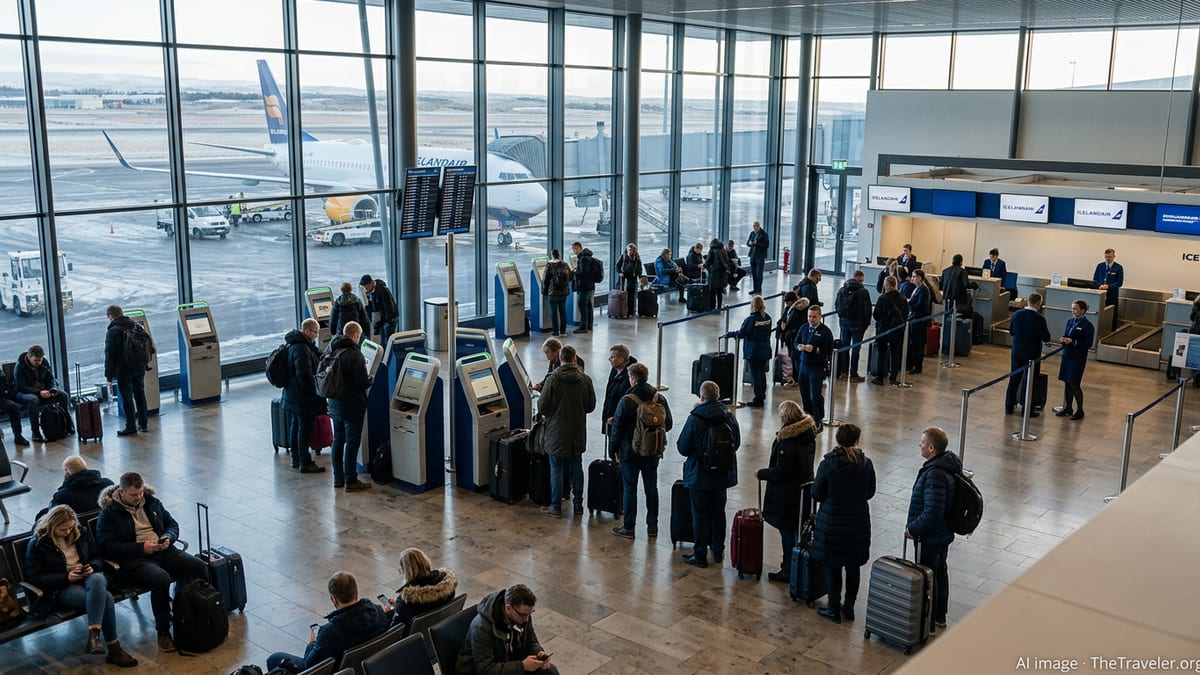
At Keflavik, departure boards showed gaps on routes that typically serve as daily lifelines for tourism and business travel. Passengers described long queues at service desks as airline staff worked to secure seats on later Icelandair flights or to reroute customers via other European hubs, including London and Copenhagen, where possible.
Domestic and regional travelers felt the disruption just as acutely. Air Iceland Connect’s decision to cancel services, including flights on the Reykjavik to Egilsstadir corridor, left some residents and visitors in Iceland’s east with fewer options to reach the capital in time for international departures. For those relying on tight same day connections, even a single missing link in the chain meant plans had to be rebuilt from the ground up.
Social media posts from affected passengers highlighted confusion about whether cancellations were due to crew availability, aircraft rotation problems or broader congestion in European airspace. As of publication, the airlines had acknowledged the cancellations but had not attributed them to a single, clearly defined cause.
Operational Pressures and a Fragile North Atlantic Network
The episode underscores how sensitive Iceland’s air network can be to operational pressures. With Keflavik functioning as the primary international gateway and Reykjavik airport serving domestic routes, disruptions at either end can quickly ripple across the system, particularly when carriers run tight schedules during peak travel periods.
Icelandair has been expanding and adjusting its European network in recent seasons, including increased capacity to major hubs such as Paris, Amsterdam and Helsinki. Those routes are designed to feed a complex web of transatlantic services as well as Iceland’s tourism market. When a single rotation is cancelled, it can remove not only a flight but an entire sequence of onward connections for passengers on multi segment itineraries.
Air Iceland Connect, operating under the Icelandair brand on domestic and regional services, plays a crucial feeder role by linking towns such as Egilsstadir with Reykjavik. Cancellations on these routes do not simply inconvenience local travelers; they can sever access to the global network for residents in remote parts of the country who rely on same day links to reach Europe or North America.
Aviation analysts note that while Iceland’s carriers generally maintain strong on time performance, the combination of variable North Atlantic weather, crew and aircraft positioning, and high load factors can reduce the margin for error. When several factors coincide, a handful of cancellations can quickly escalate into a broader disruption for passengers.
Guidance for Affected Travelers and Future Flyers
For passengers caught up in this latest disruption, the most immediate advice from travel experts is to secure written confirmation of the cancellation from the airline and to keep all receipts for meals, accommodation and alternative transport arranged as a result. This documentation can be critical when seeking reimbursement or compensation later.
Given that Icelandair and Air Iceland Connect flights fall under European air passenger regulations on many routes, eligible travelers may be entitled to assistance, rerouting or fixed sum compensation depending on the length of delay, distance flown and cause of disruption. Passengers are being urged to submit formal claims through the airlines’ customer service channels and to monitor their case status rather than relying solely on initial verbal assurances at the airport.
Looking ahead, regular travelers on Iceland’s routes recommend building extra time into itineraries involving tight connections through Keflavik, especially in winter and during busy holiday periods. Booking longer layovers can help reduce the risk that a single cancellation or delay will cause an entire itinerary to unravel.
Travel agents also suggest that passengers flying to or from regional airports such as Egilsstadir consider flexible tickets or travel insurance that explicitly covers missed connections and schedule changes. As this week’s events have shown, even a small number of cancelled flights can have outsized effects across Iceland’s finely balanced air network.
Airlines Work to Restore Confidence
In the wake of the seven cancellations, both Icelandair and Air Iceland Connect have moved to stabilize schedules and reassure customers that operations are returning to normal. Subsequent departures on core European routes from Keflavik have been operating broadly as planned, and the domestic timetable has been restored on key links within Iceland.
However, industry observers say the incident is a reminder of how quickly passenger perception can shift in a competitive transatlantic market. With travelers increasingly sensitive to disruption and delay, airlines serving Iceland must not only manage their operations carefully but also communicate clearly when problems arise.
For now, tourism officials and airport operators will be watching closely to see whether the cancellations leave any lasting mark on bookings to and from Iceland. With the busy spring and summer travel seasons approaching, the pressure is on carriers to demonstrate that this week’s disruption was an exception rather than a sign of wider instability in Iceland’s vital air links to Europe and beyond.