

More news on this day
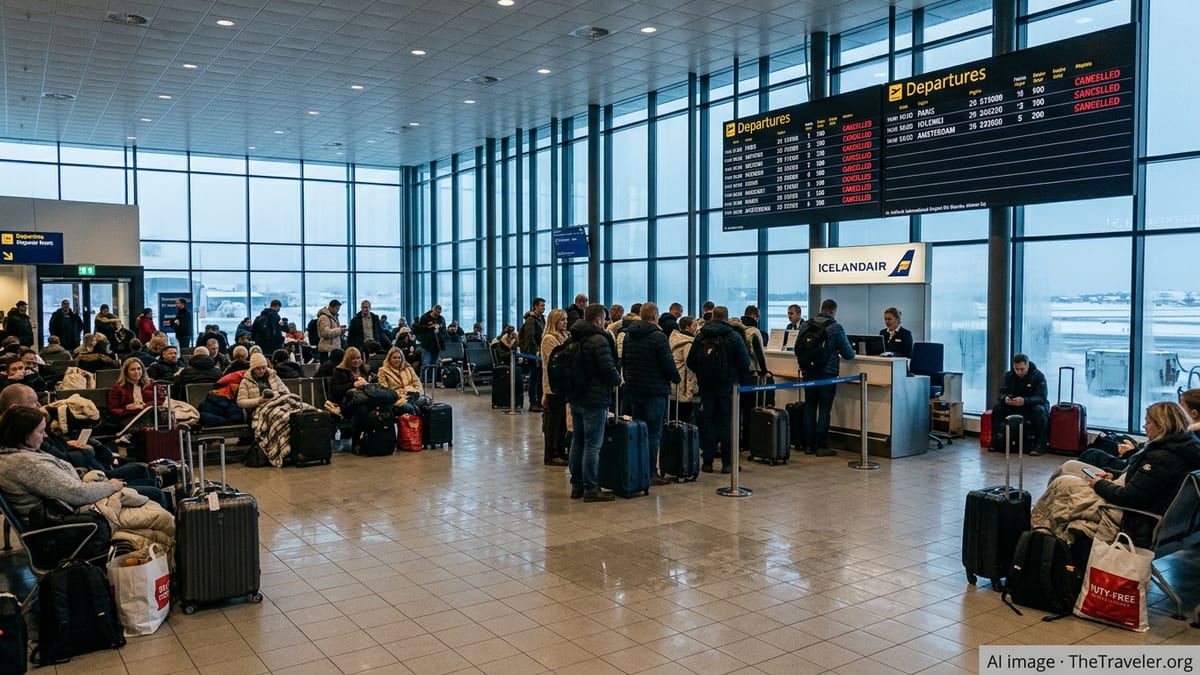
Hundreds of passengers were left sleeping on terminal benches and in hastily arranged hotels near Keflavik International Airport after a cascade of Icelandair cancellations disrupted key European routes, including services to Paris, Helsinki and Amsterdam, throwing travel plans into chaos across the continent.
Get the latest news straight to your inbox!
Sudden Cancellations Hit Key European Connections
The disruption began when at least four major Icelandair departures were cancelled from Keflavik, the airline’s main hub, affecting onward travel to major European gateways. Flights to Paris Charles de Gaulle, Helsinki Vantaa and Amsterdam Schiphol were among those grounded, cutting off connections for passengers traveling between North America and mainland Europe via Iceland.
Travellers described scenes of confusion as departure boards at Keflavik began to fill with red “cancelled” notices while airline agents scrambled to rebook customers on later services or alternative routings. Many passengers had planned tight onward connections from Paris, Helsinki and Amsterdam, only to see entire itineraries collapse with the loss of the Icelandair segments.
The cancellations also disrupted the carefully balanced wave-system that underpins Icelandair’s hub-and-spoke model, in which transatlantic arrivals and European departures are timed within narrow windows. When several flights in the bank fail to depart, knock-on effects can ripple across the network for hours or even days.
While Icelandair has not provided a detailed public breakdown of the cause of each cancellation, the timing coincides with a broader spell of operational strain across European aviation this winter, where a mix of adverse weather, congestion and crew availability issues has led to frequent delays and last-minute schedule changes at major airports.
Passengers Isolated in Iceland as Rebooking Options Shrink
For many stranded travellers, the most immediate challenge has been geographic. Iceland’s location in the North Atlantic means that when flights do not operate as planned, there are limited overland or short-hop alternatives. Once connections through Paris, Helsinki and Amsterdam fell away, passengers found themselves effectively isolated in Iceland until Icelandair or other carriers could free up seats.
Hotels around Keflavik and nearby communities reported a sudden influx of unexpected overnight guests as flights were scrubbed and rebookings pushed departures at least 24 hours later. Some passengers were sent to Reykjavik, roughly 50 kilometres away, after accommodation close to the airport quickly filled. Others resigned themselves to spending the night in the terminal, queuing repeatedly at service desks as new information trickled out.
Travellers with onward cruises, tours and rail journeys from continental Europe were among the hardest hit, facing cascading losses as nonrefundable reservations in France, Finland and the Netherlands became impossible to reach in time. Several passengers described steep last-minute fares on alternative airlines, if any seats were available at all, particularly on popular routes between Amsterdam, Paris and other major hubs.
The sense of isolation was sharpened by the time of year. With winter weather still affecting much of northern Europe, spare capacity across carriers is limited, especially on weekend and holiday-period departures. As a result, some Icelandair customers reported being offered rerouting options two or three days later, well beyond the original travel dates.
Icelandair’s Response and Passenger Care Obligations
Icelandair has said that its priority is to rebook all affected passengers at the earliest opportunity and to honour its obligations for meals, accommodation and transport in the event of significant disruption. The airline’s published policies outline a right to care when flights are cancelled, including food vouchers, hotel stays where necessary and ground transfers between the airport and lodging when same-day departures are no longer possible.
In practice, however, high volumes of disrupted travellers can strain those systems. When many flights are cancelled at once, Icelandair has acknowledged that it is not always able to issue physical vouchers on the spot. In such cases, the carrier instructs passengers to pay out of pocket for meals or hotels and submit receipts through its online claims portal after travel is completed.
Customer advocates note that while this process can work smoothly in routine disruptions, it places a heavier burden on passengers caught up in larger irregular operations, particularly families or budget travellers who may struggle to front unexpected overnight costs. Many of those stranded at Keflavik on the affected day expressed frustration at long waits for information and uncertainty over which expenses would ultimately be reimbursed.
Airport staff and volunteers attempted to bridge some of the gaps, distributing water and snacks inside the terminal and directing travellers to information counters. For those rebooked on early-morning departures, buses were arranged from hotels back to Keflavik in the pre-dawn hours, adding yet another layer of fatigue to already lengthy journeys.
European Ripple Effects on Paris, Helsinki and Amsterdam
The grounding of multiple Icelandair flights from Keflavik has had consequences well beyond Iceland’s shores. Paris Charles de Gaulle, Helsinki Vantaa and Amsterdam Schiphol each serve as major onward hubs, funnelling traffic across Europe, the Middle East and Africa. When feeder flights from Iceland fail to arrive, both inbound and outbound connectivity is reduced, exacerbating congestion already affecting many European airports this winter.
Recent data from air travel analysts has highlighted a pattern of elevated delays and cancellations across Europe in early 2026, including periodic clusters of disrupted flights at Paris, Amsterdam and Helsinki. Against that backdrop, the loss of Icelandair’s services from Keflavik removes an important redundancy for transatlantic travellers who often rely on Iceland as a flexible connecting point between North America and secondary European cities.
The disruption also has implications for carriers that codeshare or interline with Icelandair, as missed connections can strand passengers mid-journey or require complex rerouting through alternative cities. Some travellers reported being shifted from their original itineraries via Iceland onto indirect routings through London, Frankfurt or Scandinavian hubs, adding additional flight segments and hours of travel to already extended trips.
Tourism operators in France, Finland and the Netherlands are monitoring the situation closely, as even short-lived interruptions to air links can affect winter and shoulder-season bookings. Iceland’s role as both a stopover destination and a standalone draw means that instability at Keflavik reverberates through itineraries that combine visits to Iceland with city breaks in Paris, Helsinki, Amsterdam and elsewhere.
Know Your Rights if Your Icelandair Flight Is Cancelled
Under European air passenger protection rules, which also apply to Iceland-based carriers and flights to and from Iceland, travellers whose flights are cancelled may be entitled to assistance, rerouting and, in some circumstances, financial compensation. Eligibility typically depends on factors such as the cause of the disruption, the length of the delay in reaching the final destination and the distance of the journey.
Passengers on the affected Icelandair services from Keflavik are being encouraged to keep careful records of their experiences, including boarding passes, booking confirmations, receipts for meals and accommodation, and any written communication from the airline detailing the reason for cancellation. These documents are often critical when submitting claims either directly to the airline or through third-party passenger rights services.
Travel experts advise stranded passengers to first check their updated itinerary through airline apps or the Icelandair website, then confirm at the airport whether they are entitled to hotel accommodation or food vouchers before making independent arrangements. Travellers with connecting flights booked on separate tickets are particularly urged to contact those carriers as soon as possible, as they may have more limited obligations when disruptions occur earlier in the journey.
As operations at Keflavik gradually stabilise and Icelandair works through the backlog of rebookings, the episode serves as another reminder of how quickly a handful of cancellations at a key hub can leave passengers isolated. For many travellers waking up in unexpected hotel rooms across southwest Iceland, the priority now is simply getting back into the air and on to Paris, Helsinki, Amsterdam and other long-delayed final destinations.