

More news on this day
Hundreds of travelers were left stranded in Iceland over the weekend and into Monday as Icelandair cancelled a series of key transatlantic flights from Keflavik International Airport, including services ICE623, ICE631 and ICE615 to major U.S. hubs such as Newark and Boston.
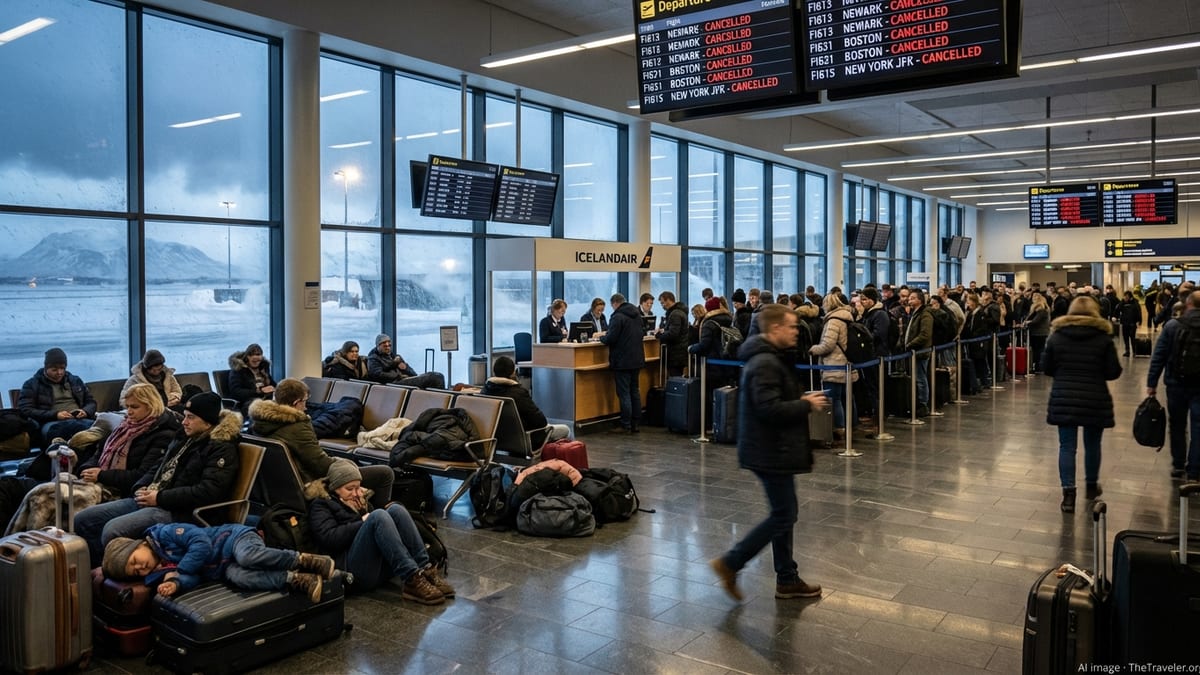
Key Transatlantic Flights Abruptly Cancelled
The disruptions centered on Icelandair’s tightly scheduled transatlantic network linking Reykjavik’s Keflavik International Airport with the northeastern United States. According to airport departure information and schedule data, flight ICE623 to Newark Liberty, ICE631 to Boston Logan and ICE615 serving the New York area were among the services cancelled on Sunday and Monday, cutting vital links just as peak evening departures were due to leave.
On Sunday, passengers bound for Newark on ICE623 and for New York on ICE615 reported sudden cancellations and rebookings as the airline adjusted its operations. By Monday, the pattern had intensified, with Icelandair withdrawing additional departures, including ICE631 to Boston and repeat cancellations of ICE623 and ICE615, effectively grounding several U.S.-bound rotations from its main hub.
The affected flights form part of Icelandair’s core transatlantic bank of departures, designed to funnel travelers from across Europe through Keflavik and onward to North America. Their cancellation not only impacted originating passengers in Iceland but also those who had already completed the first leg of a connecting journey, compounding the disruption.
Weather Chaos in the US Ripples Across the North Atlantic
The wave of cancellations came as a powerful winter storm lashed the northeastern United States, bringing heavy snow, strong winds and poor visibility to airports around New York and Boston. Authorities in the region introduced temporary travel restrictions and ground operations were repeatedly halted, prompting airlines on both sides of the Atlantic to pare back schedules and preemptively cancel flights.
With key East Coast hubs struggling to maintain basic operations, Icelandair joined other carriers in scaling back long haul services rather than risk aircraft and crew becoming stranded. Flight tracking data showed thousands of cancellations within, into and out of the United States, with Newark, John F. Kennedy, LaGuardia and Boston Logan among the hardest hit. The knock-on effect extended far beyond American airspace, as European and transatlantic connections were systematically thinned out.
For Icelandair, whose business model hinges on short connection times through Keflavik, the storm’s timing proved especially challenging. The evening departure wave to North America is critical for maintaining aircraft rotations and crew schedules. Once conditions at arrival airports deteriorated beyond safe operating thresholds, cancelling multiple outbound flights from Iceland became the only viable option, leaving aircraft and passengers on the ground.
Passengers Face Long Queues, Limited Options and Overnight Stays
Inside Keflavik’s terminal, the operational decisions quickly translated into long queues at service desks and crowded gate areas. Stranded passengers described waiting for hours to be rebooked, with staff working through backlogs as more flight status screens flipped from “scheduled” to “cancelled.” Families, business travelers and tourists alike found themselves searching for last-minute accommodation as it became clear that onward travel to the United States would not be possible the same day.
With multiple airlines serving the same U.S. destinations also cutting capacity, alternative routing options were limited. Seats on remaining flights to mainland Europe and other North American gateways filled rapidly, and some travelers opted to remain in Iceland until their original routes reopened rather than risk complex multi-stop itineraries in deteriorating weather conditions.
Icelandair said affected customers were being rebooked on the earliest available flights and that standard care obligations, such as hotel accommodation and meal vouchers where required, were being provided. However, given the scale of the broader transatlantic disruption, many passengers faced extended layovers, with some reporting that the first available options to reach their U.S. destinations were several days away.
Operational and Financial Pressure on Icelandair
The cancellations underscore the operational vulnerability of a hub-and-spoke network built around a single North Atlantic gateway. When severe weather cripples destination airports on one side of the ocean, carriers like Icelandair must rapidly rebalance aircraft and crews to avoid further disruption spiraling through the schedule in subsequent days.
Grounding multiple flights such as ICE623, ICE631 and ICE615 in quick succession can have significant financial implications. Each cancellation not only erodes short-term revenue but also adds costs related to passenger care, aircraft repositioning and crew duty time management. Industry analysts note that while weather-related disruption is considered an extraordinary circumstance in regulatory terms, the reputational impact of repeated cancellations can linger, especially on competitive U.S. routes.
In recent weeks, Iceland-based carriers and transatlantic operators more broadly have faced a series of winter-weather and infrastructure-related issues, forcing schedule cuts and exposing the tight margins on which many cross-Atlantic services run. The latest Keflavik disruptions highlight how quickly a storm system far away can unravel a carefully timed network in Iceland.
Passenger Rights and What Affected Travelers Can Expect
Under European and Icelandic air passenger protection rules, travelers whose flights are cancelled are generally entitled to a choice between rerouting at the earliest opportunity or a refund of the unused portion of their ticket. In cases where passengers are stranded overnight, airlines must typically provide meals, refreshments and hotel accommodation, regardless of whether the underlying reason for the disruption is considered extraordinary.
However, when cancellations are directly linked to severe weather or air traffic control restrictions, additional cash compensation beyond care and rerouting is often not required. Even so, consumer advocates encourage passengers to keep all receipts for meals, hotels and transport in case there are grounds to request reimbursement of reasonable expenses not directly covered at the airport.
Travel experts also advise affected passengers to monitor their bookings via airline apps and to check flight status before heading to the airport, particularly during periods of widespread weather disruption. For those still scheduled to travel on Icelandair’s U.S. routes in the coming days, industry observers expect a gradual normalization of operations once the East Coast storm system passes and airport capacities are restored, though residual delays and isolated cancellations remain possible as the airline works through the backlog.