

More news on this day
Hundreds of travelers have been left stranded in Iceland after Icelandair cancelled several key transatlantic flights, including services ICE623, ICE631 and ICE615, disrupting journeys to Newark, Boston and New York at the height of a powerful winter storm affecting the U.S. East Coast.
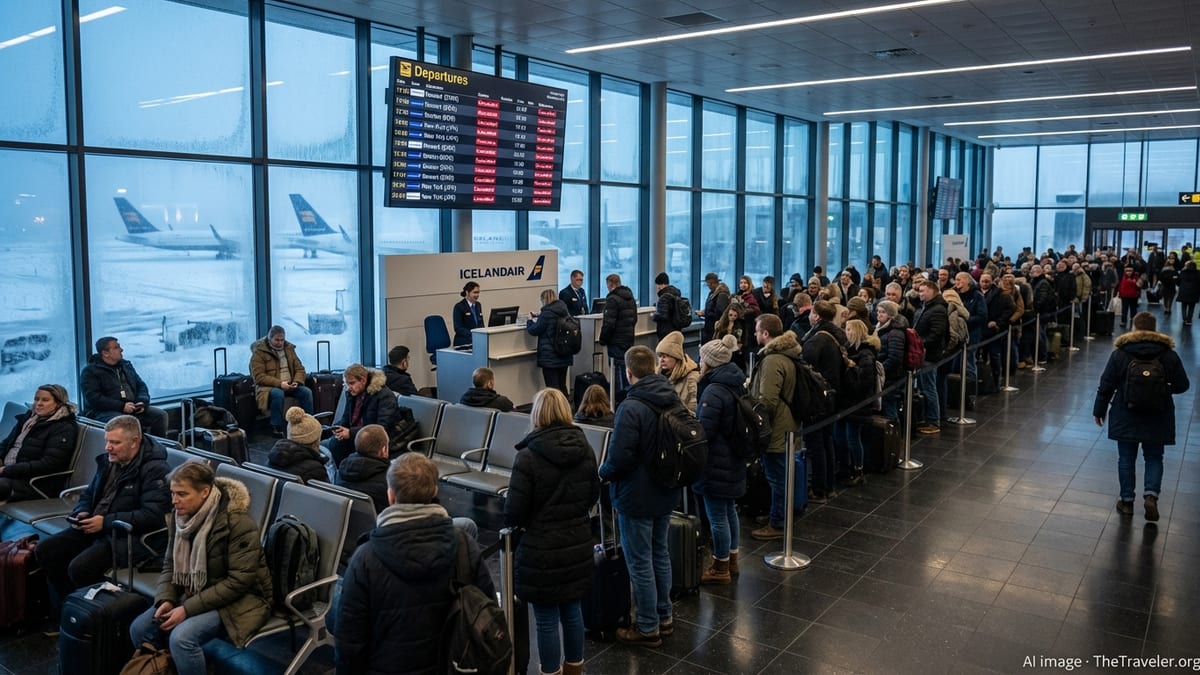
Wave of Cancellations From Keflavik Hits U.S. East Coast Routes
The disruption centers on departures from Keflavik International Airport, Icelandair’s main hub, where a series of cancellations over Sunday and Monday affected at least five transatlantic services. Among them were flight ICE623 to Newark Liberty International Airport, ICE631 to Boston Logan International Airport and ICE615 serving the New York area. Flight records showed multiple instances of ICE623 and ICE615 scrubbed on consecutive days, sharply reducing the carrier’s capacity into the northeastern United States.
The cancellations coincide with a severe winter storm sweeping across the U.S. East Coast, where authorities temporarily curtailed operations at major airports including Newark, Boston Logan and New York’s John F. Kennedy. With visibility deteriorating and high winds making runway conditions unsafe, airlines have preemptively grounded aircraft rather than risk having planes and crews stranded at closed or heavily constrained airports.
For Icelandair, whose network strategy relies on tight transatlantic connections over Keflavik, the knock on effect has been immediate. Once key evening departures to Newark, Boston and New York were pulled from the schedule, passengers arriving from Europe or domestic Icelandic routes suddenly found there was no onward flight to meet, triggering an unplanned overnight stay in Iceland for many travelers.
Airport departure boards on Monday captured the scale of the disruption, with multiple Icelandair services to the northeastern United States marked as cancelled across the late afternoon and early evening peak when most transatlantic departures are typically scheduled.
Passengers Face Long Delays, Uncertainty and Limited Alternatives
Inside Keflavik’s terminal, the operational decisions translated into long lines at service desks and growing frustration among passengers trying to salvage itineraries. Many travelers reported receiving cancellation notices for ICE623, ICE631 and ICE615 only a few hours before scheduled departure, leaving little time to organize backup plans or rearrange hotel bookings, car rentals and onward connections.
For some, the problem extended beyond a single missed flight. Icelandair’s hub and spoke model draws passengers from cities across Europe onto a bank of transatlantic departures. When the Newark or Boston leg is cancelled, travelers who started their journeys in London, Amsterdam or Copenhagen may find themselves stranded mid route in Iceland, unable to proceed and with limited options to return to their point of origin.
Alternative routings have also proved difficult. With the same storm system disrupting flights across the northeastern United States, seats on other carriers bound for Newark, Boston and New York quickly sold out or were themselves at risk of cancellation. Passengers described struggling to find available seats via other European hubs such as London Heathrow or Frankfurt, where airline operations were already stretched by their own weather related delays.
Families with children, business travelers facing missed meetings and tourists nearing the end of their vacations all faced uncomfortable choices between waiting in Iceland for an uncertain new departure time or rerouting through complex multi stop itineraries to reach their final destinations.
Icelandair Cites Weather Pressures as Operations Are Reworked
While Icelandair has not issued a detailed public breakdown of every affected flight, the airline has pointed to the severe weather affecting key U.S. airports as the primary driver of the cancellations. Aviation analysts note that when a major hub such as Newark or Boston is effectively shut, long haul flights from overseas are often cancelled at their departure point to prevent aircraft from being left out of position for the recovery phase.
Scheduling data from the weekend and Monday indicates that Icelandair concentrated cuts on repeat services to the same East Coast gateways, particularly ICE623 to Newark, ICE631 to Boston and ICE615 serving the New York area. The pattern suggests a deliberate decision to preserve flexibility elsewhere in the network while reducing exposure to storm related disruptions on the most affected routes.
Industry observers say that mid sized carriers like Icelandair face a delicate balancing act during prolonged weather events. Aircraft rotations, crew duty time limits and maintenance windows all have to be recalculated when flights are cancelled at short notice. A decision to operate one transatlantic sector can have ripples for days across the rest of the schedule if the aircraft or crew are then stuck in the wrong place.
At Keflavik, airport officials have stressed that the terminal and runways remained operational during the disruptions, underscoring that the bottleneck was largely on the other side of the Atlantic. With air traffic control restrictions and snow clearance operations continuing at major U.S. hubs, airlines have few options beyond canceling services and preparing for a staged restart once conditions improve.
What Stranded Travelers Can Expect in Terms of Care and Rights
As lines formed at help desks, attention quickly turned to what assistance passengers could claim from the airline. Icelandair has encouraged affected customers to use its official channels to rebook on the next available services once flights resume. In cases where same day travel is impossible, the carrier has been arranging overnight accommodation and meal vouchers for some stranded travelers, although the level of support can vary depending on circumstances and ticket type.
Consumer advocates in Iceland and the wider European market note that passengers on cancelled flights generally retain the right to choose between rebooking at the earliest opportunity, rerouting at a later date or receiving a refund for the unused portion of their ticket. Whether additional financial compensation is owed often depends on the cause of the disruption and whether it is deemed outside the airline’s control, as is usually the case with severe weather and airspace closures.
Travelers are being advised to keep detailed records of their expenses in Iceland, including hotel bills, meal receipts and any extra transport costs. These documents can be critical when submitting claims to the airline or to travel insurance providers, many of which offer specific coverage for extended delays and forced overnight stays due to weather related cancellations.
Experts also recommend that passengers check their booking details closely. Those who purchased tickets via third party platforms or as part of package holidays may have different support channels and refund processes compared with travelers who booked directly with the airline.
Ongoing Disruption Highlights Fragility of Transatlantic Connections
The fallout from the cancellations of ICE623, ICE631 and ICE615 is being seen by analysts as another reminder of how exposed transatlantic travel remains to sudden weather shifts. Iceland’s geographic position makes it a natural bridge between Europe and North America, but that same location places Keflavik’s tightly choreographed schedules at the mercy of storms developing thousands of kilometers away.
In recent years, carriers operating over the North Atlantic have invested in more flexible scheduling tools, additional spare aircraft capacity and enhanced communication systems intended to keep passengers better informed during disruption. Yet events such as the current East Coast blizzard show that when multiple hubs are affected simultaneously, even the most robust contingency plans can be severely tested.
For travelers, the episode serves as a stark reminder to build extra time into long haul itineraries during the winter months, consider travel insurance that explicitly covers severe weather, and monitor flight status updates closely in the 24 to 48 hours before departure. As airlines including Icelandair work to restore normal service to Newark, Boston and New York, a backlog of stranded passengers is likely to take several days to clear, keeping pressure on transatlantic capacity well beyond the passing of the storm.