

Idaho is a land of rugged mountains, deep lakes and small towns, but when it comes to passenger rail, the story is surprisingly simple. Only one Amtrak train serves the entire state: the long-distance Empire Builder, which glides overnight through the Idaho Panhandle and stops just once, at the lakeside town of Sandpoint. For travelers who love the romance of rail and want to pair it with Idaho’s outdoor landscapes, mastering this single route opens up a remarkable array of cross-country and regional journeys. This guide explains how the Empire Builder works in Idaho, how to plan trips around its unusual schedule, and what to expect before, during and after your ride.
Understanding the Empire Builder in Idaho
The Empire Builder is one of Amtrak’s classic long-distance routes, running between Chicago and the Pacific Northwest. For most of its journey it follows the historic rail corridors once used by the Great Northern and Northern Pacific railroads. Today the train operates daily in both directions and typically carries a mix of long-distance travelers, rail enthusiasts and tourists bound for national parks and major cities.
Idaho’s role on this route is modest but significant. The Empire Builder clips the far northern edge of the state, threading through forests and lake country before crossing into Washington and Montana. Along this entire stretch, there is just one passenger stop: Sandpoint, a small but busy rail junction on the shore of Lake Pend Oreille. If you want to board or alight from Amtrak in Idaho, Sandpoint is your only option, which makes understanding this station and its schedule essential for any Idaho-focused rail itinerary.
Although Idaho has no state-supported Amtrak corridors and no other active passenger lines, the Empire Builder’s single stop links Idaho directly with metropolitan hubs such as Seattle, Portland and Chicago, as well as gateway towns near Glacier National Park. That connection means you can step onto the train in a small mountain town late at night and wake up in a major city or near a national park the next day, with no airport transfers or winter driving to worry about.
Because the Empire Builder is a long-distance train rather than a commuter service, reliability is shaped by freight traffic, weather and conditions along thousands of miles of track. Timetables provide a useful baseline, but experienced riders build in buffer time on either side of their trip. If you treat the schedule as a framework instead of a guarantee, the Empire Builder can become a relaxed and memorable way to move in and out of Idaho.
Sandpoint: Idaho’s Sole Amtrak Station
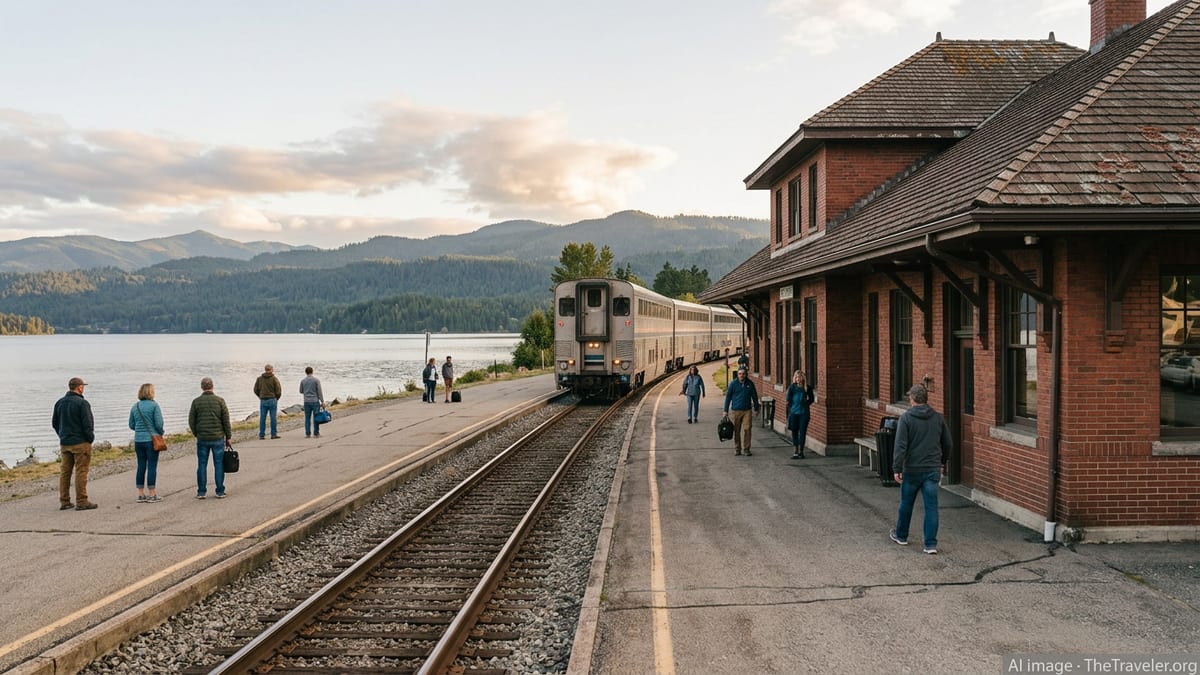
Sandpoint is the rail heartbeat of Idaho. The town sits at the junction of major east–west and north–south freight corridors and functions as a key funnel for trains connecting the Midwest, the Pacific Northwest and Canada. Into this very active rail landscape slips the Empire Builder, which stops at the historic brick depot near Sandpoint’s compact downtown. For passengers, the experience is more intimate than a big-city terminal, with a single platform, one primary track for passenger service and a clear sense of the town’s railroad heritage.
The station building dates back to the early twentieth century and has been restored to preserve its historic character while adding modern accessibility features. The platform is at ground level with tactile edging, and current information suggests the stop is accessible for passengers with mobility challenges. Amenities are more limited than at large hubs. You should not expect a full-service ticket office or extensive food options at all hours of the night, but you will find shelter, basic seating and clear signage to guide you to the correct boarding area.
One of Sandpoint’s great advantages is its location. The depot sits close to downtown streets, within walking distance of small hotels, cafes and the lakefront in reasonable weather. Local taxi companies and seasonal rideshare availability can help bridge the gap for travelers with luggage or those arriving in the middle of the night. Before you travel, it is wise to confirm current taxi hours or arrange a pickup directly with your hotel, particularly in winter or shoulder seasons when visitor numbers may be lower.
Because the Empire Builder calls at Sandpoint only once in each direction per day, the station’s daily rhythm revolves around those late-night and early-morning arrivals. You will not find a constant flow of trains and passengers; instead, there is a quiet interval followed by a brief window when the platform comes to life, lights flicker on in the coaches and conductors call out boarding instructions before the train disappears again into the night.
Empire Builder Routes Through Idaho and Beyond
The Empire Builder’s path across Idaho is short in mileage but long in possibilities. To the west, the line runs from Sandpoint into Washington state toward Spokane. In Spokane, the train is typically divided, with one section continuing to Seattle and the other to Portland. To the east of Sandpoint, the route quickly reaches Montana, passing through towns such as Whitefish and serving as one of the primary rail gateways to Glacier National Park during the summer season.
For travelers starting in Idaho, this means you can board in Sandpoint and ride west to Spokane and onward to either Seattle or Portland with a single ticket. Continuing east brings you to scenic portions of northern Montana and the high plains, eventually crossing North Dakota, Minnesota and Wisconsin before reaching Chicago. The route effectively connects northern Idaho not only to two major West Coast cities but also to a broad swath of the northern United States.
It is important to understand that there is currently no Amtrak service from Sandpoint south into the rest of Idaho. Cities such as Boise, Idaho Falls and Pocatello do not have active passenger rail service at this time. Historically, long-distance trains such as the Pioneer linked Boise and other southern Idaho communities to the national rail network, but those services were discontinued in the late 1990s. Periodic discussions about restoring additional routes surface in news coverage and planning studies, but as of early 2026, they remain proposals rather than timetabled trains.
For visitors, this reality shapes how you plan your movements. If you want to experience Idaho by train today, you will either be traveling to or from Sandpoint. Many travelers pair the rail journey with drives along scenic highways, such as routes skirting Lake Pend Oreille or connecting Sandpoint to Coeur d’Alene and Spokane. Others treat Sandpoint as a quiet intermediate stop on a much longer Empire Builder itinerary between Chicago and the Pacific Northwest, stepping off for a night or two before continuing their cross-country trip.
Schedules, Seasonality and When to Ride
The Empire Builder passes through Sandpoint on an overnight schedule in both directions, which can be a surprise if you are used to daytime intercity trains. At the time of writing, the westbound train typically reaches Sandpoint close to midnight, and the eastbound train tends to arrive in the very early morning hours. Exact times vary by timetable update and by day, so you should always confirm your specific date of travel directly with Amtrak or through the Amtrak app before finalizing connections or hotel bookings.
Because the stop occurs in the middle of the night, you need to plan carefully around check-in and check-out times at local accommodations. Some travelers choose to arrive by train, walk or take a short ride to a nearby hotel and sleep in the next morning. Others stay in Sandpoint the night before and check out late before catching an outbound train after dark. Communicating your arrival or departure time with hotel staff in advance can smooth out issues related to early morning or very late-night movements.
Seasonality also plays a major role in shaping your experience. In winter, northern Idaho can be cold and snowy, and the rail line traverses forests and mountain foothills that are subject to harsh weather. The scenery can be dramatic, but delays are more likely, and standing on an exposed platform in subfreezing temperatures requires warm clothing and good footwear. In summer, daylight lasts much longer, and depending on time changes and schedule adjustments, you may see more of the landscape along the line at dawn or dusk, especially when traveling eastbound toward Montana.
Spring and fall bring shoulder-season advantages. Crowds are usually smaller, lodging can be more affordable, and the changing light and foliage add texture to the views from the train. However, transitional weather can also lead to service disruptions in other parts of the route, which may ripple into Idaho. When planning, consider building in a cushion of several hours or an overnight stay before critical events such as flights, cruises or family gatherings at the far end of your journey.
Booking, Tickets and Onboard Experience
Booking the Empire Builder to or from Sandpoint follows the same process as any other Amtrak long-distance trip. You can reserve online, on the app or by phone, selecting Sandpoint as either your origin or destination. Fares fluctuate based on demand, date of purchase and class of service. As a rule of thumb, booking earlier gives you access to lower buckets of pricing, especially for sleeping car rooms, which can sell out quickly during popular travel periods such as summer vacation season and holidays.
You will choose among coach seats, business class where available on some segments, and sleeping accommodations such as roomettes and bedrooms. Because the Idaho segment occurs overnight for most riders, many travelers prefer a roomette, which offers privacy, beds and access to the dining car included in the fare. However, budget-conscious passengers often opt for coach and treat Sandpoint as a boarding or departure point that minimizes how many nights they spend aboard. For example, boarding in Sandpoint and riding west to Seattle involves only one night on the train.
Onboard amenities on the Empire Builder typically include a cafe car, a full-service dining car for sleeping car passengers and large picture windows throughout the train. The exact configuration can change with equipment rotations and seasonal adjustments, but the experience generally combines cross-country comfort with practical basics. Power outlets at most seats, climate control and luggage racks make it easy to settle in, while conductors and attendants can answer questions about intermediate stops, connections and approximate arrival times.
Because the train operates across multiple time zones and a variety of rail lines operated by different freight companies, delays are a part of long-distance train culture. Packing patience, snacks and flexible plans is nearly as important as your ticket. Many seasoned riders suggest bringing layers, a refillable water bottle, light entertainment and an eye mask and earplugs, especially if you are traveling overnight in coach. With the right mindset, the Empire Builder becomes less about racing to your destination and more about experiencing the gradual transition from one landscape to another.
Connecting To, From and Around Sandpoint
Reaching Sandpoint to catch the Empire Builder is often the most complex part of an Idaho rail trip. There is no direct Amtrak Thruway bus linking the station with other Idaho cities as of early 2026, so travelers typically arrive by car, regional bus, rideshare or shuttle from nearby communities. Spokane, roughly an hour and a half away by road, is the primary air gateway, with a commercial airport that offers rental cars and bus services that can be combined to reach Sandpoint.
Within Sandpoint itself, the compact size of the town works in your favor. Many small hotels and inns are located within a short walking distance of the station, and local taxi companies operate during much of the day and evening. Because the train’s arrival and departure times are late at night or early in the morning, you should confirm whether a taxi will be available at those exact hours, particularly outside of peak tourist season. Some lodging providers in the region will arrange pickups for guests arriving on the train if contacted ahead of time.
Once you arrive, you can treat Sandpoint as a base for exploring northern Idaho. The town sits on Lake Pend Oreille, with marinas, parks and viewpoints that are easy to reach on foot from downtown. Scenic drives head north toward Bonners Ferry and the Canadian border or south toward Coeur d’Alene. In winter, nearby ski areas draw visitors, some of whom use the train as a way to avoid long winter drives over mountain passes. While you cannot ride the rails deeper into Idaho at present, pairing a rail journey with a rental car or arranged shuttle unlocks a wide range of outdoor destinations.
Travelers who live elsewhere in Idaho often reverse this logic, driving or taking regional buses to Sandpoint to board the Empire Builder for the long-distance leg of their journey. Parking options near the station can be limited or time-restricted, so if you plan to leave a car, research long-term parking policies or consider arranging a drop-off instead. In many cases, combining a friend or family ride with an overnight stay before departure reduces stress and avoids last-minute scrambles caused by weather or traffic.
Future Prospects for Idaho Passenger Rail
The fact that Idaho currently has only one Amtrak stop has spurred periodic debate and planning discussions about expanding rail service in the state. Advocates often point to population growth in the Boise region and the desire for alternatives to congested highways. Federal programs encouraging corridor development and environmental goals have added new momentum in recent years, leading to feasibility studies, public surveys and concept proposals for additional routes.
One thread in these discussions involves the idea of restoring a route similar to the former Pioneer, which once linked the Pacific Northwest to Denver via southern Idaho and other interior states. Another focuses on potential regional rail or light rail in the Treasure Valley, connecting communities such as Boise, Nampa and Meridian. These ideas surface in planning documents, local media coverage and public forums, but the gap between concept and operating trains remains substantial, involving funding, negotiations with freight railroads and decisions by state leaders.
For now, travelers should treat all such projects as long-term possibilities rather than near-term options. Timelines are uncertain, and public agencies in Idaho have at times missed opportunities to secure federal planning grants or have signaled caution about taking on new rail commitments. While this may change as conditions evolve, it is safer to plan your Idaho travel around existing services rather than anticipated ones.
Despite these uncertainties, the continued operation of the Empire Builder through Sandpoint is a reminder that even a single long-distance route can provide meaningful connectivity for a state. As long as the train continues to run, Idaho maintains a direct link to the broader national passenger rail network, and travelers who understand how to use that link can build creative itineraries around it.
The Takeaway
Idaho’s passenger rail map may be sparse, but it is far from irrelevant. The Amtrak Empire Builder gives the state a direct line to Seattle, Portland, Chicago and many points in between, with Sandpoint serving as the quiet linchpin of that connection. While the train only brushes the northern tip of Idaho and calls at the station during unconventional hours, those who plan carefully can turn this apparent limitation into a memorable asset.
Success with Idaho train travel depends on a few key habits: checking the latest schedules, building flexibility into your itinerary, preparing for overnight conditions and arranging reliable local transport at each end of your journey. When you do that, the rest falls into place. You can step aboard in a small lakeside town and wake up hundreds of miles away, having watched forests, mountains and plains roll by from the comfort of your seat or sleeper.
Looking ahead, Idaho may someday regain or expand its passenger rail network as population growth, environmental concerns and federal incentives converge. Until that happens, the Empire Builder remains the essential tool for anyone who wants to experience the state by rail. Learn how it works, start or end your journey in Sandpoint and embrace the unhurried pace of long-distance train travel that still threads through the northern edge of the Gem State.
FAQ
Q1. Does Amtrak serve more than one station in Idaho?
At present, no. Sandpoint is the only active Amtrak station in Idaho, served exclusively by the long-distance Empire Builder.
Q2. What cities can I reach from Sandpoint on the Empire Builder?
From Sandpoint you can travel west to Spokane and onward to Seattle or Portland, or east toward northern Montana, the Upper Midwest and Chicago.
Q3. What time does the train usually stop in Sandpoint?
The Empire Builder typically serves Sandpoint around midnight westbound and in the very early morning eastbound, but exact times vary and should always be checked close to departure.
Q4. Is the Sandpoint Amtrak station accessible?
Current information indicates that the station has accessible features, including an upgraded platform, but travelers with specific needs should confirm details with Amtrak before booking.
Q5. Are there food and ticket counters open at Sandpoint station?
Sandpoint is a small, unstaffed stop with limited on-site services. You should purchase tickets online in advance and bring snacks or rely on the onboard cafe and dining options.
Q6. How do I get between Sandpoint and other parts of Idaho without trains?
You will need to use roads, typically by car, regional bus or arranged shuttle. There is no direct Amtrak Thruway service to other Idaho cities at this time.
Q7. Is it worth booking a sleeper for the Idaho segment?
It depends on your route. If you are riding only between Sandpoint and Spokane, coach is usually sufficient. For longer overnight legs to Seattle, Portland or Chicago, many travelers find a roomette more comfortable.
Q8. How far in advance should I book Empire Builder tickets?
Fares generally rise as departure approaches, particularly for sleeping car space. Booking several weeks or more in advance often provides better availability and pricing.
Q9. Are there plans to bring Amtrak back to Boise or southern Idaho?
Various studies and proposals have examined restoring service to southern Idaho, but as of early 2026 there is no confirmed timeline or funded project for new routes.
Q10. What happens if my Empire Builder train is delayed?
Delays are possible on long-distance routes. Amtrak will usually honor your ticket on the delayed train and may assist with rebooking missed connections, but it is wise to allow generous buffers in your plans.