

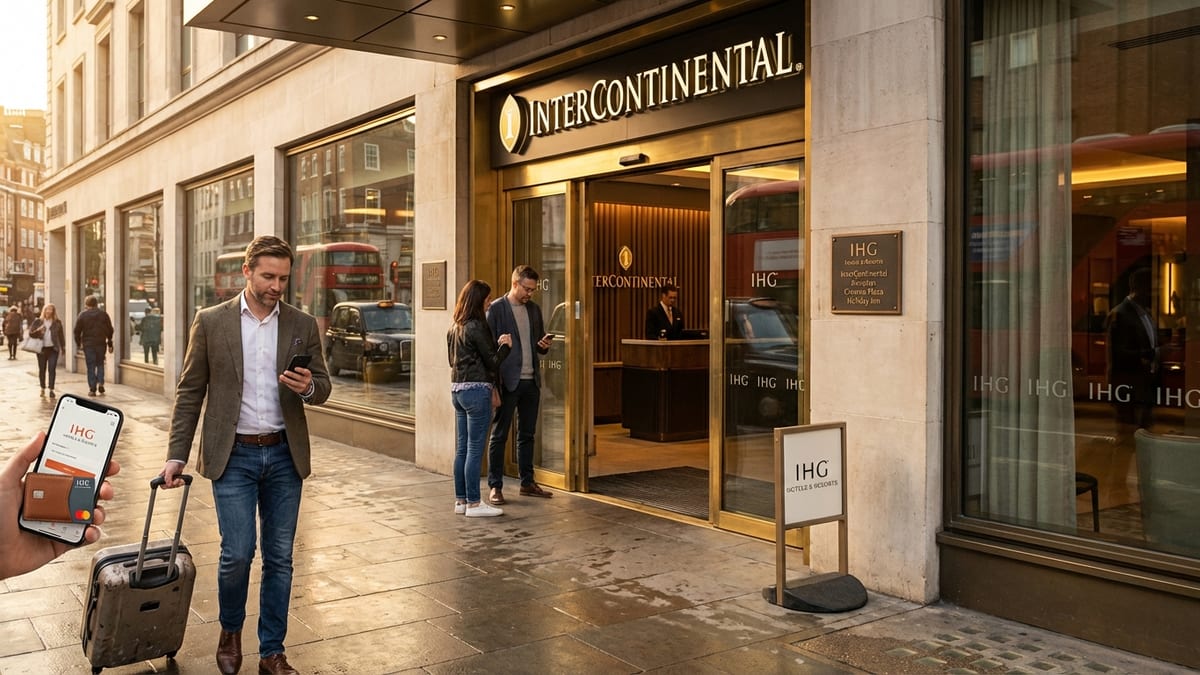
IHG One Rewards is the loyalty program for IHG Hotels & Resorts, a portfolio that spans more than 6,000 properties worldwide under brands like InterContinental, Kimpton, Crowne Plaza and Holiday Inn. For frequent travelers, its points can unlock free nights, elite perks and a range of other redemptions. Understanding exactly how IHG points work, what they are worth and how to use them strategically is essential if you want to get outsized value rather than just a modest discount on your next stay.
How IHG One Rewards Points Work
IHG One Rewards uses a straightforward premise: you earn points when you stay at participating IHG hotels, spend on co-branded credit cards or engage with partners, then redeem those points for hotel nights and other rewards. The program is free to join and all members start at the base Club level. Once you are enrolled and your membership number is attached to a reservation, virtually every eligible dollar spent at IHG properties earns points.
At most IHG brands, non-elite members earn 10 base points per eligible dollar spent on room rate and certain incidentals. Some extended-stay brands such as Staybridge Suites and Candlewood Suites earn at a lower base rate per dollar. On top of these base earnings, elite members receive a percentage bonus that accelerates their balance, meaning that the higher your elite tier, the faster your points accumulate.
IHG One Rewards also has partnerships that allow you to earn points beyond the hotel front desk. Co-branded credit cards issued in markets such as the United States stack additional points on IHG stays and on everyday categories like dining and gas. Partner offers, from rental cars to dining programs, periodically add further earning opportunities. All of this feeds into the exact same currency: IHG One Rewards points that can be redeemed once they hit your account.
Unlike some legacy hotel programs that still rely on fixed award charts, IHG uses a dynamic pricing model for its redemptions. That means the number of points needed for a reward night is tied loosely to the cash rate, demand and other factors rather than a fixed category. This has significant implications for how you think about the value of your points and when to use or save them.
What IHG Points Are Really Worth
IHG One Rewards points have no fixed cash value, but you can estimate what they are worth by comparing how many points you would spend for a stay against the cash price of the same reservation. Independent analyses of IHG redemptions across a wide range of properties typically place the average value of IHG points around 0.7 cent apiece when redeemed for standard award nights. In other words, 10,000 IHG points are often worth about 70 dollars toward a free hotel night, although the real-world value in any given booking can be higher or lower depending on the property and travel date mix.
This 0.7 cent benchmark is most useful as a reference point rather than a rule. When the cash rate is unusually high but the award price in points is relatively low, you can extract a value well above the average. For example, a 350 dollar room that costs 40,000 points would yield roughly 0.875 cent per point. On the other hand, when low cash rates coincide with high points requirements, the value can sink below half a cent per point. In these situations, paying cash and saving your points for another stay is generally the smarter move.
Alternative redemptions such as gift cards or merchandise almost always deliver a significantly lower value, commonly in the range of about 0.2 to 0.3 cent per point. The same is usually true when transferring IHG points to airline miles. By giving up a hotel currency that can reliably be worth around 0.7 cent per point for miles that may be valued less after the transfer ratio, you erode the potential of your balance. For most travelers, using IHG points primarily for hotel nights is the best way to preserve and grow their effective worth.
Because IHG uses dynamic award pricing without a published award chart, the only way to assess value is to compare cash and points for each stay. This does add a step to the booking process, but it also creates opportunities. Deals can appear in off-peak windows or in markets where cash rates spike due to local events, while points pricing lags behind or reflects a different demand curve. Savvy IHG members watch for these mismatches and pounce when the points-to-cash ratio looks favorable.
Earning IHG Points: Stays, Cards and Partners
The core of IHG One Rewards earning remains hotel stays. At most brands, Club members earn 10 base points per eligible dollar, then layer on elite bonuses that range from 20 percent for Silver Elite members to 100 percent for top-tier Diamond Elite members. That means a Diamond member paying 200 dollars before taxes at a full-service IHG property could easily earn around 4,000 base points plus a 100 percent elite bonus, for roughly 8,000 points on a single night. Extended-stay brands that earn fewer base points per dollar still benefit from these multipliers, especially for longer stays.
In the United States, co-branded IHG credit cards significantly turbocharge earning. Premium cards often award high multiples on IHG purchases in addition to solid returns in common everyday categories like gas stations, restaurants and travel. Because the earning on hotel stays stacks with your base and elite earnings, cardholders can amass very large totals from each trip. Many of these cards also include automatic elite status, which itself increases the earning rate, creating a virtuous cycle for loyal guests.
IHG One Rewards also partners with more than 35 airlines globally, giving you flexibility to earn airline miles instead of hotel points on your stays if you choose that option in your account preferences. In that case, instead of earning IHG points, you earn miles in your chosen frequent flyer program per eligible dollar spent at IHG hotels, with specific earning structures varying by airline partner and in some cases by brand. This can be useful if you are chasing a specific mileage goal, although it sacrifices future hotel points.
Other partners and promotions can top up your balance through special offers. Periodic sales on purchased points may be attractive if you need to top off for a specific redemption, provided the sale price per point is lower than the value you expect to receive. Dining, car rental and other travel-related partner promotions can also deliver bonus points when you align your spending with promotional windows. As with most loyalty ecosystems, the more you centralize your travel and related spending with one network and its partners, the faster you progress toward valuable rewards.
IHG Elite Status and How It Changes Point Value
IHG One Rewards has five main elite tiers: Club, Silver Elite, Gold Elite, Platinum Elite and Diamond Elite. Club is the automatic base level when you enroll and requires no nights or points. Silver Elite generally requires 10 qualifying nights in a calendar year, Gold Elite usually requires 20 nights or a points threshold, Platinum Elite often starts at 40 nights and Diamond Elite at 70 nights or a higher points total. Qualifying through credit card ownership is also possible in some markets, with certain cards conferring automatic Platinum status and providing a path to Diamond through annual spending.
Each tier comes with increasing benefits. Silver Elite members earn a 20 percent points bonus on stays, while Gold Elite steps that up to 40 percent. Platinum Elite members receive a 60 percent bonus and enjoy perks such as complimentary room upgrades when available, early check-in, late check-out and occasional reward night discounts. Diamond Elite members earn a 100 percent bonus on base points and gain access to benefits like free breakfast as a welcome amenity option and dedicated customer service lines. While the precise benefit set can evolve year to year, the overall pattern is that higher tiers make each stay more rewarding and each point more powerful.
From a points value perspective, elite status matters in two important ways. First, the bonus multipliers on stays accelerate how quickly you accumulate points. A Diamond member can effectively earn double the points of a base member on the same spend, which drastically shortens the time required to reach a high-value redemption. Second, elite benefits such as complimentary upgrades, late checkout and free breakfast add non-points value to your stays. When you redeem points and still receive these elite perks, the real-world value you derive from each award night can far exceed the simple cash price divided by points calculation.
Rollover nights, offered at certain elite tiers, and milestone rewards, which can provide suite upgrades or food and beverage credits after a set number of nights, further enhance the overall picture. For travelers who stay with IHG often enough to reach and maintain higher tiers, elite status transforms IHG One Rewards from a simple points program into a comprehensive value ecosystem that touches every part of the hotel experience.
Redeeming IHG Points Wisely
For most members, the primary use of IHG One Rewards points is to book reward nights at IHG hotels and resorts. With dynamic pricing, the number of points required for a free night fluctuates based on the property, date, demand and sometimes even lead time before arrival. Standard award nights can start as low as a few thousand points at lower-tier properties and extend to well over 70,000 points at luxury or high-demand hotels. Because there is no fixed chart, thoughtful comparison between cash and points for your exact dates becomes critical.
One of the most powerful ways to increase the value of your points is to target expensive cash nights but reasonably priced award nights. Citywide events, festivals and peak holiday periods can make cash rates skyrocket at mid-range and upscale properties. When dynamic award pricing does not fully keep up with that spike, your points can effectively buy far more than their usual worth. Conversely, in off-peak moments when properties are competing for occupancy with discounted cash rates, you may find that award prices remain relatively high and deliver poor value.
IHG also offers a Points & Cash option where you pay part of the cost in points and the rest in cash. This can be helpful if you are just short of the points required for a stay and prefer to avoid buying more points outright. However, the effective price you pay for the portion of the booking in cash is often equivalent to purchasing points at a fixed rate. It is important to run the math to ensure that the combination of cash and points is not worse value than either a full cash booking or using points at another time.
Other redemption choices such as gift cards, merchandise or transferring to airlines are generally less compelling. While they may be convenient in specific scenarios, the per-point value usually drops to around 0.2 to 0.3 cent or lower. If you can instead use those points for hotel stays where you routinely see 0.7 cent or more, you are effectively giving up a large portion of your reward potential. As a rule of thumb, hotel nights should be your go-to use of IHG points unless a unique opportunity or constraint pushes you in another direction.
Transferring IHG Points to Airline Miles
IHG One Rewards partners with more than 35 airline programs worldwide, allowing members to convert hotel points into airline miles. In most cases, the standard transfer ratio is effectively 5 IHG points to 1 airline mile. For example, 10,000 IHG points often convert into about 2,000 miles in many partner programs. A few exceptions exist, including programs that use unique points systems or different ratios, but the broad pattern is that you will part with a substantial number of IHG points for a relatively modest amount of miles.
In practice, the per-point value you receive from these transfers typically falls well below the value you could obtain from hotel redemptions. After factoring in the 5 to 1 conversion ratio and the typical value of many airline miles, analyses often put IHG points used in this way in the 0.2 to 0.4 cent per point range. That is significantly lower than the roughly 0.7 cent per point you might achieve with a good award night. For that reason, transferring IHG points to airlines is rarely the best primary strategy.
Another practical limitation is the process and timing. IHG currently requires members to contact its service center to convert points to airline miles rather than allowing online self-service transfers. Once requested, transfers can take several days to several weeks to complete depending on the partner. That lag makes IHG points a poor choice for last-minute mileage top-ups when you spot an award seat you want to book right away. Since flight award availability can vanish quickly, the inability to transfer instantly adds risk that your intended use of those miles may not work out.
That said, there are niche cases where converting points to miles may make sense. If you have a relatively small, orphaned IHG balance that you do not expect to grow and cannot realistically use for a meaningful hotel stay, turning those points into airline miles might be preferable to letting them sit idle. Similarly, if a specific airline award offers phenomenal value and you are certain of your travel dates, sacrificing some hotel value could be justified. These scenarios, however, are the exception rather than the rule for most travelers.
Strategies to Maximize IHG Point Value
To get the most from IHG One Rewards points, focus on aligning your earning and redeeming behavior with the program’s strengths. That starts with consolidating as many of your hotel stays as practical under the IHG umbrella so you can progress toward higher elite tiers. Once you reach Gold, Platinum or Diamond, your accelerated earning and improved on-property treatment combine to make each night more rewarding, whether you are paying cash or redeeming points.
When it comes time to redeem, treat your IHG points like a flexible travel currency rather than something to use at the first opportunity. Compare the cash price to the points cost on every booking and calculate a simple cents-per-point figure. If the value you are getting is significantly above your personal target, it is a good redemption. If it is below, consider paying cash and saving the points for a stay that delivers a better return. Over a year of travel, applying this discipline can make a noticeable difference in the effective value of your balance.
Another powerful tactic is to combine promotional bonuses and card benefits with clever timing. For example, if a promotion is offering double or triple points on stays, shifting a planned trip into the promotional window can significantly boost your earnings. Similarly, some co-branded cards offer a free night certificate each year or a fourth night free when redeeming points for longer stays. Structuring your redemptions to take full advantage of such benefits can elevate your effective per-point value well beyond the headline average.
Finally, remember that points are not an investment; they are a tool. Hotel programs can change earning rates, award pricing models and benefits with limited notice. Holding a very large IHG points balance for years without using it exposes you to the risk of devaluations. A practical approach is to earn and redeem on a rolling basis, aiming to use points within a reasonable timeframe on stays that matter to you, rather than letting them accumulate indefinitely in pursuit of a theoretical perfect redemption.
The Takeaway
IHG One Rewards points are a versatile and potentially valuable travel currency, especially for travelers who frequently stay at IHG hotels and can work their way into elite status. On average, you can expect well-managed redemptions for hotel nights to yield around 0.7 cent per point in value, with the potential to do better when dynamic award pricing underestimates the true cash value of a room. Alternatives like redeeming for gift cards, merchandise or airline miles generally reduce that value substantially.
To unlock the best of what IHG One Rewards offers, focus your strategy on two pillars: earn efficiently by leveraging elite status, co-branded credit cards and promotions, and redeem intelligently by comparing cash and points prices for every stay. Use your points where they stretch the furthest, typically during high cash-rate periods or at aspirational properties, and do not be afraid to pay cash when redemptions are weak. By taking a disciplined, value-conscious approach, you can turn IHG’s loyalty program into a powerful ally in reducing your travel costs and upgrading your hotel experiences.
FAQ
Q1. How much are IHG One Rewards points worth on average?
On average, IHG One Rewards points are often worth around 0.7 cent each when redeemed for standard hotel award nights, though the actual value depends on the specific property, dates and cash price you are comparing against.
Q2. How many IHG points do I earn per dollar spent at IHG hotels?
Most members earn 10 base points per eligible dollar at the majority of IHG brands, with extended-stay brands earning fewer base points; elite members then receive a bonus on top of those base points that ranges from 20 percent for Silver Elite up to 100 percent for Diamond Elite.
Q3. Is it better to use IHG points for hotel nights or transfer them to airline miles?
For most travelers, using IHG points for hotel nights is significantly better because the per-point value is typically much higher than what you receive when transferring to airline miles at the common 5 to 1 ratio.
Q4. Do IHG points expire?
IHG points can expire for members without qualifying account activity over a certain period, but elite members at Silver level and above generally enjoy protections that prevent their points from expiring as long as that elite status is maintained.
Q5. How does dynamic award pricing affect the value of my IHG points?
Dynamic pricing means that the number of points required for a free night changes with demand and cash rates, which can create both high-value opportunities when points prices lag behind cash increases and poor-value situations when points costs are relatively high compared with discounted cash rates.
Q6. What is the best way to check if an IHG redemption is a good deal?
The simplest method is to divide the cash rate, including taxes and fees you would otherwise pay, by the number of points required for the same booking; if the result is comfortably above your personal target value per point, it is likely a good use of points.
Q7. Can I book any room type with IHG points?
IHG points are most commonly used for standard award rooms, though availability can vary by property and date, and some hotels may offer premium room or suite redemptions at higher points prices when standard awards are not available.
Q8. How can I reach IHG elite status faster?
You can accelerate your path to elite status by concentrating your hotel stays at IHG properties, holding and using a co-branded IHG credit card that offers automatic status or elite-qualifying benefits, and taking advantage of targeted status fast-track or bonus night promotions when they are available.
Q9. Are IHG Points & Cash bookings a good value?
Points & Cash bookings can be useful if you are short on points for a particular stay, but the effective rate you are paying to make up the difference with cash is often similar to buying points outright, so you should compare all options to ensure you are not overpaying.
Q10. Should I hoard IHG points for a big trip or use them frequently?
While it can be rewarding to save for a special trip, holding very large balances for long periods exposes you to potential program changes, so a balanced approach that uses points regularly for good-value stays while still planning for occasional aspirational redemptions is usually the most prudent strategy.