

Illinois culture unfolds in distinct layers, from the glass and steel canyons of downtown Chicago to the quiet streets where Abraham Lincoln walked and the grass covered earthworks of an Indigenous city that rose a thousand years ago. Traveling between these places is less about distance and more about time, as you move from cutting edge architecture along the Chicago River to 19th century political drama in Springfield and finally to the earthen pyramids of Cahokia, once one of the largest cities in North America. Together they form a compelling route through the story of the state and, in many ways, the story of the United States itself.
Understanding Illinois Through Its Cultural Landscapes
Illinois is often summarized as the Land of Lincoln or as the state anchored by Chicago, but that shorthand misses its deeper cultural geography. Spend a few days tracing a path from the Chicago Loop to Springfield and on to the Mississippi River valley and you encounter three very different ways people have shaped this landscape: vertical skylines of glass and stone, brick fronted 19th century streets where politics played out face to face, and monumental earthworks raised by hand long before European settlement. Each offers a different vantage point on power, creativity, and community.
These places are not isolated attractions to be checked off a list. The skyscrapers along the Chicago River tell a story about industry, migration, and ambition that connects directly to Lincoln’s era, when Illinois sat on the front line of debates over slavery and democracy. Farther south, the earthen mounds of Cahokia reveal that dense urban life in this region long predates statehood, with ceremonial plazas and farming communities flourishing here between about 800 and 1350. Seen together, they complicate the idea of Illinois as simply Midwestern and modern and invite travelers to read the land in layers.
Planning an itinerary that hits all three is surprisingly straightforward. High speed trains, interstates, and regional airports link Chicago and Springfield, while the highway network and bridges around St. Louis put Cahokia within easy reach of both Illinois and Missouri hubs. The reward for this modest logistical effort is a journey that juxtaposes riverfront skyscrapers with presidential libraries and grassy pyramids, and that invites you to think about how different cultures have imagined city life along the same rivers and prairies.
Whether you are an architecture enthusiast, a history buff, or simply curious about how places evolve, approaching Illinois through Chicago architecture, Lincoln heritage, and ancient Cahokia offers a powerful framework. It shows how one state can contain both world famous icons and quieter sites that are globally significant but still relatively uncrowded, and it provides multiple entry points into conversations about preservation, innovation, and identity.
Chicago Architecture: Reading the Skyline
Contemporary Chicago grew out of crisis. After the Great Fire of 1871 leveled much of the city center, local architects and engineers began experimenting with steel frame construction that allowed buildings to rise higher and windows to open wider. The result, over several decades, was the emergence of what is often called the first modern skyline, a vertical landscape whose ancestry you can still trace in the historic towers along LaSalle Street and the river. Walking here is like leafing through an open air textbook of architectural history, with early steel frame structures standing near glass curtain wall towers and postmodern icons.
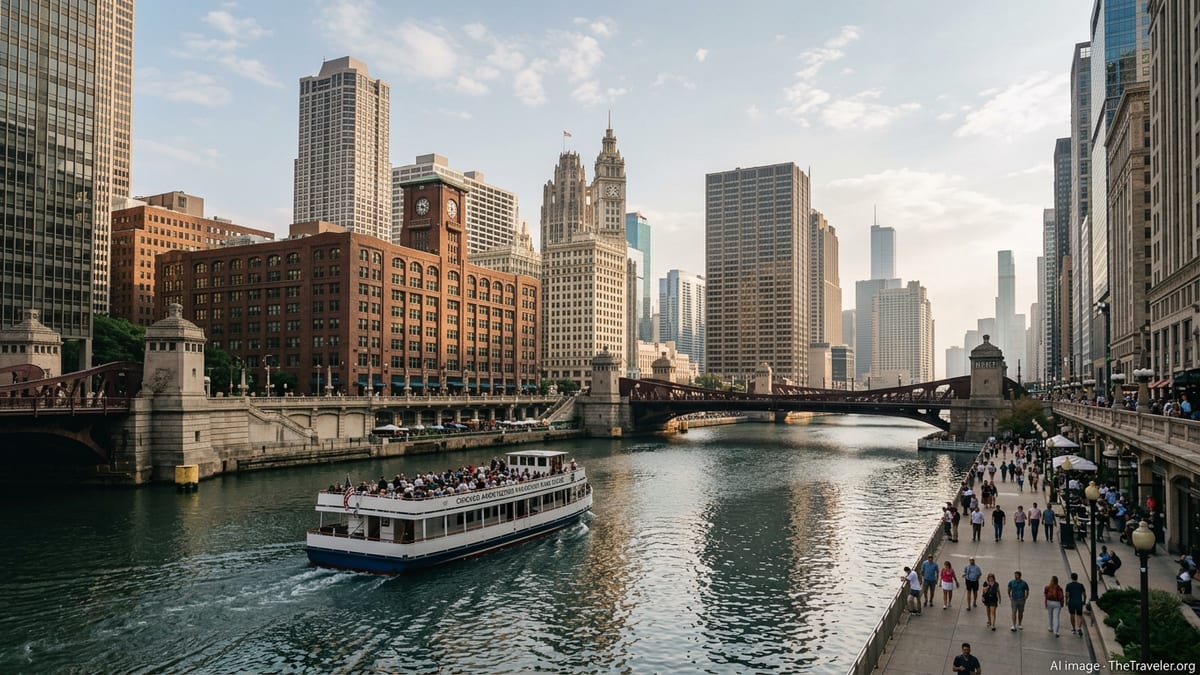
The Chicago River is the best starting point for understanding this story. Boat tours operated in partnership with the Chicago Architecture Center and other companies glide beneath bascule bridges and past many of the city’s landmark buildings, from sturdy early 20th century warehouses converted to residences and offices to contemporary towers with faceted glass and dramatic river level plazas. Guides typically highlight how innovations in structure and zoning shaped the skyline and point out details you might miss on your own, like terracotta ornament tucked above eye level or the way some towers twist to capture light. In recent years, Chicago’s main architecture cruise has repeatedly been singled out by travel and news outlets as one of the leading tours of its kind in the United States.
On land, the Chicago Riverwalk ties these elements together at human scale. This pedestrian promenade stretches along the south bank of the main branch with terraces that step down to the water, small cafes, and interpretive panels that explain how the river was physically reversed in the early 20th century to protect the city’s drinking water. Overhead rise icons such as the Wrigley Building, Tribune Tower, and Marina City, whose corncob shaped towers remain among the city’s most recognizable silhouettes. From here you can also see how more recent developments have tried to reconnect downtown with the river after decades when it functioned mainly as the city’s working back door.
Venture a few blocks inland and you encounter a dense collection of early skyscrapers that defined the so called Chicago School of architecture. Buildings like the Rookery, with its robust masonry exterior hiding an airy light court redesigned by Frank Lloyd Wright, or the Auditorium Building, which combined a theater, hotel, and offices in one mixed use complex, speak to an era when advances in elevators and structural engineering were fundamentally changing what a city could look like. Today many of these buildings welcome visitors into public lobbies or guided tours, and stepping inside offers a tactile sense of Chicago’s ongoing conversation between old and new.
Exploring Chicago’s Living Architectural Culture
Chicago architecture is not a museum piece. The city’s building culture is active and evolving, with new towers, renovated riverfront warehouses, and neighborhoods constantly reworking their historic fabric. The Chicago Architecture Center itself, located near the river, acts as both an interpretive hub and a launch point for walking and boat tours. Inside you will find large scale models of the city and hands on exhibits that explain how engineers address wind loads, how transit shapes development, and how sustainability concerns are reshaping design priorities.
Neighborhoods offer another dimension to the story. In areas like Hyde Park, Oak Park, and Bronzeville, smaller scale buildings tell stories about immigration, social movements, and design experimentation. Oak Park, just west of the city, contains one of the densest collections of Frank Lloyd Wright homes anywhere, alongside Prairie School residences by his contemporaries. In Bronzeville, historic greystone walk ups that housed generations of African American families during and after the Great Migration stand near cultural institutions that celebrate jazz, literature, and civil rights activism, reminding visitors that architecture is also about who lives inside and how they use space.
Practical considerations matter when you are exploring such a vertical city. Summers on the river can be hot and humid, with reflections from glass and water amplifying the sun, so hats, sunscreen, and water are essential. Shoulder seasons such as late spring and early fall often offer clearer views and milder temperatures, although rain and wind can still make conditions feel cooler near the lake. Many river tours scale back or pause during the coldest winter months, when ice and weather can make boat operations challenging, so visitors coming in January or February often focus on indoor tours and lobby visits instead.
Chicago’s architectural scene also intersects with its cultural calendar. Open house weekends, neighborhood festivals, and seasonal programming at museums and cultural centers often provide rare access to private buildings or normally closed rooftop terraces. Checking event calendars before you arrive can unlock experiences that go beyond standard tours, from temporary art installations in historic interiors to lectures by contemporary architects whose firms are shaping the region’s next generation of landmarks.
Walking With Lincoln: Springfield and the Presidential Story
Roughly a three hour drive or train ride south of Chicago, Springfield offers a very different urban scale and a rich concentration of sites tied to Abraham Lincoln. This is where Lincoln lived as a lawyer and legislator from 1844 until he left for Washington in 1861, and it remains the best place to explore his daily world at street level. Rather than towering glass and steel, the cityscape here is made up of low rise brick buildings, tree lined neighborhoods, and civic structures from the 19th century onward.
The Lincoln Home National Historic Site, managed by the National Park Service, preserves Lincoln’s family residence and several blocks of the surrounding neighborhood. Period appropriate wooden sidewalks, fences, and restored homes create a setting that feels distinct from modern Springfield without becoming a theme park. Ranger led tours inside the Lincoln home offer close views of rooms where the future president read, strategized, and raised his children, while exhibits in nearby houses focus on neighbors, domestic life, and the politics of the time. Visitor feedback in recent years has highlighted the way staff weave national history and personal anecdotes into accessible storytelling.
Just a short walk away, the Abraham Lincoln Presidential Library and Museum adds a more immersive and interpretive layer. The museum combines artifacts with theatrical exhibits and multimedia presentations to trace Lincoln’s rise from frontier lawyer to wartime president. It also engages with difficult subjects such as slavery, political opposition, and the toll of war, making it a useful stop for visitors who want to move beyond the more familiar stories. The adjacent library functions as a research institution but periodically opens special displays or events to the public, connecting local archives to national conversations.
Springfield’s Old State Capitol and the newer Statehouse round out the civic landscape that shaped Lincoln’s career. The Old State Capitol, where he served in the Illinois legislature and delivered important speeches, now functions as a museum and gathering place, allowing visitors to stand in reconstructed chambers that echo with political debates from the 1840s and 1850s. A short drive away, Oak Ridge Cemetery holds Lincoln’s tomb, a site of quiet reflection where visitors can consider the human cost of the conflicts that defined his presidency. Together, these places give Springfield an unusually cohesive narrative thread and make it easy to spend one or two days following Lincoln’s footsteps.
Beyond Springfield: Wider Lincoln Heritage
While Springfield is the most concentrated Lincoln hub, the broader Illinois landscape contains many other touchpoints. To the northwest, Lincoln’s New Salem State Historic Site reconstructs the small frontier community where Lincoln lived in the 1830s. Log buildings, costumed interpreters, and surrounding woods and fields help visitors visualize a world of flatboats, general stores, and local politics that laid the groundwork for his later career. Recent reporting has noted state investments in restoring and updating the site after years of deferred maintenance, a reminder that even iconic heritage landscapes depend on ongoing care.
Smaller towns and countryside sites also preserve traces of Lincoln’s legal circuit riding days, when he traveled by horseback or carriage between county seats arguing cases. Courtrooms, markers, and preserved homes give a sense of how physically demanding 19th century politics and law could be. For travelers with more time and a car, following stretches of the old circuit routes offers a very different pace from city sightseeing, with rolling fields, small town diners, and courthouse squares providing a backdrop to historical stops.
Engaging with Lincoln heritage also means acknowledging that his story is part of a much larger narrative about race, citizenship, and memory in the United States. Museums and historic sites increasingly interpret the perspectives of African Americans, women, and political opponents who shaped and responded to his era. Exhibits in Springfield and elsewhere often highlight the contributions of Black soldiers, the experiences of enslaved people seeking freedom, and the contested nature of Reconstruction and civil rights that followed Lincoln’s death. Visitors who approach these sites with questions rather than easy hero worship tend to come away with a richer, more nuanced understanding.
From a practical standpoint, Lincoln related sites in Illinois are generally accessible year round, although hours and programming can vary by season. Summers bring more living history demonstrations and school group traffic, while winter visits can feel quieter and more contemplative. Many interior spaces are compact, so booking timed tickets or arriving early in the day can help avoid crowds, especially on weekends or during holiday periods that coincide with school breaks.
Cahokia: The Ancient City Beneath the Prairie
Travel even farther back in time at Cahokia Mounds State Historic Site in southwestern Illinois, across the Mississippi River from today’s St. Louis. Here, between roughly 800 and 1350, a vibrant Mississippian culture built the largest pre Columbian urban center north of Mexico, organized around monumental earthen mounds, broad plazas, and outlying farmsteads. At its peak around the year 1100, scholars estimate that Cahokia may have rivaled or exceeded many European cities in population, with tens of thousands of residents spread across the main precinct and surrounding settlements.
The site today encompasses around 2,200 acres protected by the State of Illinois, forming the core of a cultural landscape recognized as a National Historic Landmark and inscribed by UNESCO as a World Heritage Site in 1982. Within this area, visitors encounter more than 70 remaining mounds, including Monks Mound, a massive four terrace structure that rises roughly 100 feet above the surrounding plain and ranks as the largest prehistoric earthen construction in North America. Climbing the long staircase to its summit offers a striking view of both the preserved archaeology and the modern industrial and urban surroundings that press close to its edges.
Cahokia’s interpretive center has long served as the main gateway for understanding the site, with exhibits that explain how archaeologists piece together the story of a city that left no written records. Displays describe the construction of mounds basket by basket, the layout of neighborhoods around plazas, the role of agriculture, and evidence for long distance trade that brought materials such as copper and marine shell into the region. As of early 2026, the state and partner organizations have been working on upgrades that include digital tools and an augmented reality tour app that lets visitors overlay reconstructions of buildings and plazas onto the present day landscape when viewed from key points like the top of Monks Mound.
Walking the grounds reveals how much of Cahokia lies under lawns, fields, and modern development. Some mounds are subtle rises in the terrain, while others are fenced off or partially surrounded by roads and houses. Interpretive signs and maps help visitors visualize the vanished wooden temples, elite residences, and solar aligned timber circles that once punctuated the skyline. The experience can be quietly powerful: instead of ruins made of stone, you navigate a city largely returned to grass and soil, requiring active imagination to see its former density.
Visiting Cahokia Responsibly
Cahokia is both a tourist destination and an active archaeological site, and visiting with care helps preserve its integrity and honor the Indigenous communities connected to its history. Trails and mown paths guide visitors across the main plaza, around mounds, and through small patches of reconstructed prairie. Staying on these routes protects sensitive ground surfaces and minimizes erosion on the mounds themselves. Even casual actions like cutting across a slope or rolling bikes down an embankment can accelerate damage to earthworks that have survived for centuries.
Weather and season strongly shape the experience here. In spring and early summer, grasses and wildflowers can be lush, and views from Monks Mound stretch across fields to the distant Gateway Arch and downtown St. Louis. Summer heat and humidity, along with limited shade on some trails, make water, sun protection, and comfortable footwear essential. Autumn often offers cooler temperatures and clearer air, with fall color in nearby woods adding contrast to the earth tones of the mounds. In winter, visits can feel almost austere, with low angled light and bare trees sharpening the shapes of the earthworks against the sky.
The interpretive center typically offers orientation films, exhibits, and a small shop with books and crafts related to Indigenous history and archaeology. Special events, including lecture series, guided walks, and cultural demonstrations, are scheduled throughout the year, often in partnership with Native communities and scholars. Checking ahead for programming can transform a simple stroll into a deeper learning experience, especially for travelers interested in current research on topics such as Cahokia’s political structure, environmental impact, and eventual decline.
Respectful engagement also means understanding that Cahokia’s story did not end when its population dispersed. Descendant communities across the Midwest and South maintain cultural traditions and oral histories connected to mound building societies, and contemporary Indigenous artists, scholars, and activists are increasingly visible in interpretive efforts. Visitors can listen for these voices in exhibits, public talks, and publications, and can carry that awareness forward when visiting other Indigenous heritage sites across North America.
Connecting Chicago, Lincoln, and Cahokia
Seen individually, Chicago’s skyline, Springfield’s Lincoln landmarks, and Cahokia’s earthworks might seem like separate chapters in history. Yet they share common themes that emerge clearly when you experience them on a single trip. Each represents a moment when people in Illinois reimagined what a city or community could look like and how it should function within a wider world. At Cahokia, leaders and builders organized labor and resources to create ceremonial and political centers that anchored a vast agricultural hinterland. In Lincoln’s Springfield, residents experimented with democratic governance and legal structures that would shape a growing nation. In Chicago, industrial capitalism and engineering innovation produced a vertical metropolis that broadcast modernity across the globe.
All three places also illustrate how fragile cultural achievements can be. Cahokia’s population eventually declined, likely due to a complex mix of environmental change, social stress, and shifting trade networks. Lincoln’s life ended in violence just as the country he helped hold together faced the difficult work of Reconstruction. Chicago has rebuilt from fire and weathered waves of deindustrialization and demographic change. What travelers encounter today are the preserved fragments and evolving legacies of those stories, curated and interpreted through the lens of contemporary values and scholarship.
For visitors, connecting these dots can turn a conventional sightseeing itinerary into a more reflective journey. Standing on Monks Mound, you can look toward the distant silhouette of modern skylines and consider how urban forms rise and fall. Walking the wooden sidewalks near Lincoln’s home, you might think about who was and was not included in the civic conversations of the 1850s and how those debates continue. Drifting along the Chicago River under mirrored towers, you can ask whose stories are reflected in glass and whose are harder to see. Illinois, in this sense, becomes a classroom where questions about power, memory, and belonging are written into the built and unbuilt environment.
Practical planning is straightforward for travelers who want to experience this full cultural triangle. Chicago serves as the primary gateway, with major airports and rail connections. From there, Amtrak and highway routes link to Springfield, and interstate corridors run southwest toward the Cahokia area and the broader St. Louis region. Many visitors allow at least three full days to touch all three focal points, with additional time if they want to add neighborhood exploration in Chicago, circuit riding routes in Lincoln country, or side trips to other mound sites and Mississippi River communities.
The Takeaway
Illinois reveals its richest stories when you move beyond quick labels and explore its layered cultural landscapes. Chicago’s architecture embodies a confident, ever evolving vision of urban life, shaped by technical innovation and economic ambition but grounded by a strong sense of place along the river and lakefront. Springfield and the state’s wider Lincoln heritage sites bring national history down to human scale, with wooden sidewalks, modest parlors, and courthouse debates that invite you to consider how political ideals are lived in everyday spaces.
Cahokia adds an essential, often underappreciated dimension to this picture, reminding visitors that complex urban societies flourished here long before European settlement. Its grass covered mounds and expansive plazas challenge narrow timelines and invite questions about how different cultures understand leadership, spirituality, and sustainability. Taken together, these destinations show that Illinois is not only a crossroads of rail lines and highways, but also a crossroads of ideas about how communities organize themselves and leave traces on the land.
For travelers willing to follow the threads from ancient earthworks to Victorian houses to glass walled skyscrapers, Illinois offers a rewarding and thought provoking journey. You will leave with more than photographs of skylines and historic homes. You will carry a sense of how many different futures people have imagined here, and how those futures, in turn, have become the layered past that shapes the state today.
FAQ
Q1. How much time should I plan to see Chicago architecture, Springfield’s Lincoln sites, and Cahokia on one trip?
Most travelers need at least three full days, with one day focused on downtown Chicago’s riverfront and historic core, one on Springfield’s Lincoln sites, and one on Cahokia and the surrounding area. Adding extra days allows for neighborhood exploration and a less rushed pace.
Q2. Is Cahokia suitable for visitors who are not archaeology experts?
Yes, Cahokia is very accessible to non specialists. The interpretive center, signs, and occasional guided programs explain the site in clear language, and walking the mounds and plazas is enjoyable even if you are new to Indigenous North American history.
Q3. Do I need a car to visit Springfield and Cahokia from Chicago?
You can reach Springfield from Chicago by train or bus, but having a car provides more flexibility for moving between multiple sites and reaching rural locations such as New Salem. Cahokia is easiest to visit with a car, though rideshare and regional transit options may cover parts of the route depending on schedules.
Q4. When is the best season to take a Chicago architecture river cruise?
Architecture cruises generally operate from spring through fall. Late spring and early fall often provide comfortable temperatures and good visibility, while midsummer can be hot and bright on the water. Many river tours reduce or pause operations in the coldest winter months.
Q5. Are Lincoln sites in Springfield appropriate for children and families?
Yes, many Lincoln related attractions are family friendly. The Lincoln Home offers short, engaging tours, and the Presidential Museum includes interactive exhibits and theatrical presentations designed with younger visitors in mind, making Springfield a good destination for multigenerational trips.
Q6. How physically demanding is a visit to Cahokia Mounds?
The main plaza and several mounds can be explored on relatively level paths, but climbing the staircase up Monks Mound involves a sustained ascent that can be challenging for some visitors. Taking your time, wearing sturdy shoes, and bringing water help make the experience manageable.
Q7. Can I visit Chicago’s notable buildings without joining a guided tour?
Yes, many significant buildings have publicly accessible lobbies and plazas that you can explore on your own. However, guided walking or boat tours provide historical context and access to details you might otherwise miss, so combining independent exploration with at least one tour often works best.
Q8. Are there opportunities to learn about contemporary Indigenous communities connected to Cahokia?
Interpretive materials at Cahokia increasingly highlight descendant communities, and special events often feature talks, performances, or demonstrations by Indigenous artists and scholars. Checking the site’s event schedule before your visit can help you plan around these opportunities.
Q9. How should I dress for visiting these sites across different seasons?
Layered clothing is useful year round in Illinois, where weather can shift quickly. Comfortable walking shoes are essential in all three locations, and in warmer months you will want sun protection and water, especially at Cahokia and on Chicago river cruises where shade can be limited.
Q10. Is it possible to base myself in one city and day trip to the others?
Chicago can serve as a base for long day trips to Springfield or the Cahokia area, but travel times can be substantial. Many visitors prefer to spend at least one night in Springfield or near Cahokia to reduce time on the road and to experience these destinations in the early morning or evening when they are quieter.