

Lake Michigan is one of North America’s great inland seas, a freshwater horizon shared by four states and lined with sandy beaches, dune country, and small towns that live for summer. For many travelers, the key decision is not whether to go, but which side of the lake to choose. If you are torn between Illinois and Michigan for your next Lake Michigan trip, the contrast could not be more interesting: Illinois offers big-city access and compact slices of shoreline, while Michigan delivers mile after mile of small towns, dune-backed beaches, and classic road trip territory. This guide compares both sides so you can decide where to base your Lake Michigan escape.
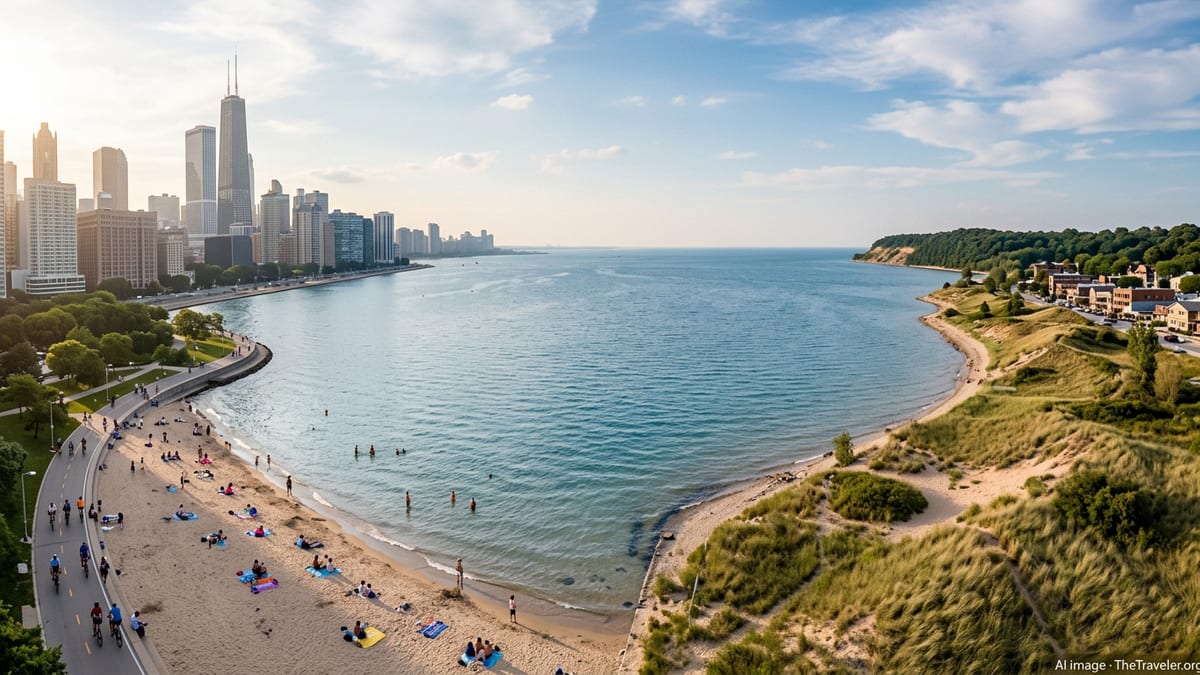
Lake Michigan in Illinois vs Michigan: Big Picture Differences
Illinois and Michigan share the same vast lake but deliver very different travel experiences. Illinois has a relatively short stretch of Lake Michigan shoreline, concentrated almost entirely in and around Chicago and the state’s northeastern corner. The feel is urban and suburban: beaches framed by a skyline, commuter trains, and harbors, with a handful of state park and small-town escapes close to the Wisconsin border. It is ideal if you want Lake Michigan as a backdrop to museums, dining, and nightlife or if you are working with a long weekend.
Michigan, by contrast, holds hundreds of miles of Lake Michigan coastline, from the state line near New Buffalo all the way up to the tip of the Lower Peninsula and beyond. This side of the lake is built for beach vacations: long arcs of sand, tall dunes, beach towns spaced every 20 or 30 miles, and scenic roads that rarely wander far from the water. The experience is less about one major city and more about hopping from harbor town to harbor town.
Because the character of each shoreline is so different, your choice often comes down to priorities. Travelers who want culture, architecture, and night life wrapped around a few hours on the sand usually lean toward Illinois. Those picturing sunsets over the lake, afternoons in small breweries or ice cream shops, and long drives between beaches tend to prefer Michigan. Both share the same freshwater swimming and soft summer light, but the pace and atmosphere are worlds apart.
Seasonality is another key factor. In both states, the prime time for Lake Michigan travel runs roughly from late May through September, with July and August offering the warmest water. Outside of those months, Illinois still shines as a city break with lake views, while many of Michigan’s small lake towns turn quieter and feel more like off-season retreats than full-service resort communities.
Beaches in Illinois: Cityfront Sand and Compact Escapes
Illinois beaches cluster along the southwestern corner of Lake Michigan, with Chicago at the center of the experience. Here, lake days and city life blur together. On a summer weekend, residents head to popular city beaches such as North Avenue Beach or Oak Street Beach, where golden sand fronts deep blue water and the skyline forms a dramatic backdrop behind joggers, cyclists, and volleyball nets. It is one of the few places in the United States where you can spend the morning in an art museum and the afternoon swimming off a beach within the same city limits.
North of downtown, neighborhood beaches along Chicago’s lakefront trail offer a slightly more low-key feel while still staying firmly urban. They are easy to reach by public transit or bike, and many have lifeguards in season, concessions, and nearby parks. The water quality along this corridor has improved over the years, though summer storms can temporarily affect swimming conditions, so it is wise to check local advisories if you plan to be in the lake.
Beyond the city, the Illinois shoreline narrows to a series of parks, harbors, and suburbs. Illinois Beach State Park, near Zion, is one of the few large-scale natural stretches of coastline in the state. The park protects dunes, wetlands, and a relatively wild-feeling strand of sand, offering a very different experience from Chicago’s manicured waterfront. Farther south, beaches around Waukegan and other Lake County communities provide accessible local stretches of shoreline that are popular with nearby residents.
What Illinois lacks in sheer length of coastline, it compensates for with convenience. From Chicago’s core, you can often reach a beach on foot, by bike, or via a quick train ride. If you want to pair lake swimming with music festivals, restaurant openings, ballgames, or museum visits and you do not have the time or desire to drive far, Illinois gives you a lot of Lake Michigan with minimal logistics.
Beaches in Michigan: Dunes, Space, and Classic Lake Town Vibes
Cross to Michigan’s side of Lake Michigan and the beach experience changes the moment you reach the first dune. From the state line north to towns like Grand Haven, Holland, Saugatuck, Ludington, and up toward Sleeping Bear Dunes, the coast unfolds in a series of sand-rich state parks and city beaches that feel distinctly resort-like in summer. Many of these beaches feature wide strands of sand backed by tall dune ridges and forest, giving them a more natural and spacious feel than many Illinois spots.
Popular waterfronts such as Oval Beach near Saugatuck, Grand Haven State Park, Pere Marquette Beach in Muskegon, and Warren Dunes State Park in southwest Michigan are known for soft sand, rolling dunes, and big-sky sunsets. Inland from the beach, you usually find compact downtowns with ice cream stands, casual restaurants, small hotels, vacation rentals, and a marina or fishing harbor. On a typical day, visitors might hike a dune trail in the morning, spend midday on the sand, then wander into town for dinner and a walk along the pier to watch the sun sink into the lake.
Farther north, Sleeping Bear Dunes National Lakeshore and towns along the M-22 coastal route introduce even more dramatic scenery. Here, high bluff-top viewpoints look down on aquamarine water that can resemble the Caribbean on a calm day. Long undeveloped stretches of shoreline separate small communities like Empire, Glen Arbor, and Frankfort. While these northern areas are not the focus for every traveler, they illustrate how much variety Michigan packs along its coastline compared with Illinois.
This abundance of beaches also means it is easier to spread out. Even peak-season weekends still leave room to find a quieter access point if you are willing to walk a bit farther from the parking lot or drive beyond the most popular town. For travelers longing for long walks on uncrowded sand or an escape that feels more like a traditional seaside holiday, Michigan’s side usually has the edge.
Small Towns and Local Culture Along the Shore
On the Illinois side, the best-known communities along Lake Michigan are essentially extensions of metropolitan Chicago. Suburbs such as Evanston, Wilmette, Winnetka, and Lake Forest have pleasant public beaches and leafy residential streets, but they are primarily commuter towns with limited tourist infrastructure compared with dedicated resort communities. You will find some boutique hotels, restaurants, and summer events, yet visitors often base themselves in Chicago and treat these locations as day-trip destinations rather than standalone stays.
Closer to the Wisconsin border, towns near Illinois Beach State Park and Waukegan Harbor offer marinas, simple motels, and family-oriented attractions. These communities make practical bases if you want lake time without staying downtown in the city or if you are road tripping along the western edge of Lake Michigan. The vibe is straightforward and local-driven rather than overtly touristed.
Michigan’s lakefront towns, meanwhile, have built their identities around seasonal visitors. Places like New Buffalo, St. Joseph, South Haven, Saugatuck, Douglas, Holland, Grand Haven, and Ludington combine historic main streets with boardwalks, waterfront parks, regular festivals, and a rotation of summer events. Many have lighthouses, piers, farmers markets, and regional arts scenes that come alive in warm weather.
This difference reshapes the daily rhythm of a trip. In Illinois, evenings might center on Chicago’s neighborhoods, rooftop bars, or theater, with the lake serving as a scenic counterpoint. In Michigan, you might stroll to a harbor-side concert, join crowds for sunset on the pier, or linger on a café patio watching boats return to the marina. Travelers who enjoy the ritual of a walkable small-town center with an obvious connection to the water often find Michigan’s side more aligned with their expectations.
Road Trips and Scenic Drives: City Lakefront vs Coastal Highways
If your vision of a Lake Michigan trip involves the open road, Illinois and Michigan present distinctly different options. In Illinois, the signature drive is Chicago’s famed lakefront roadway, a multi-lane route that threads between the city skyline and the lake. On a clear day, driving this corridor delivers constant water views on one side and skyscrapers and parkland on the other. It is visually striking but remains fundamentally urban, with traffic, interchanges, and city driving patterns. North of the city, the route transitions into suburban arteries and U.S. highways that clip the shoreline in spots but rarely stay glued to it for long stretches.
For a classic coastal road trip, Michigan’s side generally offers more. In the southwest corner, Red Arrow Highway and nearby routes link New Buffalo, Union Pier, Three Oaks, and other small communities, giving an immediate taste of country roads, farm stands, and short detours to the lake. Farther north, a string of state highways and designated scenic routes hug the coastline. One of the most celebrated is M-22, which traces the shore through the Sleeping Bear Dunes region and has become a destination in itself for fall color drives and summer beach hopping.
Road trippers also have access to short but dramatic loops such as the Pierce Stocking Scenic Drive within Sleeping Bear Dunes National Lakeshore, where overlooks stand high above the water, or winding corridors through dune and forest near towns like Holland and Ludington. These routes tend to be two-lane roads with moderate speeds, allowing time to pull into overlooks, roadside parks, and small villages that you might otherwise pass by.
For travelers starting in Chicago, it is entirely possible to combine both states in a single itinerary, using Illinois primarily as an entry point. Many visitors pick up a rental car in the city, spend a night or two enjoying the urban shoreline, then cross into Michigan for several days of slower-paced driving along the coast. In that scenario, Illinois feels like the prologue and Michigan becomes the core of the road trip.
Access, Logistics, and Trip Planning Considerations
When weighing Illinois against Michigan for a Lake Michigan getaway, logistics matter as much as scenery. Chicago is one of the most accessible cities in the United States, with major air connections, rail service, and interstate highways converging downtown. From the moment you arrive, the lake is visible and reachable by public transport. You can realistically experience a Lake Michigan beach day in Illinois without renting a car, especially if you stay along the lakefront and focus on city beaches.
Michigan’s shoreline typically requires more driving. The nearest beach towns in southwest Michigan are a relatively short drive from Chicago by Midwestern standards, but you will still need a car or an organized transfer. Once you reach your chosen base, many beaches are within a short drive or even a long walk from town, but the distances between towns can be significant. For travelers who enjoy road trips, the driving becomes part of the appeal; for those who prefer to minimize time behind the wheel, Illinois offers a more compact alternative.
Accommodation styles also differ. In Illinois, you will find the full range of city hotels, from luxury properties to budget chains, as well as vacation rentals and a limited number of campgrounds near the lake outside the urban core. In Michigan’s lake towns, smaller inns, independent motels, vacation rentals, and campgrounds are more common. Availability can tighten during peak summer weeks and holiday weekends, and some properties operate on a seasonal schedule, so booking ahead is wise.
Cost is another variable. Chicago’s hotels and dining can be relatively expensive, particularly in prime lakefront neighborhoods. However, you may save on transportation if you can avoid renting a car. Michigan towns can range from budget-friendly to upscale, especially in highly sought-after destinations, but many travelers find that day-to-day expenses such as parking, casual dining, and activity fees feel slightly more relaxed compared with a downtown city stay.
Which Side Is Better for You? Matching Trip Style to Destination
Choosing between Illinois and Michigan for a Lake Michigan trip ultimately comes down to the trip you imagine. If your ideal weekend includes world-class museums in the morning, a lakefront bike ride in the afternoon, and dinner in a city neighborhood before a late-night concert, Illinois will likely satisfy. You can treat the lake as one highlight among many, sliding beach time into an otherwise urban itinerary without complex planning.
If instead you picture slow mornings, time on a cottage porch, beach towels drying on a railing, and evenings built around sunset, ice cream, or a campfire, Michigan’s side is usually a better match. The density of beach towns and the prevalence of dune-backed state parks lend themselves to a relaxed, nature-forward holiday. Children can roam at the water’s edge, and adults can trade the rush of a city schedule for the cadence of waves and harbor bells.
Activity preferences also help clarify the choice. Urban runners, cyclists, and swimmers often love Chicago’s string of lakeside parks and paths, while hikers, paddlers, and campers gravitate to Michigan’s network of trails, rivers, and campgrounds near the lake. Photographers may be drawn to both: Illinois for the juxtaposition of glass towers and open water, Michigan for classic landscape scenes of dunes, lighthouses, and sandy crescents.
For many travelers, the answer is not strictly either-or. A balanced approach might include a night or two in Chicago to enjoy its architecture and culture, followed by several days roaming Michigan’s western shore. With careful planning, you can watch the sunrise over Lake Michigan’s urban edge in Illinois and end the same trip watching the sun set into the lake from a quiet pier in Michigan.
The Takeaway
Illinois and Michigan carve very different experiences along the same vast lake. In Illinois, Lake Michigan is a spectacular urban waterfront, threaded by parks and beaches that serve one of the country’s largest cities and its surrounding suburbs. It is an easy choice for short getaways, especially if you want to pair beach time with big-city culture and do not want to spend much time driving.
Michigan’s side, by contrast, is an extended string of small towns, dunes, and beaches that feel purpose-built for vacation. The shoreline is longer, the scenery more varied, and the pace gentler. Long drives become part of the adventure, revealing one harbor and beach after another. If your priority is a classic summer escape centered almost entirely on the lake, Michigan generally offers more room to roam.
In the end, neither side is objectively better; they simply cater to different kinds of trips. Travelers chasing museums, food, and nightlife wrapped around a few hours on the sand will likely be happiest in Illinois. Those seeking day after day of dunes, sunsets, and small-town charm will probably favor Michigan. With enough time, you do not have to choose at all. The same lake that touches city skyscrapers in Illinois also laps against quiet stretches of sand in Michigan, and experiencing both offers a fuller picture of what a Lake Michigan vacation can be.
FAQ
Q1. Is Illinois or Michigan better for a first Lake Michigan trip?
For a first visit focused on convenience and variety, Illinois works well because Chicago offers easy access, public transit, and a mix of beaches and city attractions. If you already know you want a slower-paced beach town experience, starting in southwest Michigan can be just as rewarding.
Q2. Where is the water warmer, Illinois or Michigan?
Water temperatures along both coasts are broadly similar, warming from late June through August and cooling again in early fall. Shallow, protected areas can feel slightly warmer, and day-to-day conditions vary with wind and weather rather than state lines.
Q3. Do I need a car to enjoy Lake Michigan in Illinois?
You can experience many Chicago beaches without a car by using public transportation, biking, or walking along the lakefront path. To reach more remote parks and suburban beaches north of the city, a car becomes much more helpful.
Q4. Do I need a car to enjoy Lake Michigan in Michigan?
In most Michigan lake towns, a car is very useful, especially if you want to visit multiple beaches or explore scenic drives. Some towns are walkable once you arrive, but the distances between communities make driving the simplest option.
Q5. Which side has better small beach towns?
Michigan generally has more classic beach towns built around tourism, with walkable main streets, harbor fronts, and seasonal events. Illinois has pleasant lakefront suburbs and small cities, but they tend to feel more residential and less like dedicated resort communities.
Q6. Are the beaches more crowded in Illinois or Michigan?
Popular Chicago beaches can feel very busy on hot summer weekends, while some Michigan state parks and well-known town beaches also draw large crowds. Michigan’s longer coastline creates more opportunities to find quieter stretches if you are willing to explore beyond the most famous spots.
Q7. How many days should I plan for a Lake Michigan road trip in Michigan?
For a meaningful taste of Michigan’s Lake Michigan shoreline, many travelers set aside at least four to seven days, allowing time to visit several towns, explore dunes, and build in unscheduled beach hours.
Q8. Can I combine Illinois and Michigan in one Lake Michigan vacation?
Yes. A common approach is to begin with two or three nights in Chicago, enjoy its urban lakefront, then rent a car and drive into southwest Michigan for several more days of small-town and beach-focused exploring.
Q9. When is the best time of year to visit Lake Michigan beaches?
Late June through early September typically offers the warmest air and water, with July and August being the peak for swimming. May, early June, and late September can still be pleasant for walks, sunsets, and sightseeing, though the water is cooler and some services may operate on limited schedules.
Q10. Is Lake Michigan safe for swimming?
Lake Michigan can be wonderful for swimming, but conditions change quickly. It is important to heed local advisories, watch for posted flags, stay aware of rip current risks, and follow lifeguard guidance where available on both the Illinois and Michigan shores.