

More news on this day
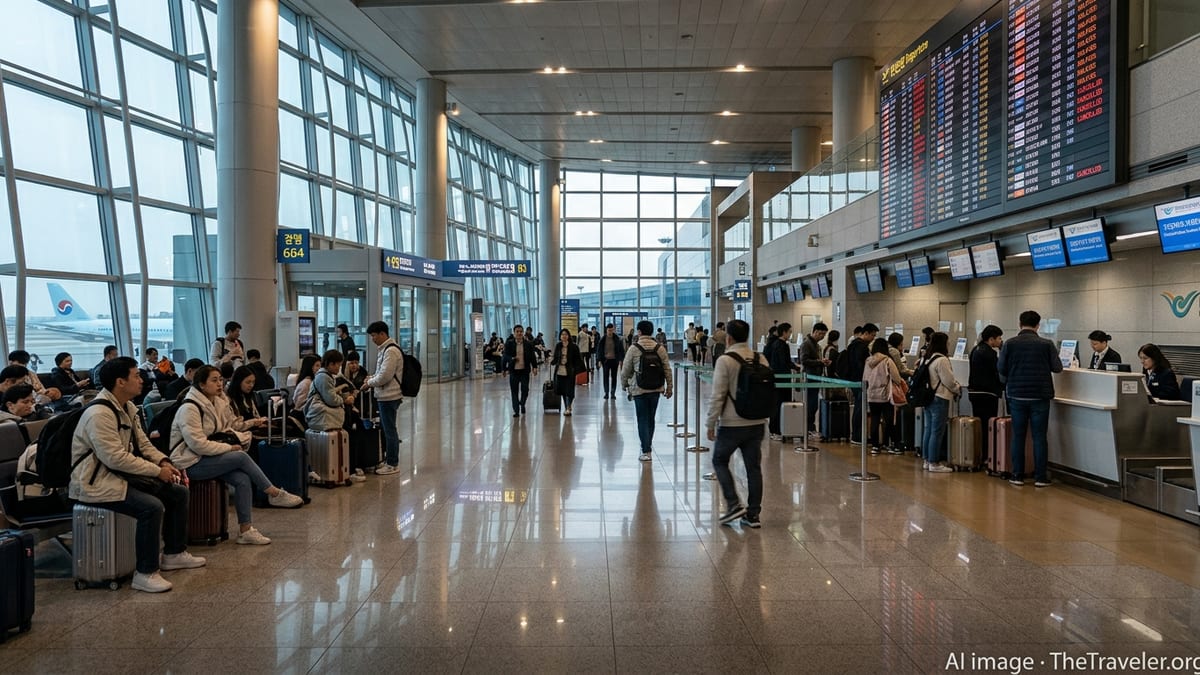
Flight disruptions at Incheon International Airport in South Korea are leaving dozens of travelers bound for Kuala Lumpur stranded, as a key cancellation ripples through already stretched international schedules and contributes to a wider pattern of delays across Asian and Middle Eastern hubs.
Get the latest news straight to your inbox!
Key Cancellation Triggers Knock-On Delays
Recent operational data and traveler accounts indicate that a cancellation affecting services between Seoul Incheon and Kuala Lumpur has intensified pressure on an already fragile regional network. The affected flight, part of a tightly timed schedule linking Northeast Asia with Southeast Asia and onward long-haul routes via major Gulf and European hubs, was withdrawn at short notice, forcing last-minute reaccommodation efforts at Incheon.
Publicly available flight-tracking information shows that the cancellation removed a key connection window for passengers transiting through Incheon on itineraries to and from Kuala Lumpur. With many itineraries built around narrow transfer margins, the loss of one departure has translated into missed onward connections and an accumulation of stranded travelers in departure halls.
Reports from recent weeks describe congestion and long processing times at Incheon, particularly during peak departure banks, which has compounded the effect of any schedule disruption. Travelers connecting between Northeast Asia and Southeast Asia, including those heading to Malaysia’s capital, have been particularly exposed to cascading delays when even a single flight is removed from the timetable.
The disruption comes amid a broader period of instability for international flight schedules, with airlines still recalibrating capacity and contingency plans in response to shifting travel demand, changing airspace availability and ongoing operational constraints across Asia and the Middle East.
Stranded Passengers Face Long Waits and Limited Options
Passengers caught in the latest disruption at Incheon describe scenarios in which a cancelled sector to Kuala Lumpur left them queuing at transfer desks for hours, in some cases overnight, while alternative routings were identified. Because many Kuala Lumpur services are already operating near capacity, rebooking options have been constrained, extending the time that affected travelers remain stuck at the airport.
Anecdotal accounts circulating on traveler forums and social platforms consistently reference crowded customer-service counters, limited seating in gate areas and uncertainty over rebooking timelines for those whose itineraries depended on the cancelled Incheon–Kuala Lumpur flight. Some travelers report being re-routed via third-country hubs in the Gulf or broader Southeast Asia, with journeys extended by many hours or, in some cases, an additional travel day.
Published guidance from consumer and aviation channels notes that when a key regional leg is cancelled, airlines typically prioritize passengers with the earliest onward connections, which can leave others facing lengthy waits for open seats on subsequent departures. At peak travel times, stranded passengers may find that alternative flights from Incheon to Kuala Lumpur, or via nearby hubs, are heavily overbooked, leading to a backlog that may take multiple days to clear.
Travel commentators point out that, while such cancellations may affect a relatively small number of individual flights, the knock-on effect is magnified when they occur at major transit hubs like Incheon that handle large volumes of connecting traffic bound for Southeast Asia and beyond.
Wider Network Disruptions Add Pressure on Asia–Middle East–Europe Links
The situation at Incheon is unfolding against the backdrop of wider schedule disruptions affecting major corridors that include Kuala Lumpur as a key waypoint. Recent weeks have seen extensive cancellations and reroutings involving Gulf carriers and other long-haul operators, leaving passengers stranded in cities such as Dubai and Kuala Lumpur as airlines adjusted operations and airspace routings.
According to published coverage from aviation and business outlets, these interruptions have created pockets of stranded travelers across multiple hubs and have placed additional strain on Southeast Asian routes that function as alternatives or backup connections. Kuala Lumpur, as one of the principal gateways in the region, has featured in numerous accounts of disrupted itineraries and rebooked passengers seeking onward travel to Europe and North Asia.
The interplay between disruptions in the Gulf and cancellations at Incheon has intensified competition for seats on remaining services linking Northeast Asia, Southeast Asia and long-haul destinations. With airlines adjusting frequencies and equipment types in response to evolving conditions, any additional irregular operation at a major node like Incheon can quickly produce shortages of onward capacity for Kuala Lumpur-bound passengers.
Industry observers note that this interconnected pattern underscores how a cancellation on a seemingly localized sector, such as Incheon to Kuala Lumpur, can echo across several regions, particularly when alternative routings are simultaneously constrained by events elsewhere in the global network.
Operational Strain at Incheon Highlights Vulnerabilities
Incheon International Airport, one of Asia’s busiest hubs, has been experiencing periods of operational strain as international travel volumes continue to recover. Travelers have documented longer queues at security and immigration, as well as crowding during early-morning and late-evening departure waves, conditions that can magnify the impact of any unplanned change to the flight schedule.
Travel discussion boards and recent commentary have described situations in which partial staffing, uneven use of security lanes and surging passenger volumes led to bottlenecks in certain terminal zones. When flights are delayed or cancelled in this context, re-accommodating passengers quickly becomes more difficult, and customer-service teams must balance queue management with the complex task of rebuilding itineraries that often involve multiple carriers.
Public information released by airlines and airport stakeholders in the region emphasizes ongoing efforts to refine capacity planning, staffing and ground-handling procedures. However, observers argue that the latest disruption involving Kuala Lumpur-bound passengers illustrates how even incremental schedule changes can expose systemic vulnerabilities when traffic is dense and contingency margins are slim.
Analysts suggest that airlines operating through Incheon may increasingly look at building greater buffer times into their schedules and strengthening interline arrangements to ensure more flexible responses when a key sector like Incheon–Kuala Lumpur is cancelled at short notice.
Advice for Travelers Connecting Through Incheon to Kuala Lumpur
In light of the recent disruption, travel industry guidance advises passengers planning to connect through Incheon on routes to Kuala Lumpur to leave additional time for transfers and to build more conservative assumptions into their itineraries. Booking slightly longer connection windows, where possible, can reduce the risk of missed onward flights if an upstream delay or schedule change occurs.
Consumer advocates also recommend that passengers closely monitor their bookings in the days leading up to departure, as many airlines now update schedules and aircraft assignments repeatedly in response to network pressures. Where permitted by fare rules, selecting itineraries with multiple daily frequencies between Incheon and Kuala Lumpur or via alternative Southeast Asian hubs can provide more fallback options in the event of disruption.
Published guidance further suggests that travelers familiarize themselves with airline disruption policies, including provisions related to accommodation, meal vouchers and rebooking priority during cancellations. Understanding these frameworks in advance can help stranded passengers navigate airport customer-service processes more effectively if they are affected by a cancellation at Incheon.
While the latest disruption has highlighted the challenges facing passengers on the Incheon–Kuala Lumpur corridor, analysts observe that it also reinforces the broader importance of resilience planning in an era when regional events, airspace changes and operational bottlenecks can rapidly transform a single cancelled flight into a multi-day journey for those caught in the middle.