

More news on this day
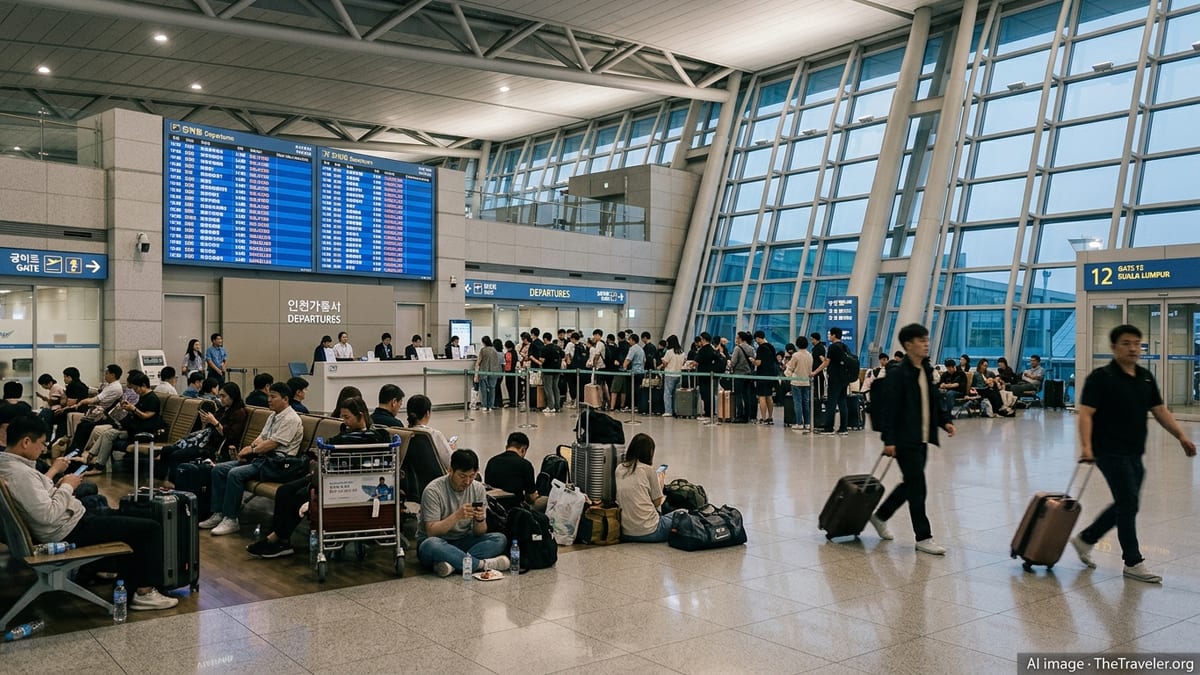
Flights at Incheon International Airport in South Korea faced fresh disruption this weekend after a key service to Kuala Lumpur was cancelled, leaving dozens of passengers stranded in terminal areas and triggering knock-on delays across multiple international routes in and out of the hub.
Get the latest news straight to your inbox!
Cancellation at Incheon Triggers Chain Reaction of Delays
The latest disruption at Incheon International Airport unfolded on a busy travel weekend, when a scheduled departure to Kuala Lumpur was withdrawn at short notice. Publicly available flight tracking data and airline updates indicate that the cancellation left travelers already checked in and past security with limited immediate alternatives, concentrating affected passengers in departure lounges for several hours.
Airport operations remained technically open, but the loss of a high-demand service on the Seoul Incheon to Kuala Lumpur corridor created a bottleneck as rebooking options narrowed. With many long-haul and regional flights operating near capacity, airlines struggled to accommodate displaced passengers on the same day, pushing some rebookings to later departures and, in certain cases, to next-day services.
Observers of Incheon’s traffic patterns noted that even a single high-capacity cancellation on a trunk route can reverberate across the network. Ground handling tasks such as baggage offloading, retagging, and document checks added further time to the recovery, slowing boarding for subsequent flights on nearby gates and contributing to rolling delays across several evening departures.
The disruption added fresh scrutiny to Incheon’s recent performance, following months of online reports from travelers describing longer queues at security and more frequent schedule changes during peak periods. While the airport continues to handle large volumes of international traffic, the latest incident has renewed concerns about resilience when individual flights are removed from the timetable at short notice.
Impact on Kuala Lumpur Route and Southeast Asia Connections
The Seoul Incheon to Kuala Lumpur sector is a major link between Northeast and Southeast Asia, serving both point-to-point demand and a sizable share of transfer traffic bound for destinations across Malaysia and the wider region. When the key flight was cancelled, passengers with onward tickets to cities such as Penang, Kota Kinabalu, and Singapore saw carefully timed itineraries unravel as minimum connection windows were breached.
Travel industry data shows that the corridor between Incheon and Kuala Lumpur is traditionally operated by a mix of full-service and low-cost carriers, with schedules designed to feed into early morning and late-night banks at Kuala Lumpur International Airport. The removal of even one of these rotations can break those patterns, forcing passengers onto less direct routings via alternative hubs such as Bangkok, Hong Kong, or Doha, or requiring overnight stays that were not part of original plans.
Social media posts from affected travelers over the weekend described long waits at service counters and uncertainty over when replacement flights would be confirmed. Some reported being rebooked onto later departures from Incheon, while others were offered rerouting via third-country gateways, adding several hours to total journey time. For travelers on tight business itineraries or connecting to events in Malaysia, the delays raised the risk of missed meetings and nonrefundable bookings on the ground.
For Kuala Lumpur-bound tourism flows, the disruption came at a time when regional carriers have been steadily rebuilding networks and adding capacity after previous years of reduced schedules. Any interruption on a key feeder route such as Incheon has the potential to ripple into hotel arrivals, tour departures, and domestic flight loads in Malaysia, especially on weekends when demand is typically strongest.
Conditions Inside the Terminal as Passengers Waited
Inside Incheon’s terminal, passengers facing extended waits sought seating, power outlets, and updated information on revised departure times. Based on publicly shared photos and descriptions, gate areas serving long-haul flights became noticeably more crowded as rebooked passengers converged on replacement services, while others remained in limbo waiting for confirmation of new itineraries.
Some travelers reported difficulty accessing timely information via customer-service hotlines, noting that on-the-ground staff and digital channels were dealing with high volumes of queries. Airline mobile apps and airport displays remained key sources of real-time status updates, but changes in boarding times and gate assignments meant that many passengers repeatedly checked screens or refreshed their devices while they waited.
The strain on amenities highlighted an increasingly common theme at major hubs when irregular operations occur. Seating near the departure gates for popular Southeast Asia and Oceania routes filled quickly, and families with children and older travelers appeared particularly affected by the lack of available rest areas. Duty-free zones and food outlets saw a rise in foot traffic as stranded passengers tried to pass the time or use meal vouchers provided under standard disruption policies.
Despite the congestion, airport services such as security and immigration remained operational, and there were no reports of terminal closures. However, the concentration of disrupted passengers in specific concourses created localized crowding that contrasted with otherwise normal activity in other parts of the airport.
Knock-On Effects on Other International Routes
Beyond the immediate cancellation on the Kuala Lumpur sector, the disruption produced secondary impacts across Incheon’s wider international network. Aircraft and crew rotations were adjusted, leading to schedule changes for flights to other Asian destinations and, in some cases, altered departure times to long-haul markets.
Public timetables and airline advisories show that carriers operating from Incheon typically depend on tightly sequenced turnarounds to maintain daily or near-daily frequencies. A delayed arrival or a grounded aircraft can cascade into later departures on subsequent legs, with cumulative delays building through the day. This pattern appeared to play out around the time of the Kuala Lumpur cancellation, with some outbound services experiencing moderate to significant delays.
Travel forums and real-time tracking platforms reflected growing frustration among passengers whose flights were not directly cancelled but departed late as the airport and airlines worked through the operational backlog. Travelers connecting through Incheon on their way from North America or Europe to Southeast Asia, or vice versa, reported anxieties over missed connections and shortened layovers, especially where re-clearing security or changing terminals was required.
For airlines, the event underscored the continuing challenge of balancing high load factors with the need for schedule resilience. With many routes already operating at strong occupancy levels, there was limited spare capacity to absorb disrupted passengers, increasing the likelihood of overnight delays or complex rerouting when irregular operations occur.
Advice for Travelers Using Incheon and Kuala Lumpur
In light of the latest disruption, publicly available guidance from airlines, airports, and travel experts continues to emphasize preparation and flexibility for passengers connecting through major hubs such as Incheon and Kuala Lumpur. Travelers are encouraged to monitor flight status closely in the 24 hours before departure, as short-notice schedule adjustments have become more frequent across many international networks.
For those planning connections between Incheon and Kuala Lumpur, building in longer layover times than the minimum advertised can offer a buffer when one leg of the journey is delayed or cancelled. Passengers booking complex itineraries with separate tickets may face additional risk, as protection and automatic rebooking often apply only when all segments are on the same reservation and carrier or alliance.
Travel insurance with coverage for missed connections, extended delays, and overnight accommodation continues to be recommended by many consumer advocates, particularly for long-haul journeys that depend on one or two critical transit points. Keeping essential items such as medication, documents, and a change of clothes in carry-on baggage can also make an unexpected night at an airport hotel or transit lounge more manageable.
While Incheon remains a key gateway between Northeast Asia and Southeast Asia, the latest Kuala Lumpur-related disruption highlights how quickly even a single cancellation can affect hundreds of travelers across multiple continents. For passengers, staying informed, allowing extra time, and understanding rebooking options remain central strategies for navigating an increasingly crowded and occasionally fragile global air travel network.