

More news on this day
Independent hotels and alternative accommodations are accelerating their use of artificial intelligence tools in early 2026, aiming to defend margins and meet rising guest expectations in a slowing but more demanding travel market.
Get the latest news straight to your inbox!
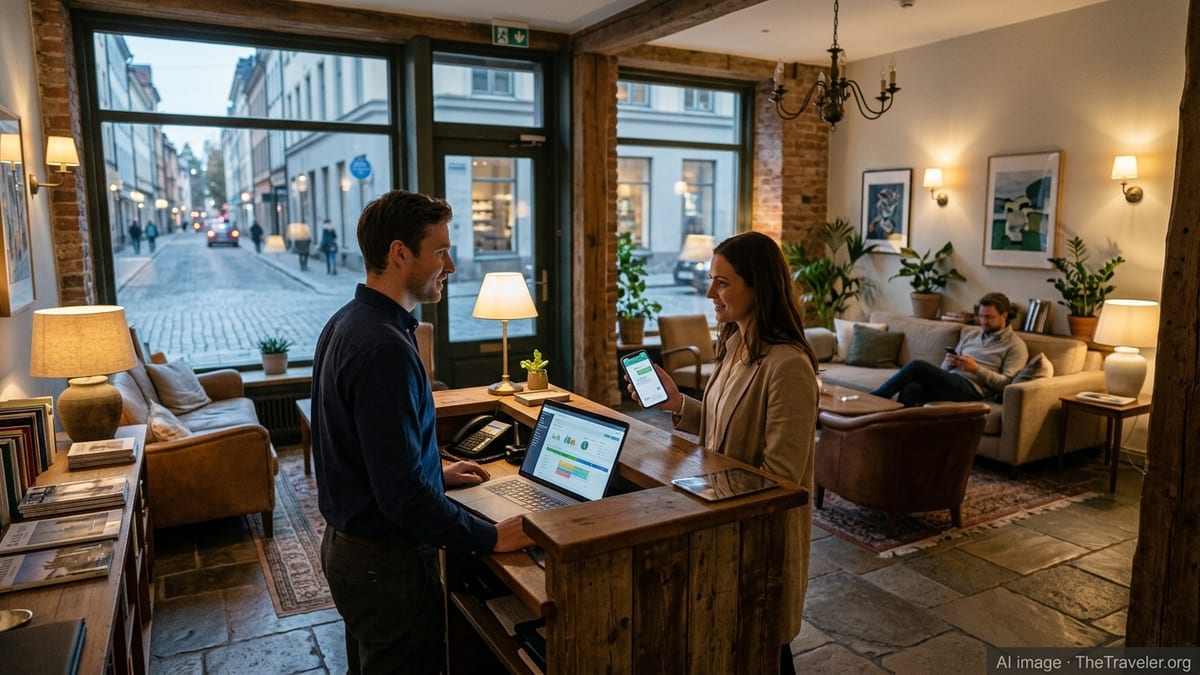
New Market Pressures Push Smaller Players Toward Automation
After several years of post‑pandemic recovery, publicly available forecasts point to more moderate travel growth in 2026, with higher operating costs and softer booking curves squeezing smaller accommodation providers. Research on artificial intelligence adoption among small and medium‑sized enterprises indicates that competitive pressure and labor constraints are now key triggers for investment, a pattern increasingly visible in independent hospitality businesses.
Many owner‑operated hotels and short‑term rentals report thinner staffing levels than before 2020, even as guests expect faster responses, richer digital information and more personalized service. Industry commentary in late 2025 and early 2026 highlights operators facing volatile demand, shorter lead times and aggressive discounting from large hotel groups with sophisticated revenue management platforms.
In this environment, AI tools are being framed less as experimental add‑ons and more as essential infrastructure. From dynamic pricing to automated guest messaging, independent properties are adopting systems that promise near real‑time decisions and 24‑hour coverage that would be difficult to match with traditional staffing models.
AI Revenue Engines Move Beyond Large Chains
Revenue management has become one of the earliest and most visible areas of AI deployment among independent accommodations. Technology providers that historically served smaller hotels and hostels are now embedding predictive and so‑called causal AI directly into their property management and distribution platforms, promoting the tools as a way to close the gap with chain brands.
Cloudbeds, which focuses on independent hotels and short‑term rentals, has expanded its Signals and Revenue Intelligence tools, describing them as AI‑driven systems that help hoteliers anticipate demand and optimize pricing decisions in real time. Company materials and trade coverage around its Passport 2025 event pointed to an integrated approach that combines market data, booking patterns and property‑level performance into automated recommendations for rates and inventory allocation.
Other hospitality technology firms have followed a similar path. Guestline highlighted an AI‑powered revenue management system at ITB Berlin 2025, positioning it specifically for independent hotels that lack dedicated revenue teams. Reports indicate that the tool is designed to adjust pricing based on demand signals, competitor rates and booking windows, effectively giving smaller properties a rules‑based, machine‑assisted revenue manager.
Consulting analysis published in March 2026 describes pricing optimization as one of the clearest value pools for AI in hospitality, with algorithms tuning room rates and availability across channels. While much of the commentary has focused on global brands, the same logic is now being applied to independents through plug‑and‑play cloud systems that do not require large in‑house data teams.
Guest Messaging, AI Concierges and the Race for Responsiveness
Alongside pricing, guest communication is emerging as a frontline application for AI among smaller accommodations. Messaging platforms and property management systems increasingly promote AI assistants that can answer routine questions, coordinate check‑ins and triage maintenance requests across channels like email, messaging apps and booking platform inboxes.
A partnership between Cloudbeds and AI provider GigaML, announced in 2025, introduced Engage, a voice‑enabled AI concierge available to tens of thousands of independent hotels using the Cloudbeds platform. Public descriptions of the service emphasize 24‑hour coverage for common guest inquiries, upsell suggestions and simple reservation changes, with the goal of freeing staff time for higher‑value interactions.
Third‑party tools targeting partners of large online travel agencies are also proliferating. Runnr.ai, for example, has promoted AI guest messaging that can handle a high proportion of inbound questions from Booking.com guests and other channels, automating answers about arrival times, parking, house rules and local recommendations. Reports from the company suggest that such tools can automate most standard messages while passing complex or sensitive issues to human staff.
At the platform level, Booking Holdings has highlighted new generative AI tools for accommodation partners, including Smart Messenger and Auto‑Reply features unveiled in 2025. Earnings commentary indicated that these tools are designed to help properties respond faster to guest inquiries, with the wider corporate transformation program expected to generate significant cost savings. For independent operators that rely heavily on major distribution platforms, these embedded features lower the barrier to testing AI without a separate technology procurement.
Marketing, Content and Distribution Get an AI Upgrade
As the accommodation market becomes more crowded, visibility on search engines, maps and booking platforms is becoming harder to secure, especially for smaller brands. AI‑enabled content tools are emerging as another area where independents can compete with limited marketing budgets.
Cloudbeds has rolled out an AI assistant within its website builder, designed to help small properties generate and refine search‑optimized descriptions, headings and on‑site copy based on a simple business profile. According to product documentation, the tool can rework basic information about a property into structured web content, saving owners time and potentially improving discoverability.
Beyond first‑party websites, AI is also influencing how independent stays appear across the wider travel web. Stay22, a Canadian company that provides accommodation maps to event organizers and publishers, has developed an AI tool that automates the addition of affiliate links to booking partners. Public information indicates that the tool is meant to make it easier for media and creators to surface nearby independent stays alongside major brands, broadening distribution without individual negotiations.
With booking platforms themselves experimenting with AI‑driven trip planners and natural‑language search filters, independent accommodations are increasingly navigating an ecosystem in which algorithmic systems interpret both their content and guest reviews. Industry analysis suggests that property descriptions, images and responses to feedback may all feed into ranking and recommendation systems, prompting independents to treat content management as a strategic function.
Balancing Promise, Costs and Guest Trust
Despite rapid product launches, adoption is far from uniform. A 2025 European accommodation barometer commissioned by Booking.com found that many small and mid‑sized hoteliers recognized the potential of AI but expressed concern about costs, data privacy and uncertain return on investment. The report pointed to a divide between early adopters investing in multiple AI tools and more cautious operators taking a wait‑and‑see approach.
OECD research on AI uptake among small and medium‑sized enterprises similarly notes that skills gaps, integration complexity and vendor dependence remain significant barriers. For family‑run hotels and independent vacation rentals, the prospect of entrusting pricing or guest communications to opaque algorithms can be unsettling, particularly when reputations are built on personal relationships and local knowledge.
Guest sentiment is also mixed. While surveys cited by Booking.com and other travel firms show a growing share of travelers comfortable with AI‑supported planning, online forums carry frequent complaints about automated support systems that feel unresponsive or make it harder to reach a human agent. For independent accommodations that compete on service, misconfigured chatbots or rigid automated replies risk undermining the very differentiation they seek.
Analysts and consultants argue that the most resilient independent operators in 2026 are likely to be those that blend AI with human judgment, using automation to handle repetitive or data‑heavy tasks while keeping staff focused on high‑touch, locally informed service. As AI tools move from experimentation to everyday utility, the challenge for smaller players will be less about whether to adopt them and more about how to govern, monitor and continually refine them in a market where both demand and expectations show no sign of standing still.