

More news on this day
Indian Railways has announced an extended run of special weekly services between Visakhapatnam and Sir M Visvesvaraya Terminal (SMVT) Bengaluru for Holi 2026, responding to unprecedented demand on one of the south’s most sought-after festival corridors and signalling a wider push to manage record-breaking seasonal travel this March.
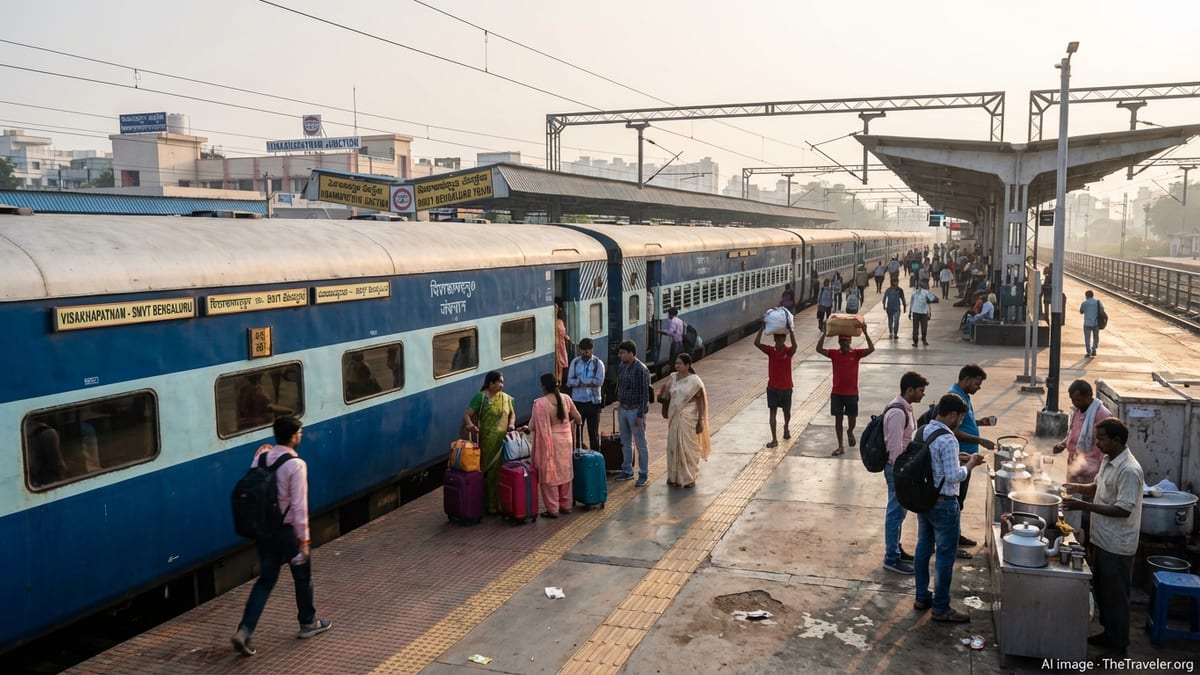
Extra Services Timed to Meet Peak March 2026 Holi Rush
The extended Visakhapatnam – SMVT Bengaluru specials come as rail authorities across India brace for what is shaping up to be a record Holi travel season in March 2026. Railway officials have cleared additional weekly trips under train numbers 08581 and 08582, designated as special fare services, to operate across the core festival window.
According to recent notifications from East Coast Railway and South Central Railway, the Visakhapatnam – SMVT Bengaluru Special (08581) is scheduled to run on Sundays from early March until the end of the month, with the return SMVT Bengaluru – Visakhapatnam Special (08582) operating on Mondays over the same period. The timing aligns closely with projected passenger peaks around Holi, which falls in late March this year.
The new timetable effectively builds on earlier seasonal operations of this pair, which had already been deployed for festival and summer rush in previous years. By confirming a continuous weekly pattern for the entire Holi window, Indian Railways aims to give passengers more predictability and a better chance of securing confirmed berths on this busy east–south axis.
Railway planners say the extended run is part of a broader, zone-wise strategy to front-load capacity where demand is most intense. With advance reservations for the Holi period already filling up fast, putting additional weekly specials into the system now is intended to prevent a last-minute scramble for tickets on flagship long-distance routes.
From Short-Term Festival Extra to Strategic Weekly Corridor
What began a few years ago as a short-term Holi special between Visakhapatnam and Bengaluru has steadily evolved into a strategically important seasonal corridor. Earlier Holi editions, such as the 2025 services branded under numbers 08549 and 08550, saw packed coaches and long waitlists as passengers from Andhra Pradesh and Odisha sought direct connectivity to Bengaluru.
On the back of those load factors, railway managers incrementally expanded the offering. By late 2025, a new spell of weekly specials under 08581 and 08582 was authorised for an extended festival season, operating from mid-September through late November to handle combined Dussehra and Deepavali crowds. That experience, coupled with sustained patronage, set the template for the more ambitious Holi 2026 deployment now taking shape.
The latest move effectively upgrades the Visakhapatnam – SMVT Bengaluru special from an occasional relief train into a semi-regular seasonal link. Officials have signalled that, where operating conditions allow, similar extended weekly patterns could be repeated in future festival peaks, transforming what was once ad hoc capacity into a more predictable travel option for migrant workers, students and family travellers on this route.
For passengers, that shift matters. Instead of waiting for last-minute announcements, they can now plan Holi journeys weeks in advance, particularly around weekends, when the Sunday–Monday pairing provides a natural structure for outbound and return trips between the coast and Karnataka’s capital.
Coastal–Tech Hub Link at the Heart of India’s Holi Travel Story
The Visakhapatnam – SMVT Bengaluru corridor sits at the intersection of two powerful travel trends that become especially visible during Holi: the pull of coastal hometowns in Andhra Pradesh and Odisha, and the gravitational force of Bengaluru as a pan-Indian technology and services hub.
Visakhapatnam, a key city on the east coast, draws students, IT and engineering professionals originally from the region who now live and work in Bengaluru. During festivals, many of them attempt to return home, placing enormous strain on mainstream routes via Vijayawada or along the Howrah–Chennai trunk line. The direct specials to SMVT Bengaluru provide an alternative that bypasses some of the most crowded junctions and shortens overall journey times.
Railway officials note that the composition of passengers on these trains is highly diverse: young professionals with reserved AC tickets, families travelling together in sleeper coaches, and budget-conscious migrants making use of general class. Holi’s colourful celebrations amplify that mix, as travellers carrying sweets, gifts and luggage fill platforms and coaches on both ends of the route.
By positioning the Vizag–SMVT Bengaluru specials as dedicated Holi connectors, Indian Railways is capturing and shaping this seasonal flow more efficiently. The weekly pattern is also expected to smooth demand spikes that would otherwise overwhelm a smaller number of standard express services on neighbouring lines.
Part of a Nationwide Ramp-Up of Holi Festival Services
The extension of the Visakhapatnam – SMVT Bengaluru specials is emblematic of a wider national push for Holi 2026, a season in which Indian Railways plans to operate up to 1,500 special trains across multiple zones. Central Railway alone has announced 186 special services for the period, while South Central Railway and South Western Railway have rolled out their own slates of festival extras targeting popular northbound and eastbound destinations.
East Coast Railway has been among the most active in this effort, unveiling a basket of Holi-oriented services that includes the 08579/08580 Visakhapatnam – Charlapalli pair, the Visakhapatnam – Tirupati specials, and long-haul links between coastal Odisha and north India such as Puri–Patna. Within that package, the 08581/08582 Visakhapatnam – SMVT Bengaluru weekly special has emerged as a flagship southbound connection.
Railway planners say these trains are calibrated not merely by geography but by detailed data on booking patterns, previous waitlist volumes and passenger feedback. On several key festival routes, special trains now run on fixed days of the week across an entire month rather than as one-off extras, giving them the feel of seasonal timetable additions rather than sporadic relief services.
The Holi 2026 operations also sit against a backdrop of broader infrastructure upgrades. New zones, such as the South Coast Railway headquartered in Visakhapatnam, are set to become fully operational in the coming months, promising more granular control over capacity planning and the possibility of additional festival-focused schedules radiating from the Andhra coast.
Timings, Pattern and What Passengers Can Expect
Under the current Holi 2026 plan, train 08581 Visakhapatnam – SMVT Bengaluru Special is slated to depart on Sundays throughout March, providing a weekend outbound option from the coast. The corresponding 08582 SMVT Bengaluru – Visakhapatnam Special runs on Mondays, giving Bengaluru-based passengers a structured way to return home after the weekend or to begin a homebound journey early in the festival week.
Exact departure and arrival timings vary by timetable update, but the trains are typically configured as overnight or near-overnight services, allowing travellers to board in the afternoon or evening and arrive the following morning or midday. The rake composition generally includes AC two-tier and three-tier coaches, sleeper class and general unreserved coaches, reflecting the mixed demographic that uses the route.
Given the special-fare designation, ticket prices are slightly higher than some regular express services, but officials argue that passengers are paying for guaranteed festival-period capacity and more convenient slots. Booking is available through standard reservation channels and online platforms, and authorities have urged travellers to secure seats early, as initial quotas for Holi dates have already begun to fill.
At intermediate stations, staff are being briefed to manage crowding on platforms, especially near general coaches. Visible signage, public announcements and temporary queuing systems are likely to be deployed on the busiest days, particularly around Holi week itself, when walk-in demand from last-minute travellers typically spikes.
Operational Challenges Behind the Holi Capacity Surge
Running extended weekly specials between Visakhapatnam and SMVT Bengaluru is operationally complex, railway officials acknowledge. The corridor traverses busy sections that also handle high volumes of freight, including coal and container traffic critical to ports on the east coast. Finding daytime and overnight slots that do not cripple freight flows or delay regular passenger services requires careful timetable choreography.
Maintenance windows for both locomotives and passenger coaches must be built around the Sunday–Monday running pattern, often relying on tight turnarounds in terminal yards. Crew availability also plays a role, as additional drivers, guards and on-board staff must be rostered for the festival period without undermining safety or working-hour norms.
Signals and traffic control centres across the route are expected to operate at near-peak utilisation for much of March, particularly on weekends when Holi specials, regular long-distance expresses and regional trains all converge. Railway managers say contingency plans are in place for fog, localised disruptions or technical snags, but they concede that some knock-on delays are almost inevitable when the network is this heavily loaded.
Despite those pressures, Indian Railways has made a point of prioritising festival specials for Holi, treating them as a core public-service obligation. In internal briefings, officials have underlined that for many lower- and middle-income families, trains like the Vizag–SMVT Bengaluru specials are the only affordable way to travel home for the festival.
Passenger Experience: Crowded Coaches, Growing Expectations
For passengers, the extension of the Visakhapatnam – SMVT Bengaluru specials is welcome news, but it does not eliminate all travel pain points. Even with the extra services, Holi journeys are often crowded, especially in general and sleeper classes, where families compete for limited space and travellers board at multiple intermediate stations.
Cleanliness and punctuality remain recurring concerns. With tight rake rotations and intensive utilisation, coaches can show the strain of back-to-back runs, and on-time performance can be challenged by bottlenecks on shared stretches of track. Authorities insist that additional cleaning staff and on-board housekeeping services are being deployed for festival specials, but implementation can vary across trips.
On the positive side, frequent travellers on the route say that having a dedicated weekly Holi special between Visakhapatnam and SMVT Bengaluru has already improved their planning. In previous years, many relied on indirect routes via Chennai, Vijayawada or Hyderabad, often requiring multiple changes and overnight waits in unfamiliar stations. A through service, they say, cuts both journey time and stress.
Digital ticketing has also altered the Holi travel experience. With bookings for these specials opening in advance, passengers are increasingly tracking availability online, setting alerts and using data from previous seasons to decide when to buy, where to board and which class to target for the best balance of comfort and cost.
Looking Ahead: Will Holi Specials Become Semi-Permanent Links?
As Indian Railways leans more heavily on extended festival specials like the Visakhapatnam – SMVT Bengaluru weekly service, transport analysts are asking whether some of these trains could evolve into near-permanent fixtures. Strong load factors over repeated festival cycles, they argue, are evidence of underlying structural demand, particularly along corridors linking emerging coastal cities with metro job markets.
Officials have so far framed the Holi specials as temporary additions subject to operational feasibility, but they acknowledge that lessons from this year’s deployments will feed into future timetable planning. If the Vizag–SMVT Bengaluru services continue to run full in both directions during peak periods, additional seasons such as summer vacations or year-end holidays could see similar weekly patterns.
The pending full roll-out of the South Coast Railway zone, headquartered in Visakhapatnam, may further reshape the picture. With more granular control over originating services from the Andhra coast, planners will have greater flexibility to design corridors that reflect regional travel realities rather than legacy administrative boundaries.
For now, though, the focus remains firmly on Holi 2026. As thousands of passengers in both cities scramble to secure berths on the extended specials, the Vizag–SMVT Bengaluru link has become a test case for how India’s rail network can adapt, at speed and at scale, to the emotional and economic pull of festival travel.