

More news on this day
India’s aviation and diplomatic establishments are weighing their options after Dubai moved to cap foreign airlines at a single daily round-trip, a temporary measure tied to the Iran crisis that is hitting Indian carriers particularly hard and raising the prospect of retaliatory limits on UAE-based airlines.
Get the latest news straight to your inbox!
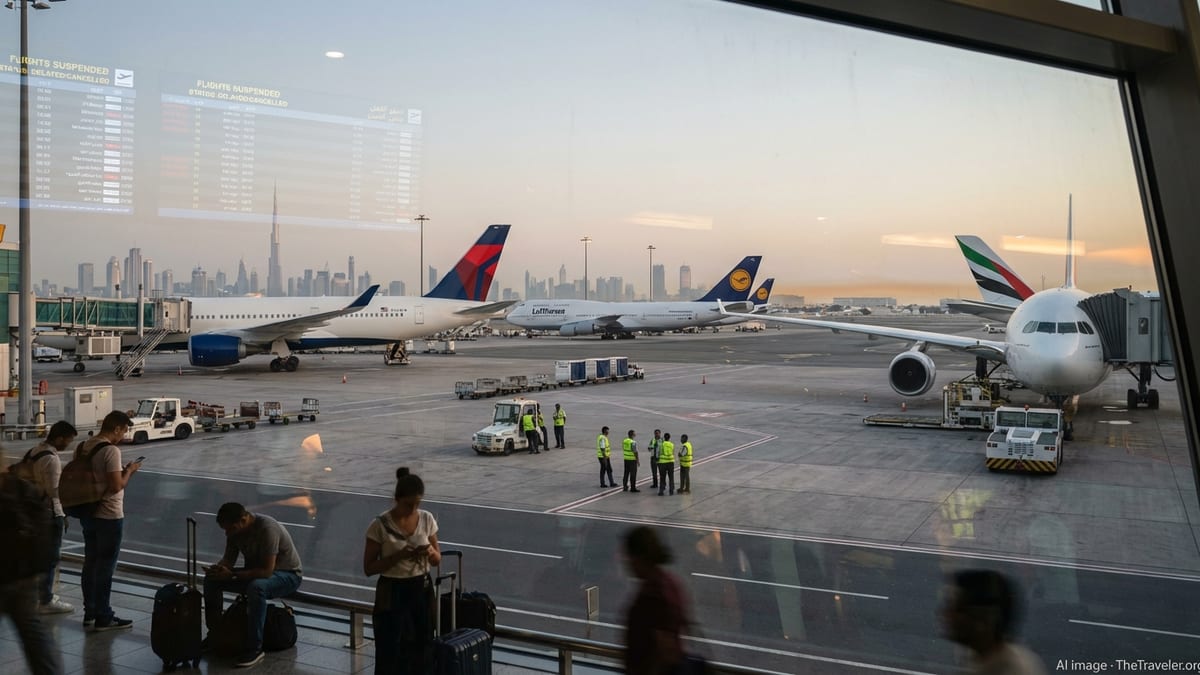
Dubai’s One-Flight Rule Reshapes a Crucial Corridor
Publicly available information shows that Dubai Airports has instructed all non-UAE airlines, including Indian carriers, that they may operate only one round-trip per day in total to Dubai International and Al Maktoum International between 20 April and 31 May 2026. The restriction, framed as a capacity and safety response to regional tensions with Iran, extends limits first introduced immediately after conflict escalated earlier this year.
Reports indicate that the cap reduces overall foreign airline capacity into Dubai by around 90 percent for the period, with India among the most exposed markets. The India–Dubai corridor is one of the busiest international flows for Indian travelers, connecting not only point-to-point traffic but also millions of passengers transiting onward to Europe, North America and Africa.
Emirati carriers such as Emirates and flydubai are not subject to the same one-flight-per-day ceiling, according to multiple industry reports, allowing them to maintain far more extensive schedules out of Dubai. Analysts note that this asymmetry is sharpening concern in New Delhi and within India’s airline industry that Indian operators could lose market share, at least temporarily, to their UAE competitors.
While Dubai’s move is officially described as temporary and linked to constrained airspace and operational risk, travel analysts cited in regional coverage suggest the measure could be extended if the security situation around Iran and the wider Gulf does not stabilise in the coming weeks.
Indian Airlines Face Disproportionate Disruption
The Federation of Indian Airlines, which represents IndiGo, Air India and SpiceJet, has sent a formal communication to India’s Ministry of Civil Aviation outlining the impact of Dubai’s cap on Indian carriers. According to summaries of the letter carried in Indian media, Indian airlines have been asked to cancel large numbers of flights and consolidate what remains into a single daily rotation per carrier group.
For large operators such as IndiGo and Air India, which together run multiple daily services from several Indian cities to Dubai under normal conditions, the cutback is severe. Travel-focused outlets estimate that Indian carriers collectively planned hundreds of flights on the India–Dubai sector between late April and the end of May that will now need to be reduced or re-routed. Some services are being shifted to alternative Gulf hubs where feasible, while others are simply cancelled.
The reduction adds to existing headwinds for Indian aviation. A prolonged restriction on using Pakistani airspace has already forced longer routings on many westbound services, raising costs and stretching aircraft and crew availability. Elevated jet fuel prices linked to the Iran conflict have further compressed margins. The Dubai cap, in this context, removes one of the most lucrative and high-demand international sectors just as airlines were counting on summer traffic to strengthen their balance sheets.
Airlines now face difficult choices on which Indian cities retain direct Dubai links and which will rely on connections through other hubs. Larger metros such as Delhi and Mumbai are expected to keep a pared-back Dubai presence, while secondary cities may see direct links suspended for the duration of the cap.
Diplomatic Pressure and Talk of Reciprocal Measures
According to published coverage of the Federation of Indian Airlines’ communication, the group is urging the Indian government to seek relief from Dubai on two tracks. First, it wants New Delhi to press for additional slots or higher frequency allowances specifically for Indian carriers, arguing that India’s market size and passenger flows justify more than a one-flight cap. Second, if that effort fails, it has called for calibrated reciprocal restrictions on Emirates and flydubai in Indian airports.
Commentary in Indian business media suggests that reciprocal limits could take the form of capping Emirati carriers to one daily frequency on key India routes for the same April–May window, or restricting new capacity additions until the Dubai cap is lifted. Such steps would mark a rare escalation in an aviation relationship that, until now, has largely been defined by expansion and liberalisation.
Public statements from New Delhi so far have been cautious, with officials signalling that all options remain on the table while emphasising passenger welfare and the need to maintain essential connectivity. Analysts note that India’s government must balance pressure from domestic airlines with broader strategic and economic ties with the United Arab Emirates, which include trade, investment and a large Indian expatriate community.
For Dubai, easing the cap too quickly could be seen as premature while airspace and infrastructure remain under strain from the Iran-related conflict and recent attacks on UAE territory. For India, allowing the restriction to persist without some concessions risks entrenching competitive disadvantages for its carriers in a key international market.
Travelers Caught Between Security and Connectivity
For travelers, the immediate effect of Dubai’s one-flight rule is a sharp tightening of seat availability and a surge in fares on remaining services between India and the emirate. Aviation and travel portals report that economy-class prices on some peak dates in late April and May have risen significantly compared with earlier in the year, as capacity shrinks faster than demand.
Passengers with existing bookings on cancelled flights are being offered re-accommodation on the limited remaining services or refunds, but many are finding that suitable alternatives are either sold out or substantially more expensive. Those using Dubai as a transit hub to reach Europe or North America are increasingly being re-routed through Doha, Abu Dhabi, Muscat or even non-Gulf hubs such as Istanbul and Singapore, depending on airline alliances and available capacity.
Travel advisors quoted in specialist media are encouraging passengers to build in longer connection times, stay flexible on dates and consider secondary airports where possible. Indian tourists heading to popular destinations in the Middle East and beyond are also being urged to keep a close eye on schedule updates as airlines continue to adjust their networks in response to evolving restrictions.
Despite this, demand for international travel out of India remains robust, particularly around school holidays and festival periods. With Dubai long established as both a leisure hotspot and a global transfer point, many travelers are likely to accept longer journeys and more complex routings rather than cancel trips outright, at least in the short term.
Broader Impact on Gulf Hubs and Regional Aviation
The Dubai cap unfolds against a backdrop of wider disruption across Middle Eastern airspace caused by the Iran conflict. Regional and international media report that parts of Iranian, Iraqi and other nearby airspace remain restricted, forcing airlines to use longer or more southerly routes. Several global carriers have temporarily suspended services to certain Gulf destinations or reduced frequencies to manage operational risk.
Dubai, Doha and Abu Dhabi, traditionally resilient hubs, have all reported schedule adjustments, aircraft reassignments and temporary suspensions of select routes while they adapt to the evolving security picture. In the UAE, authorities have focused on maintaining core connectivity while introducing measures such as the foreign-airline cap in Dubai to manage traffic flows and reduce congestion during peak risk periods.
Industry observers note that India’s response to Dubai’s one-flight policy will be closely watched across the region. If New Delhi opts for firm reciprocal limits, other countries could follow suit in future disputes over slots and capacity, potentially reshaping the delicate balance in the Gulf’s hub-and-spoke model. Conversely, a negotiated compromise that restores some additional flights for Indian carriers without triggering a tit-for-tat escalation would reassure markets that aviation ties can withstand geopolitical shocks.
For now, the one-flight cap illustrates how quickly strategic tensions can ripple through the travel ecosystem, affecting everything from airline economics and diplomatic ties to individual holiday plans. As the Iran crisis continues to evolve, travelers and industry stakeholders alike will be watching for signs that Dubai and New Delhi can find common ground to stabilise one of the world’s most important aviation corridors.