

More news on this day
Indian airlines are set to operate about 10 per cent fewer flights in the upcoming summer schedule, as carriers recalibrate capacity in response to tighter crew duty rules, grounded aircraft and a turbulent international operating environment.
Get the latest news straight to your inbox!
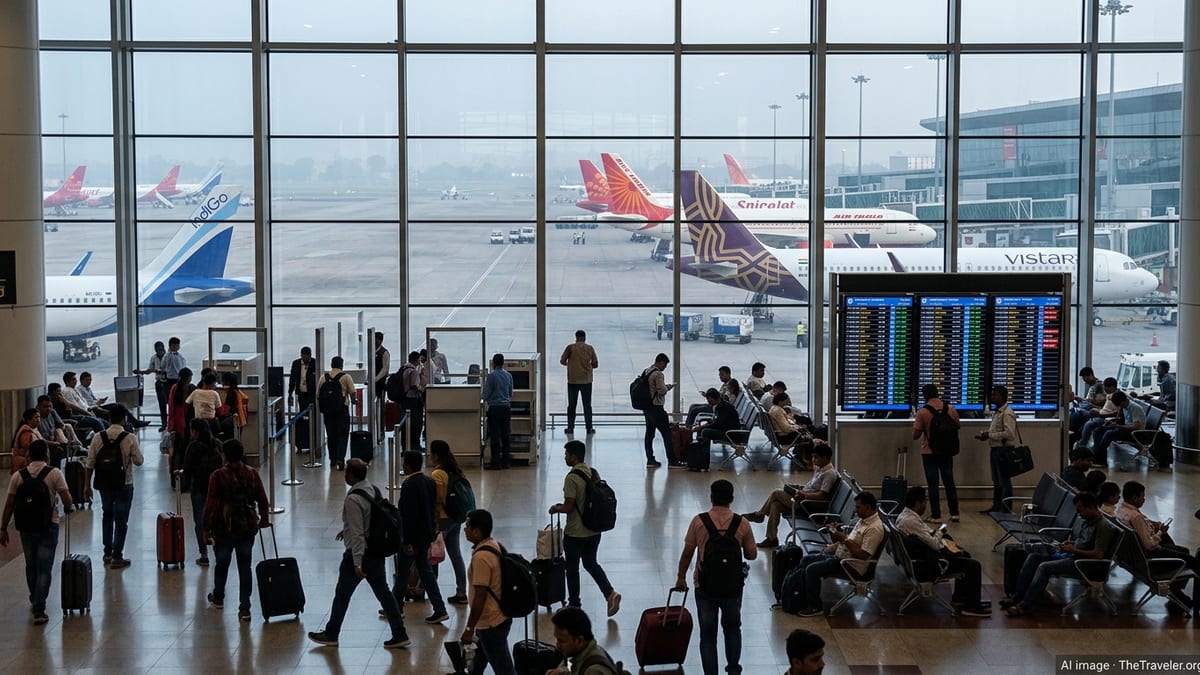
Summer schedule scaled back after a turbulent winter
The summer schedule, which runs from late March to the end of October, typically marks a period of aggressive capacity expansion by Indian airlines to capture peak holiday and business travel demand. This year, publicly available filings and media reporting indicate a more cautious stance, with planned flights trimmed by around a tenth compared with earlier targets.
The pullback follows a winter marked by widespread disruptions, most visibly at IndiGo, India’s largest carrier by market share. Reports indicate that IndiGo cancelled thousands of flights in early December 2025 after struggling to adjust rosters to new Flight Duty Time Limitation norms, prompting the regulator to order a 10 per cent reduction in the airline’s approved winter schedule.
Subsequent coverage shows that this regulatory curtailment and the airline’s own stabilisation plan have had a knock-on effect on capacity planning for the April to October 2026 period. Rather than restoring all of the earlier planned flights, IndiGo and several rivals have submitted more conservative schedules designed to prioritise reliability over rapid growth.
While detailed consolidated figures for the entire domestic market are still emerging, industry analysts cited in recent business reports estimate that the combined effect of airline-level cuts will leave total scheduled flights in the summer season roughly 10 per cent below what had been projected before the winter crisis.
IndiGo rethinks growth targets under crew and fleet pressure
IndiGo’s revised summer plans are central to the sector-wide reduction. Documents reported by Indian business media indicate that the carrier, which had originally aimed for as many as 2,550 daily departures in the summer, has scaled that ambition back significantly as it works through crew shortages and incorporates stricter duty-time norms.
The airline is now seeking regulatory approval to operate in the range of roughly 1,875 to 1,950 daily narrow-body flights in the summer season, supported by additional ATR turboprop services and a limited number of wet-leased aircraft. That revised plan equates to an increase over last summer’s actual operations, but remains materially lower than the initial target set before the winter meltdown.
Publicly available information shows that a portion of IndiGo’s fleet remains grounded due to ongoing Pratt & Whitney engine issues, constraining the number of deployable aircraft. Combined with the need to roster more pilots per block of flying hours under the updated duty rules, this has forced the airline to balance growth aspirations with operational resilience.
Analysts point out that IndiGo’s recalibration alone can shift overall Indian domestic capacity, given its market share of well above half of all passengers carried. Even modest percentage adjustments at the airline therefore translate into noticeable changes in the total number of flights available to travellers.
Other carriers juggle expansion and resource constraints
Other Indian carriers are using the summer schedule to fine-tune their networks rather than pursue aggressive across-the-board expansion. Coverage of Air India’s northern summer plan highlights targeted increases on select international routes, including additional frequencies to London Heathrow, Birmingham, Zurich and Vienna, as part of the group’s long-term transformation strategy.
However, those international additions are being layered onto a domestic environment where crew availability, maintenance windows and aircraft induction timelines are under scrutiny. Sector observers note that while full-service and newer low-cost carriers such as Akasa and Air India Express may see an opportunity to capture share left on the table by IndiGo’s pullback, they remain constrained by training pipelines and aircraft delivery schedules.
SpiceJet, which has been restructuring its fleet and finances, is expected to add aircraft through 2025 and 2026, but its ability to rapidly step into any capacity gaps is limited by the pace at which grounded aircraft can be returned to service. Regional operators and upcoming entrants are similarly unlikely to offset a 10 per cent sector-wide reduction in the near term.
As a result, the net picture is one of selective growth and route rationalisation, rather than an all-out capacity race. Airlines appear to be prioritising routes with strong year-round demand and higher yields, while quietly trimming marginal or highly seasonal services from the summer plan.
Geopolitics and airspace constraints reshape long-haul strategies
The summer schedule has also been shaped by external factors beyond domestic regulatory changes and fleet issues. Continuing closure or restrictions on Pakistani airspace for Indian airlines, combined with conflict in parts of West Asia, have complicated flight planning on some of the country’s most lucrative long-haul corridors.
Media coverage over the past year has highlighted how carriers such as Air India have been forced to route many Europe and North America services via technical stops in Europe to refuel, in order to avoid closed or high-risk airspace. These detours increase block times, fuel burn and crew costs, reducing the commercial attractiveness of certain flights.
In response, airlines are using the summer schedule to rationalise long-haul operations, focusing on routes and frequencies that can sustain higher operating costs or be supported through improved aircraft utilisation elsewhere in the network. This, in turn, feeds back into decisions about how much short-haul capacity can be supported by available aircraft and crews.
Industry analysts say the combination of airspace constraints, volatile fuel prices and lingering supply-chain issues around aircraft and engines has made this summer’s planning cycle unusually complex, pushing airlines to err on the side of restraint in their published schedules.
What fewer flights could mean for Indian travelers
For passengers, a 10 per cent reduction from previously envisaged flight levels is likely to be felt most on busy metro corridors and popular leisure routes during peak travel weeks. With less spare capacity in the system, load factors are expected to remain high, particularly around school holidays and festival periods.
Travel trade commentators suggest that with airlines focused on maintaining punctuality and avoiding another wave of large-scale cancellations, last-minute fares on constrained routes could rise more sharply than in previous years. At the same time, the rollback of temporary domestic fare caps, introduced at the height of the IndiGo crisis, is expected to give carriers broader pricing flexibility.
On the positive side for travelers, a more conservative schedule may reduce the risk of abrupt, same-day cancellations that characterised parts of the last winter season. By aligning flight plans more closely with available crews and airworthy aircraft, airlines aim to deliver a steadier, if slightly less abundant, summer offering.
For the wider tourism sector, including hotels and destinations that rely heavily on air connectivity, the scaled-back schedules will be closely watched. While overall air traffic is still expected to grow compared with last year’s actual levels, the decision by Indian airlines to operate roughly 10 per cent fewer flights than originally planned underlines how a maturing market is learning to trade sheer volume for greater operational resilience.