

More news on this day
Indian Railways is preparing for one of its most ambitious capacity jumps in recent years, with plans for 1,024 new trains and 4,651 additional coaches to be rolled out across the network in 2026, a move that is expected to ease crowding, open new long-distance links and significantly upgrade day-to-day travel for millions of passengers.
Get the latest news straight to your inbox!
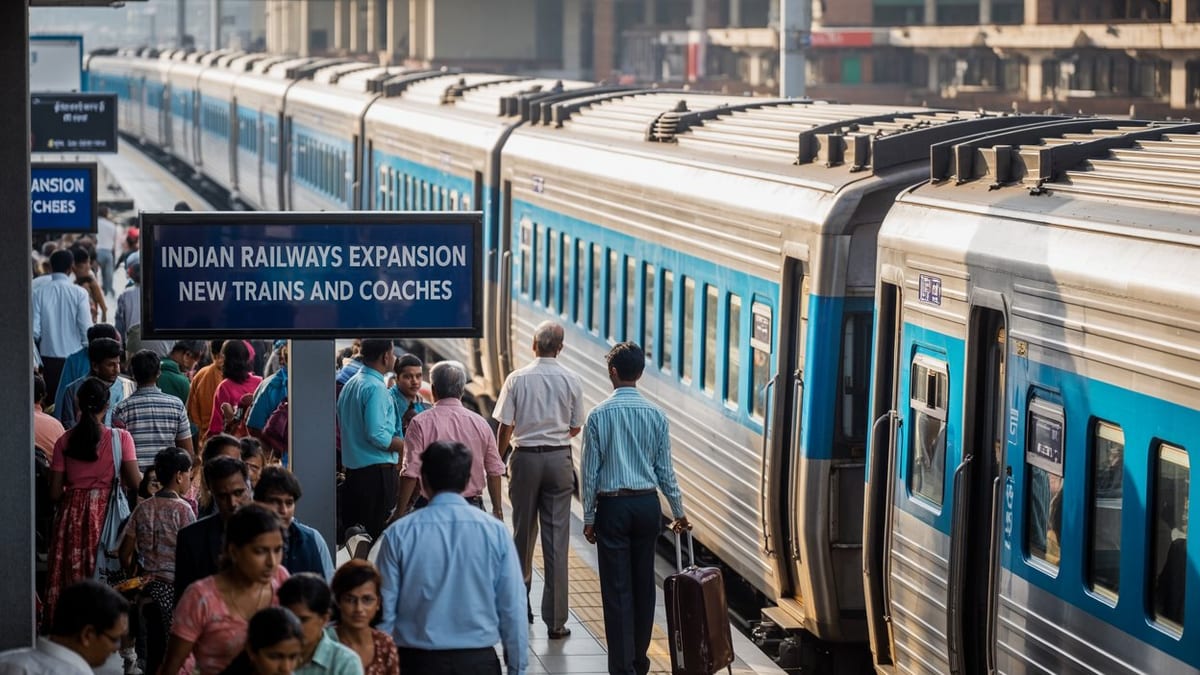
Image by Latest International Railway News, Global Rail Industry News
A Record-Breaking Year of New Trains
Publicly available planning documents and recent budget analyses for 2025–26 and 2026–27 indicate that Indian Railways is aligning its capital spending toward a sharp increase in passenger-carrying capacity, including a pipeline that adds more than one thousand new train services over the 2026 calendar year. This expansion builds on multi-year commitments for modern rolling stock such as Vande Bharat, Amrit Bharat and other superfast services that are already appearing on key intercity corridors.
The figure of 1,024 new trains reflects a combination of brand-new services and upgraded or extended routes that will operate as new train pairs in the timetable. These additions are being linked to a rolling stock programme that envisages thousands of fresh coaches entering service, enabling Indian Railways to run longer formations on busy routes while also introducing new point-to-point connections between state capitals, tier-two cities and emerging tourism hubs.
Budget documents for 2025–26 show that coach and locomotive production has been steadily scaled up to support this push, with economic and railway analyses highlighting thousands of new coaches being built at Integral Coach Factory, Modern Coach Factory and Rail Coach Factory. These manufacturing targets, combined with higher capital outlay for safety and capacity works, underpin the planned expansion of services set to be visible to passengers in 2026.
For travelers, the most immediate impact will be seen on sectors that are currently chronically waitlisted. Additional services on trunk routes such as Delhi–Kolkata, Delhi–Mumbai, Chennai–Bengaluru and eastern and northeastern corridors are expected to absorb some of the latent demand that has been spilling over to buses and low-cost airlines, particularly during festivals and holiday peaks.
4,651 New Coaches to Ease Congestion and Upgrade Comfort
The plan to deploy 4,651 additional coaches across the system in 2026 is central to how the new trains will be configured. Coach production targets collated in recent budget and economic survey coverage show a clear shift toward high-capacity, safer and more comfortable Linke Hofmann Busch (LHB) rakes, which are steadily replacing older ICF stock. This allows the network to lengthen trains without compromising on braking performance or ride quality.
The new coaches are expected to be distributed across reserved sleeper classes, unreserved general coaches and air-conditioned categories, including chair car and AC 3-tier. Analyses of recent years’ trends show rising demand in both ends of the spectrum: budget-conscious travelers rely heavily on unreserved and sleeper segments, while a growing middle class is booking AC berths and seats on premium express services. The 4,651-coach expansion is designed to address both markets simultaneously.
Travelers can expect more trains with dedicated disabled-friendly coaches, better toilet facilities and improved lighting and charging points, as design standards from the latest Vande Bharat and Amrit Bharat series filter into mainstream coach production. In practical terms, this means that even non-premium trains added to the timetable in 2026 are more likely to feature modern fittings instead of legacy layouts that many passengers still associate with long-distance rail journeys.
On high-density routes, Indian Railways is also expected to use the additional coaches to lengthen existing popular trains where platform and loop line infrastructure allows. This approach, coupled with new services, offers a twin-track strategy to reduce overcrowding inside coaches at peak times and to gradually bring average occupancy closer to more manageable levels.
Vande Bharat, Amrit Bharat and the New Face of Long-Distance Travel
The 2026 wave of new trains will not be limited to conventional express services. Reports on recent inaugurations show that semi-high-speed Vande Bharat and non-AC superfast Amrit Bharat trains are being deployed more widely, connecting cities such as Udaipur and Ahmedabad, Nagercoil and New Jalpaiguri, and Panvel and Alipurduar. These routes illustrate how Indian Railways is using new train categories to shrink travel times and improve reliability over long distances.
Vande Bharat services, with their trainset configuration and improved acceleration, are expected to feature prominently among the 1,024 new trains where track geometry and signaling support higher speeds. For passengers, this translates into faster journeys on key business and tourism corridors, along with on-board amenities such as better seating, information systems and more efficient climate control.
Amrit Bharat trains, designed as affordable but faster long-distance options with modern non-AC coaches, are emerging as a bridge between traditional mail/express services and premium trains. Their expansion across eastern, northern and southern routes points to a deliberate strategy to upgrade the experience of budget travelers without significantly raising fares. By 2026, a meaningful share of the new trains entering service is expected to follow this template.
These premium and quasi-premium additions are complemented by targeted seasonal and festival specials, such as Vande Bharat festival trains between Patna and New Delhi operated during peak travel periods in 2025. The expanded coach pool in 2026 will give zones greater flexibility to run similar short-term specials, smoothing demand spikes that have historically resulted in long waiting lists and overcrowded general compartments.
How the 2026 Expansion Will Change Your Journey
For regular travelers, the significance of 1,024 new trains and 4,651 coaches will be felt in everyday details: shorter waitlists, more choice of departure times, and better odds of securing a preferred class of travel. Passengers on overburdened routes may see additional overnight options or new early-morning and late-evening departures, making it easier to plan weekend trips or short business visits without losing working days.
The expansion is also expected to improve connectivity for smaller cities and towns that currently rely on a limited number of long-distance trains. New services that originate or terminate in such locations can reduce dependence on distant junctions, cutting overall journey time and the need for multiple changes. This is particularly relevant in regions of the northeast, central India and parts of the Konkan and coastal belts, where rail remains the most affordable long-distance mode of transport.
On board, travelers are likely to encounter a more consistent standard of rolling stock as older coaches are phased out and replaced with new builds. Features such as better suspension, enhanced crashworthiness and improved fire safety come built into the latest coach designs, contributing to a quieter, more stable ride and a higher sense of security, especially on overnight journeys.
Digital tools are expected to complement the physical expansion. As more trains are introduced, railway authorities are relying increasingly on data-driven timetable planning and dynamic pricing models, refining routes based on observed demand. For passengers booking tickets online, this should gradually translate into a wider spread of reasonably priced seats across multiple trains instead of intense competition for a handful of popular services.
What Travelers Should Watch for in 2026
As the 2026 timetable takes shape, travelers will want to track new train introductions in their region, particularly in the months following the start of the financial year, when many services linked to the fresh allocation of coaches are typically scheduled to begin. Rail users can expect waves of timetable updates as zones commission newly built rakes, complete crew training, and finalize rake links that determine how trains are rotated across routes.
Those planning major trips in late 2026 may benefit from revisiting booking plans closer to the date, since additional trains or upgraded services may appear on key sectors after the initial release of the timetable. This is especially likely on corridors earmarked in recent budgets and project pipelines for decongestion and travel time reduction.
Frequent rail passengers and travel businesses will also be monitoring how quickly the 4,651 new coaches are absorbed into regular operations. The pace at which they enter service will influence how soon crowding eases and how widely features from flagship trains, such as better interiors and passenger information systems, trickle down to ordinary express services.
While the exact rollout sequence will vary by zone and project readiness, the larger pattern is clear: 2026 is being positioned as a landmark year in which Indian Railways converts years of investment in infrastructure, manufacturing and new train concepts into a tangible, network-wide upgrade of the travel experience.