

The Midwest may be better known for cornfields than coastlines, but the dunes that rise above Lake Michigan tell a different story. Two of the region’s standout destinations, Indiana Dunes National Park on the south shore and Sleeping Bear Dunes National Lakeshore on the northern lower peninsula of Michigan, both deliver sweeping sand, big freshwater surf, and miles of trails. Yet they offer very different experiences. If you are deciding between Indiana Dunes and Sleeping Bear Dunes for your next trip, this side by side guide breaks down the key differences so you can choose the dunes escape that best fits your time, travel style, and budget.
At a Glance: Two Very Different Dune Escapes
Indiana Dunes and Sleeping Bear Dunes share a common backbone of wind sculpted sand, dune ridges, and Lake Michigan’s inland sea, but the feel of each place is strikingly different. Indiana Dunes National Park hugs a heavily developed stretch of shoreline between industrial facilities, commuter rail lines, and small resort towns in northwest Indiana, a short drive from Chicago. Sleeping Bear Dunes National Lakeshore, by contrast, sprawls across a largely rural section of the Leelanau and Benzie county coastline in northern Michigan, with forests, farms, and small villages framing the dunes.
Indiana Dunes is compact and surprisingly accessible. The national park, together with adjacent Indiana Dunes State Park, protects roughly 15,000 acres and about 15 to 18 miles of sandy shoreline, depending on how you count the patchwork of units. Visitors can step off an interstate or a South Shore Line commuter train and be on the beach or a trail in minutes. Sleeping Bear Dunes is far larger and more remote, with more than 70,000 acres of protected land and water and dozens of miles of Lake Michigan coast. Reaching it requires a several hour drive from major cities, but the payoff is a more immersive, wild feeling landscape.
The net effect is that Indiana Dunes lends itself to quick getaways, day trips, and spontaneous beach days, while Sleeping Bear Dunes functions better as a dedicated vacation hub. Both can deliver memorable dune adventures, but which one is “better” depends on how much time you have and what kind of experience you are after.
Getting There, Getting Around, and Trip Logistics
When it comes to pure convenience, Indiana Dunes is tough to beat. From downtown Chicago, drivers can reach the park’s western trailheads and beaches in roughly an hour in light traffic. Several park areas sit only a few miles off Interstate 94 and the Indiana Toll Road, and local highways stitch together the various beach access points and towns. The South Shore Line commuter train adds a rare car free option, with multiple stations including Dune Park and Beverly Shores within walking or biking distance of lakefront access points and the national park visitor center.
Sleeping Bear Dunes demands more commitment. The main gateway village of Empire is about five hours by car from Chicago under good conditions, and roughly four hours from Detroit or Grand Rapids. Public transportation options are limited and usually seasonal, so most visitors arrive by private car or rental vehicle. Once you are there, distances inside the lakeshore are moderate, but trailheads, overlooks, and campgrounds are spread out across several clusters of land on the mainland and the offshore Manitou Islands, making a car almost essential.
Lodging logistics also differ. Around Indiana Dunes, you will find a mix of chain hotels, small inns, vacation rentals, and campgrounds in nearby communities like Chesterton, Porter, and Michigan City. Within the park, the Dunewood Campground offers seasonal sites set back from the lake, and Indiana Dunes State Park has its own popular campground closer to the beach. Sleeping Bear Dunes has no hotels within the lakeshore boundary, but nearby towns like Empire, Glen Arbor, and Frankfort provide motels, lakeside resorts, cabins, and vacation homes. The national lakeshore itself runs several rustic campgrounds and backcountry sites that appeal to visitors seeking darker skies and quieter nights.
If your available time is limited to a single day or you are relying on transit, Indiana Dunes is the more practical choice. If you have several days or a week and prefer settling into one scenic area and exploring deeply by car, Sleeping Bear Dunes becomes the stronger contender.
Beaches, Water, and Classic Lake Days
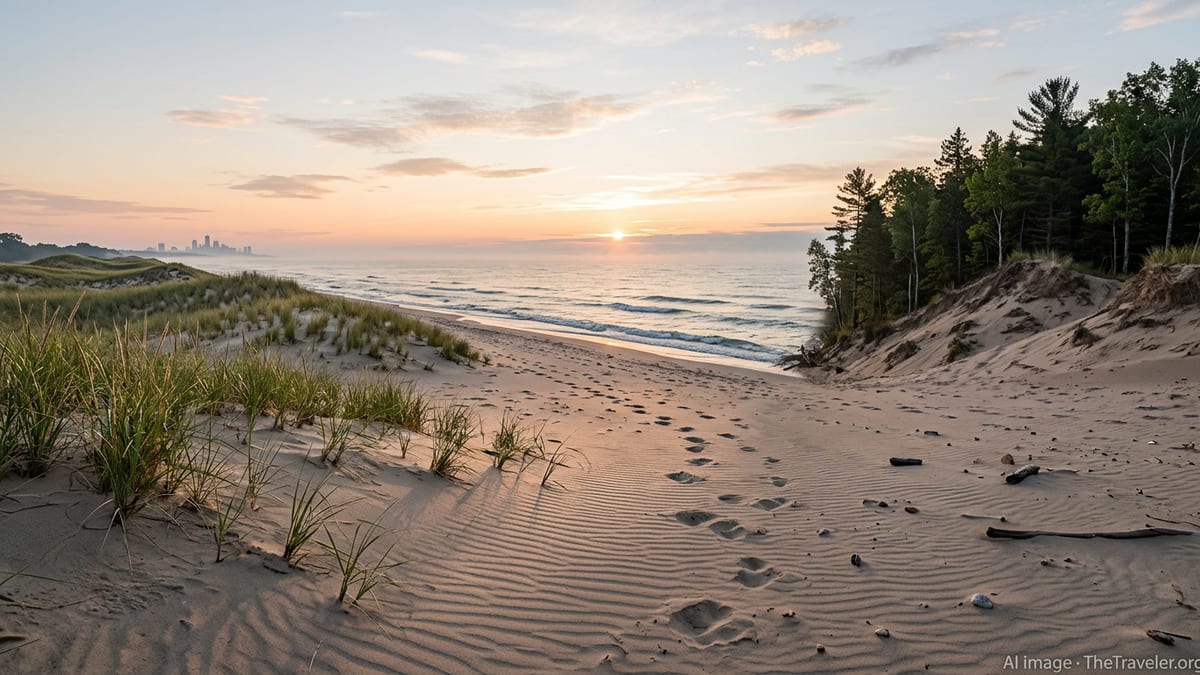
Both parks promise soft sand and freshwater waves, but their beach experiences differ in character. Indiana Dunes’ shoreline is a patchwork of wide swimming beaches, narrow strips of sand, and stretches near industrial infrastructure. West Beach, a national park unit with a broad strand and dune backed boardwalks, is among the most popular. The state park’s main beach is another favorite, with a long curving shoreline and views of distant Chicago on clear days. Smaller accesses like Kemil Beach and Porter Beach feel more low key and residential, especially outside peak summer weekends.
Sleeping Bear Dunes, on the other hand, is known for its dramatic meeting of towering dunes and deep blue water. Classic spots like the beach at the base of the Dune Climb, the Lake Michigan shore at Empire, and wide strands near Glen Haven offer more expansive views with less visible development. Water color in this northern stretch of Lake Michigan tends to run a striking turquoise on sunny days, and the long fetch of open lake can bring in rolling surf that feels more like an ocean than an inland lake.
Water temperatures are a relevant difference. Southern Lake Michigan near Indiana Dunes typically warms earlier in the season, making May and June swims more tolerable, and late summer water can feel relatively mild by Great Lakes standards. In the Sleeping Bear region, the larger volume of open water and more northerly latitude keep temperatures cooler, so even July and August swims can be brisk, and shoulder season dips are refreshing bordering on frigid. For travelers prioritizing frequent, comfortable swims, especially with young children, Indiana Dunes often has the edge.
Beach amenities follow the development patterns. At Indiana Dunes, it is easier to pair your beach day with nearby restaurants, shops, and services in adjacent towns, and some access points are reachable from commuter rail. Sleeping Bear Dunes’ beaches feel more remote and scenic but usually require a short drive to reach dining and other services in villages like Glen Arbor or Empire. If your ideal dunes trip is built around a string of relaxed beach days with simple logistics and ample facilities, Indiana Dunes is often more convenient. If you dream of quieter, more pristine feeling beaches, Sleeping Bear Dunes tends to feel more special.
Dune Hikes, Scenic Drives, and Signature Views
On the hiking and scenery front, Sleeping Bear Dunes earns a reputation as the more spectacular of the two. The Dune Climb, a steep wall of sand that visitors can ascend from a roadside parking area, is one of the lakeshore’s iconic experiences. From its crest, fit hikers can continue along a marked route across rolling dunes all the way to the Lake Michigan shore, although the out and back trek is longer and more strenuous than it first appears. The Pierce Stocking Scenic Drive, a one way loop road with multiple overlooks, offers some of the most impressive vantage points in the region, including a high bluff view down to the lake hundreds of feet below.
Beyond those headliners, Sleeping Bear Dunes is rich in trails that combine forests, inland lakes, and dune scenery. Routes like the Empire Bluff Trail, Pyramid Point, and portions of the Sleeping Bear Heritage Trail provide moderate hikes with commanding views over the lake and patchwork farmlands. The variety lets you match outings to your group’s abilities, from short interpretive walks on boardwalks to challenging dune scrambles and longer day hikes inland.
Indiana Dunes’ dunes and viewpoints are smaller in scale but surprisingly varied. The national park and state park together offer roughly 50 miles of trails through foredunes, oak savanna, wetlands, and hardwood forest. Popular hikes include the West Beach Succession Trail, where stairs and boardwalks climb from the parking area through several stages of dune development to views over the lake, and the Cowles Bog Trail, a National Natural Landmark loop that passes through wetlands and wooded dunes before reaching an often quiet stretch of beach. In the state park, the 3 Dune Challenge links three of the area’s tallest dunes for a short but intense workout with panoramic lake views.
If your primary goal is to experience vast dune scenery, sweeping cliffs, and more dramatic vistas, Sleeping Bear Dunes feels like the more cinematic option. If you are happy with more modest hills, forested ridges, and closer views of the shoreline, Indiana Dunes can still feel rewarding, especially when paired with frequent dips in the lake. Visitors who prefer scenic drives to strenuous hikes may also appreciate that the Pierce Stocking loop at Sleeping Bear offers big views with minimal walking, while Indiana Dunes’ best overlooks usually require at least some stair climbing or trail walking.
Nature, Wildlife, and Seasonal Experiences
Both parks protect surprisingly rich ecosystems, but they emphasize different aspects of Great Lakes nature. Indiana Dunes is often cited as one of the most biologically diverse national parks for its size, with habitats ranging from open sand and marram grass foredunes to black oak savannas, marshes, swales, and pockets of old growth forest. Birdwatchers value the area during migration seasons, when warblers, waterfowl, and shorebirds move along the coast. Spring wildflowers in the woods and savannas can be excellent, and summer brings displays of prairie and dune plants adapted to hot, dry sand.
Sleeping Bear Dunes offers a broader sweep of northern Michigan landscapes. Here, high perched dunes sit above forested bluffs, inland lakes, and farm country with orchards and vineyards. Deciduous and mixed forests blaze with fall color, making September and early October especially photogenic. Wildlife sightings may include white tailed deer, foxes, porcupines, and a variety of songbirds and raptors. Offshore, the Manitou Islands preserve even quieter environments with extensive dune fields, cobble beaches, and dark night skies that appeal to backcountry campers and stargazers.
Seasonality shapes the visitor experience in both places. Indiana Dunes has a longer practical season for casual visits, in part because the surrounding communities stay active year round and the milder southern latitude makes shoulder season outings more comfortable. Winter can still bring lake effect snow, but some visitors enjoy snowshoeing and quiet walks on empty beaches. Sleeping Bear Dunes experiences harsher winters with deeper snow and more frequent closures of services. Summer and early fall are prime time, especially when paired with seasonal attractions like farm stands and wineries, while late fall through early spring feel very quiet and more logistically challenging.
For nature focused travelers with limited time, Indiana Dunes offers a slice of Great Lakes biodiversity within an easy drive of major cities. For those willing to travel farther for more immersive landscapes, greater night sky darkness, and a mix of dunes with rural countryside, Sleeping Bear Dunes delivers a stronger sense of escape.
Crowds, Atmosphere, and Nearby Towns
The atmosphere in and around each park reflects their geography. Indiana Dunes sits at the edge of a major metropolitan area, and on warm summer weekends its parking lots can fill quickly with day trippers looking for a beach break from the city. The vibe at popular spots like West Beach or the state park beach can feel lively and sometimes crowded, especially on holiday weekends. In shoulder seasons or on weekdays, activity levels drop sharply, and it becomes much easier to find a quiet section of sand or a mostly empty trail.
Sleeping Bear Dunes, though more remote, is no secret either. Summer brings substantial visitation, particularly to the Dune Climb, Empire Bluff, and certain beaches. However, the larger size of the lakeshore and the relative lack of nearby large cities helps disperse visitors. Many people are staying for multi day vacations rather than quick beach outings, which can translate into a more relaxed, slow paced feel. Early mornings and evenings often feel especially tranquil, with long pastel sunsets stretching over the lake.
Nearby towns further distinguish the two destinations. Around Indiana Dunes, communities like Chesterton, Porter, Beverly Shores, and Michigan City offer a mix of small town main streets, outlet shopping, casual restaurants, and industrial heritage. Chicago’s skyline is a distant but present backdrop on clear days, reinforcing the sense that you are on the fringe of a larger urban region. Around Sleeping Bear Dunes, the anchors are small resort villages like Empire and Glen Arbor, as well as the larger hub of Traverse City an hour away. Here the feel is more distinctly “Up North,” with cottage style lodging, ice cream shops, kayak outfitters, and farm to table restaurants serving local cherries and other regional specialties.
If you enjoy pairing your dunes exploration with urban culture, big city dining, and a broad range of non nature activities, Indiana Dunes functions well as an extension of a Chicago trip. If you would rather lean into small town charm, starry skies, and a slower pace, Sleeping Bear Dunes fits that role more naturally.
Costs, Time Investment, and Who Each Park Suits Best
Both Indiana Dunes National Park and Sleeping Bear Dunes National Lakeshore charge entrance fees that are in line with other national park units, and both participate in annual pass programs. Actual cost differences for most visitors will come more from transportation, lodging, and trip length than from park entry itself. Because Indiana Dunes is close to population centers, a family can visit on a day trip without paying for overnight accommodations. Sleeping Bear Dunes almost always involves at least one hotel or campground night, turning even a quick visit into more of a mini vacation.
Time investment is a defining factor. Indiana Dunes can deliver a satisfying sample of trails, dunes, and beach in a single well planned day. You might hike a loop like the Cowles Bog Trail, cool off with a swim, and still have time for a sunset from a dune overlook before driving home. Sleeping Bear Dunes merits a longer stay; two or three full days allow you to climb the dunes, drive the scenic loop, explore multiple beaches, and perhaps fit in paddling on an inland lake or a bike ride on the heritage trail. A week long stay can easily combine dunes time with visits to nearby wineries, farm markets, or a side trip to Traverse City.
As a rough guide, Indiana Dunes is often the better choice for travelers who are short on time, on a tighter budget, or testing the waters of Great Lakes travel for the first time. It also works well for families with young children who prefer shorter drives and ready access to services. Sleeping Bear Dunes suits travelers who prioritize scenery, do not mind a longer journey, and want to build a trip around both dunes and broader northern Michigan explorations. Hikers, photographers, and visitors seeking a more remote feeling escape often rank Sleeping Bear higher once they have experienced both.
Ultimately, there is no universally “better” park. Instead, each shines in different scenarios. Many Midwest travelers start with Indiana Dunes because it is so accessible, then later plan a dedicated trip to Sleeping Bear Dunes when they have more time. Seen that way, the two destinations complement rather than compete with each other, offering different chapters in a broader story of Lake Michigan’s dune country.
The Takeaway
Choosing between Indiana Dunes and Sleeping Bear Dunes comes down to aligning your trip with your priorities. Indiana Dunes National Park and the adjacent state park deliver a remarkably complete dunes experience within a short reach of Chicago and other Midwestern cities. Their strengths are convenience, a relatively long practical season for swimming, and easy layering of beach time with short hikes across a range of habitats. The backdrop includes rail lines, suburbs, and industrial structures, but for many travelers that tradeoff is more than acceptable given how little planning or travel time a visit requires.
Sleeping Bear Dunes National Lakeshore, by contrast, rewards those willing to journey farther for larger scale scenery. Here the dunes rise higher, the viewpoints feel more expansive, and the surrounding countryside leans into a classic “Up North” atmosphere of forests, farms, and small lakeside towns. The water is colder and the logistics more involved, but the overall sense is one of deeper escape and immersion in a cohesive landscape.
If you have a single free summer day and want to feel sand under your feet and freshwater waves on your skin without leaving the orbit of a major city, Indiana Dunes is likely your best bet. If you are carving out several days for a dedicated dunes vacation and you prize scenery, hiking, and a slower pace over pure convenience, Sleeping Bear Dunes is more likely to feel like the trip of a lifetime. Whichever you choose, the lesson both places share is simple: you do not have to leave the Midwest to find big sand, big water, and a powerful sense of shoreline wildness.
FAQ
Q1. Which park is better for a quick weekend or day trip, Indiana Dunes or Sleeping Bear Dunes?
Indiana Dunes generally works better for short trips and spontaneous days because it is close to major highways and the Chicago area, making travel times and logistics simpler.
Q2. Where will I find more dramatic dune scenery and bigger views?
Sleeping Bear Dunes typically offers more dramatic vistas, with higher perched dunes, long bluffs, and wider sweeping views over Lake Michigan and the surrounding countryside.
Q3. Is the water warmer at Indiana Dunes or Sleeping Bear Dunes?
In most summers, water near Indiana Dunes tends to warm earlier and feel milder, while the more northerly waters around Sleeping Bear Dunes usually stay noticeably cooler.
Q4. Which destination is better for families with young children?
Both can work well, but Indiana Dunes often suits families with younger kids thanks to shorter drives, easier access to amenities, and generally warmer swimming conditions.
Q5. Do I need a car to visit Indiana Dunes or Sleeping Bear Dunes?
At Indiana Dunes you can combine commuter rail with walking or rideshares, though a car still helps. Sleeping Bear Dunes is much more car dependent, with limited public transport.
Q6. How many days should I plan for each park?
Indiana Dunes can be sampled in a single day, though two or three days allow deeper exploration. Sleeping Bear Dunes usually rewards at least two to three full days, and more if you can spare them.
Q7. Which park has better hiking options?
Sleeping Bear Dunes has more extensive networks of scenic hikes with big viewpoints, while Indiana Dunes offers shorter, diverse trails that showcase a mix of dunes, wetlands, and forests.
Q8. Are there good town or dining options near both parks?
Yes. Indiana Dunes is ringed by small cities and suburbs with many dining choices, while Sleeping Bear Dunes is near resort style villages and, a bit farther away, the larger food scene of Traverse City.
Q9. Which destination feels less crowded in peak summer?
Both see busy periods, but Sleeping Bear Dunes often feels more spread out because of its larger size and more dispersed trailheads and beaches, especially outside a few headline sites.
Q10. If I love dunes, is it worth visiting both Indiana Dunes and Sleeping Bear Dunes?
Yes. Many travelers visit Indiana Dunes for quick, accessible trips and later plan a longer vacation to Sleeping Bear Dunes, finding that each park offers a distinct and complementary experience.