

More news on this day
Travelers flying to India after March 31 face a tighter enforcement of the country’s new e-Arrival Card system, as a six‑month transition period ends and digital pre-arrival registration effectively becomes the default for foreign visitors.
Get the latest news straight to your inbox!
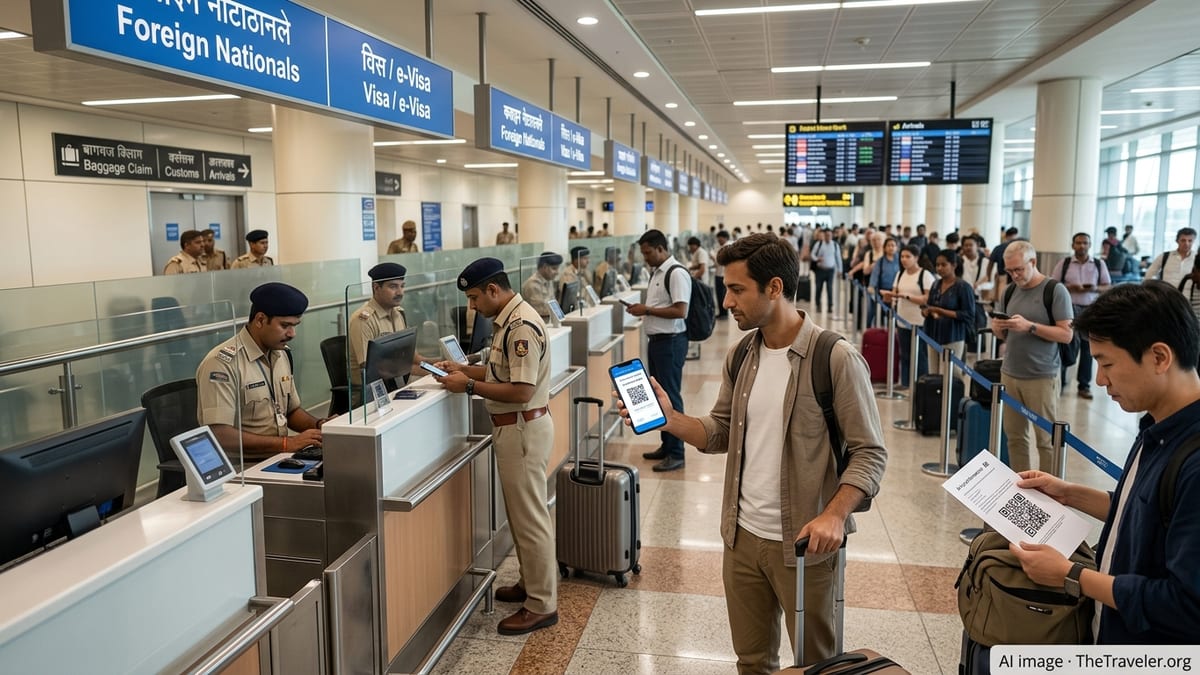
From Pilot Phase To Mandatory Digital Entry
India’s e-Arrival Card was first introduced on October 1, 2025, replacing the long-standing paper disembarkation card for most foreign nationals. Public advisories from Indian consulates and recent airline guidance describe the change as part of a wider digitization drive at border checkpoints, intended to speed up arrivals and reduce manual data entry at immigration counters.
During the initial rollout, foreign travelers could still fall back on paper cards if they had not completed the form online. Reports indicate that this six‑month transition window is scheduled to close around March 31, 2026. From April 1 onward, the expectation at international airports is that foreign passengers will arrive with an e-Arrival Card already submitted and ready to be scanned.
According to publicly available consular notices, the requirement applies to foreign nationals entering India on regular visas as well as many categories of short-stay visits. Several advisories explicitly mention that the electronic card must be completed before entry, signaling that the digital process is no longer optional but a core element of pre-travel paperwork.
Recent coverage from aviation and immigration briefings also shows that airlines are increasingly building the e-Arrival Card into their own document checks. Passengers who cannot show proof of completion risk delays at departure or on arrival, as staff must confirm that all mandatory data has been submitted in the digital system.
Who Must Complete The E-Arrival Card
Guidance from Indian missions abroad and global mobility firms indicates that the e-Arrival Card is required for almost all foreign nationals flying into India. This includes tourists, business visitors, students, medical travelers, conference delegates, and other short-term entrants who previously filled out a paper arrival form on the plane or in the terminal.
Some early explanations suggested exemptions for certain categories, notably Overseas Citizen of India (OCI) cardholders, who often use dedicated fast-track channels. However, more recent consular advisories now state that both foreign nationals and OCI cardholders are expected to complete the e-Arrival Card prior to arrival. Travelers are therefore being urged to treat the requirement as universal unless a specific exemption is clearly listed in current official guidance.
Indian citizens arriving on an Indian passport continue to be processed under separate procedures and are not part of the core e-Arrival Card mandate. Nonetheless, airlines may still prompt mixed-nationality families or groups to ensure that any non-Indian members have filed the online card, particularly when they hold foreign passports or visas.
Travel reports also note that the e-Arrival Card is distinct from an Indian visa or e-visa. It does not replace the need for prior visa approval where required, and travelers remain responsible for holding the correct visa type for tourism, business, study, employment, or other purposes.
When And How To File The New Form
Official advisories and airline bulletins consistently point to a filing window that opens up to 72 hours before arrival in India. Several practical guides recommend completing the e-Arrival Card as soon as final flight details are confirmed, but no more than three days ahead of landing, in case schedules change and require updates.
The form is submitted online through India’s designated e-Arrival platform and associated mobile applications. Travelers are asked to provide passport details, nationality, date of birth, flight number, date and port of arrival, intended address in India, contact information, purpose of visit, and recent travel history. There is no fee for the e-Arrival Card and no biometric submission at this stage.
Once the form is successfully filed, the system generates a confirmation, often in the form of a QR code or printable acknowledgment. Airline and immigration staff may ask to see this confirmation during check-in, at boarding, or on arrival. Passengers are therefore encouraged to save a screenshot on their phone and carry a paper printout as a backup.
Reports from the first months of operation highlight occasional technical issues, including periods when the website or app has experienced heavy demand. Travel advisors suggest submitting the e-Arrival Card early within the 72-hour window to avoid last-minute problems if systems are slow or temporarily unavailable.
What Changes After April 1 For Incoming Flights
The most significant shift from April 1 is not the creation of the e-Arrival Card itself, which has been in place since October 2025, but the likely end of routine paper-card fallback at major airports. Public information describing a six‑month transition period points to late March 2026 as the point at which physical disembarkation cards are expected to be withdrawn from everyday use.
In practical terms, this means airlines may begin treating the e-Arrival Card in the same way they treat a mandatory visa or travel authorization. At check-in, agents can request proof that the online form has been completed and may advise passengers without confirmation to file it immediately before they are accepted for the flight.
On arrival, immigration counters will rely on the digital data already received, rather than asking travelers to fill out forms in the hall. This is intended to speed processing, but it also leaves less room for passengers who have not complied. While individual outcomes can vary, travel advisories warn that arriving without an e-Arrival Card could lead to significant delays, secondary processing, or even denial of boarding on the outbound leg if the issue is detected too late.
Industry observers note that India is following a wider global pattern, echoing recent digital arrival initiatives in destinations such as Thailand and Indonesia. For travelers, the common thread is a shift in work from the airport to the days just before departure, with more obligations handled online rather than at the counter.
Practical Tips For Travelers Planning Trips Now
For trips scheduled on or after April 1, foreign visitors are being advised to treat the e-Arrival Card as a non-negotiable part of their travel checklist. That means confirming visa status first, then booking flights, accommodation, and internal transport, and finally scheduling a reminder to complete the e-Arrival Card between 72 and 24 hours before the scheduled arrival time in India.
Travelers should keep all the required data handy when filling out the form, including passport details, visa information, full address and phone number for at least the first night’s stay, and an emergency contact. Having these details ready can make the process quick, particularly for families or groups where one person may be completing multiple submissions.
Because policies and technical platforms can evolve, prospective visitors are encouraged to review the latest public advisories from Indian missions, airlines, and widely cited immigration briefings close to their departure date. Reports indicate that these channels are being updated as the transition period ends and any remaining gray areas, such as treatment of last-minute travelers, are clarified.
For now, the central message for anyone flying to India in the coming weeks is straightforward. The paper card era is ending, and the e-Arrival Card has moved from a pilot tool to an essential pre-departure requirement that should be completed carefully and on time.