

More news on this day
Indian budget carrier IndiGo is restoring and adding flights to Dubai, Abu Dhabi and Sharjah through March, strengthening air links between India and the United Arab Emirates just as tourism to the Gulf country shows renewed momentum after weeks of regional disruption.
Get the latest news straight to your inbox!
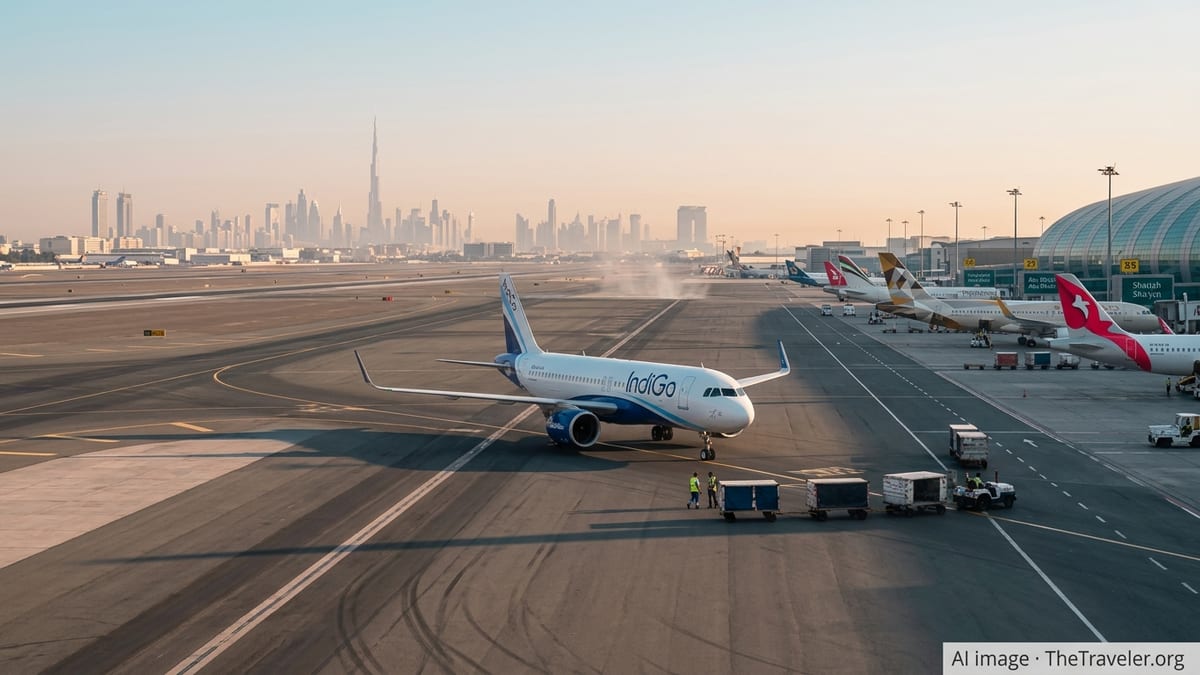
New IndiGo Flights Boost Access to Dubai, Abu Dhabi and Sharjah
Publicly available schedules show IndiGo operating a growing mix of scheduled and special services into Dubai, Abu Dhabi and Sharjah this month, following a period of curtailed operations linked to regional airspace closures. The additional flights are aimed at clearing passenger backlogs while rebuilding the airline’s core India–UAE network ahead of the busy late spring travel period.
Reports on recent schedule changes indicate that IndiGo has progressively resumed services into key UAE gateways, with limited frequencies already operating on routes such as Abu Dhabi to major Indian metros and select secondary cities. Activity at Sharjah has also picked up, where IndiGo routes serve high‑demand destinations for Indian expatriate communities and visiting friends and relatives traffic.
Industry trackers note that the airline’s presence in the UAE now spans Dubai, Abu Dhabi and Sharjah, alongside other airports in the federation, underpinning IndiGo’s position as a primary low‑cost link between India and the Gulf. The March ramp‑up, while still constrained by evolving security and airspace conditions, is viewed as an early step back toward a more typical schedule profile.
Aviation analytics point out that the resumption is unfolding against a backdrop of volatile day‑to‑day adjustments. While some India–UAE services have returned, others remain suspended or re‑timed at short notice, requiring travellers to pay close attention to airline and airport advisories as operations stabilise.
UAE Tourism Recovering Despite Regional Disruptions
Tourism data released over recent months show the UAE, and Dubai in particular, sustaining a broad recovery in international arrivals compared with pre‑pandemic levels, helped by large‑scale events, new attractions and an expanding hotel pipeline. Analysts say the rebound has been especially strong from India, historically one of the country’s largest source markets.
Sector commentary highlights that Dubai’s visitor numbers in 2024 and early 2025 were already tracking near or above previous records, fueling high hotel occupancy in core leisure districts and business hubs. Similar trends have been observed in Abu Dhabi and Sharjah, where new museums, waterfront developments and cultural programming are designed to attract both regional and long‑haul visitors.
The sudden wave of flight suspensions and diversions across the Gulf in late February and early March 2026 temporarily interrupted this momentum, with thousands of travellers stranded at UAE airports during peak travel days. However, as carriers including IndiGo gradually rebuild schedules, tourism stakeholders expect the setback to be short‑lived provided regional security conditions stabilise.
Travel trade reports suggest that demand from India has remained resilient, with many passengers opting to reschedule rather than cancel trips outright. This underlying appetite for UAE holidays, business visits and family travel is one of the key factors underpinning airlines’ decisions to restore capacity quickly into Dubai, Abu Dhabi and Sharjah.
What March Passengers Should Expect on IndiGo’s UAE Routes
For travellers booked on IndiGo services to or from Dubai, Abu Dhabi or Sharjah in March, the operating environment remains fluid. Schedules published in reservation systems are being updated frequently, and recent news coverage has documented same‑day changes as airspace restrictions ease in phases across parts of the region.
Passengers are being advised in public statements and advisories to monitor their flight status closely, use airline digital channels for real‑time updates and allow additional time at airports where operational bottlenecks persist. At several points in early March, IndiGo relied on special relief and non‑scheduled flights between Gulf airports and Indian cities to repatriate stranded customers and reposition aircraft.
Travel consultants note that seat availability on certain India–UAE routes can tighten quickly when disrupted services are reinstated, as carriers work through waitlists accumulated during earlier cancellations. This may particularly affect high‑demand city pairs linking Indian labour and expatriate hubs with Dubai, Abu Dhabi and Sharjah, where seasonal demand is elevated by school holidays and religious travel.
In practical terms, passengers heading to the UAE this month may encounter later‑than‑usual departure times, equipment swaps or short‑notice rebookings onto alternative IndiGo flights or different airports within the federation. Industry observers recommend that travellers remain flexible with their plans and keep documentation, visas and accommodation bookings easily accessible in case itineraries are adjusted.
Strategic Role of India–UAE Connectivity in Aviation Recovery
IndiGo’s renewed focus on Dubai, Abu Dhabi and Sharjah comes as airlines across the Gulf seek to stabilise networks after a turbulent period. Aviation commentators regularly describe India–UAE traffic as one of the most critical flows in the wider Middle East market, supporting tourism, trade, labour movement and onward long‑haul connections.
Even before the latest round of disruptions, IndiGo had been steadily building out its presence in the UAE, linking a growing roster of Indian cities to Abu Dhabi and complementing its established operations at Dubai and Sharjah. Corporate travel bulletins and airline briefings have framed these routes as central to IndiGo’s international strategy, leveraging high‑density narrow‑body aircraft to serve short‑haul Gulf markets.
For the UAE, the restoration of IndiGo capacity is part of a broader goal to keep inbound and outbound traffic flowing despite regional headwinds. Tourism authorities and economic planners view reliable air links with India as essential for sustaining hotel occupancy, retail spending and the country’s position as a global events and transit hub.
Aviation analysts caution that the pace of normalisation will depend on how quickly regional security concerns recede and airspace restrictions are lifted. However, they also stress that the structural drivers of India–UAE travel, including demographic ties and visa‑friendly policies, remain firmly in place, supporting a gradual return to growth once flight operations fully stabilise.
Implications for Travellers and the Wider Gulf Aviation Market
The incremental restart of IndiGo flights into Dubai, Abu Dhabi and Sharjah is being closely watched by other carriers operating in the Gulf, as it provides an early signal of how quickly demand can rebound following large‑scale disruption. If load factors remain strong through late March and April, industry observers expect additional capacity increases and potentially the return of pre‑disruption frequencies on multiple routes.
For travellers, the short‑term picture is one of cautious optimism. While delays and schedule shifts remain possible, the growing list of flights in and out of UAE airports offers more options than were available only weeks earlier. This is particularly significant for Indian nationals living and working in the Gulf, many of whom depend on low‑cost links for essential trips home.
Looking ahead, network planners suggest that airlines may build greater redundancy into their India–Gulf schedules, including a wider distribution of flights across Dubai, Abu Dhabi and Sharjah to spread operational risk. IndiGo’s use of all three major UAE hubs illustrates how carriers can flex capacity between airports as demand and operational constraints evolve.
As March progresses, attention will remain on whether IndiGo and its regional competitors can sustain a stable schedule through the upcoming summer season. Should that happen, the current wave of added and restored flights to Dubai, Abu Dhabi and Sharjah may come to be seen as an important turning point in the UAE’s broader tourism and aviation recovery narrative.