

More news on this day
Thousands of air travelers are stranded at major Gulf hubs including Muscat, Doha, Dammam, Khasab, Dubai, Abu Dhabi, Jeddah, Kuwait City and Bahrain after IndiGo cancelled 137 flights in the Middle East, as sweeping airspace closures triggered by ongoing US and Israeli strikes on Iran cascade into one of the most severe travel disruptions the region has seen in years.
IndiGo Extends Cancellations As Conflict Spreads Across Skies
India’s largest low cost carrier has extended its suspension of select international flights using Middle East airspace until March 2, 2026, at 23:59 Indian Standard Time, citing a rapidly evolving security situation in and around Iran and West Asia. The move follows emergency advisories from regulators and aviation safety agencies warning of heightened risks to civil aviation in the region.
According to figures shared by India’s civil aviation authorities and airline statements, IndiGo has cancelled more than 190 international services across March 1 and 2, with at least 137 of those directly touching Middle East routes. The routes most affected include services linking Indian cities with Muscat, Doha, Dammam, Kuwait, Bahrain, Dubai, Abu Dhabi, Jeddah and other Gulf gateways, forcing last minute groundings and diversions.
The cancellations come on top of a broader wave of suspensions by Air India, Air India Express, SpiceJet and Akasa Air, after a joint US and Israeli offensive on Iran and subsequent Iranian retaliation prompted countries including Iran, Israel, Iraq, Syria, Kuwait, Bahrain, Qatar and the United Arab Emirates to close portions of their airspace. That combination of military activity and regulatory action has effectively sealed off key corridors used by Indian carriers on their westbound routes.
IndiGo has told passengers that all decisions are being taken as a precautionary safety measure, stressing that its operations team is monitoring NOTAMs and international advisories in real time. The airline is offering full flexibility and fee waivers for travel to and from the Middle East and other affected international sectors until March 7, 2026, for customers who booked on or before February 28.
Terminals Packed As Passengers Sleep On Floors And Queue For Answers
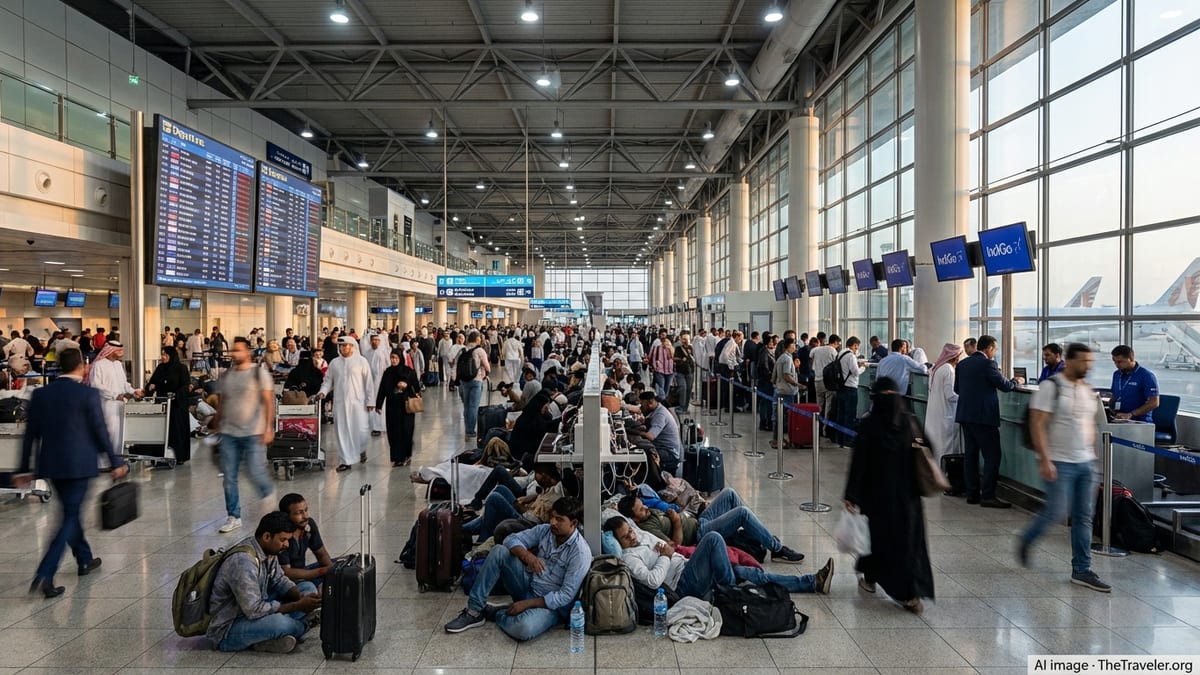
By Sunday morning, terminals from Muscat to Bahrain were packed with weary travelers sleeping on the floor, queueing at transfer desks and scrambling for scarce information as IndiGo aircraft remained out of position and ground operations struggled to keep up with the unfolding disruption. At Dubai and Abu Dhabi, where hub operations were also curtailed for local carriers, stranded IndiGo customers joined tens of thousands of passengers from other airlines vying for hotel rooms and alternative connections.
At Doha’s Hamad International Airport, long lines formed at rebooking counters as departures boards filled with red cancellation notices for services to Indian cities such as Mumbai, Delhi, Hyderabad and Kochi. Similar scenes played out in Dammam and Kuwait, where IndiGo’s short haul point to point model usually offers regular shuttles for workers and families moving between the Gulf and India’s smaller metros.
In Jeddah and Dubai, travelers described spending the night in crowded seating areas after their flights were first delayed, then cancelled outright as airspace closures spread and dispatchers were forced to redesign routings on the fly. With many Gulf states temporarily off limits and remaining corridors pushing aircraft far to the south over Saudi Arabia, finding legal and economically viable paths to India became increasingly difficult overnight.
Airport authorities in several Gulf countries have activated contingency plans designed for mass disruptions, opening additional seating zones, distributing basic refreshments and working with airlines to prioritize vulnerable passengers. However, officials acknowledged that the combination of regional military tension and the sheer scale of international hub traffic has severely stretched available capacity.
Regulators Warn Of High Risk Region As Airlines Reroute Or Ground Flights
India’s Directorate General of Civil Aviation has advised carriers to avoid the airspace of 11 countries in West Asia, including Iran, Israel, Lebanon, the United Arab Emirates, Saudi Arabia, Bahrain, Oman, Iraq, Jordan, Kuwait and Qatar until at least March 2, describing the area as a high risk environment for civil aviation. The advisory echoes a bulletin from the European Union Aviation Safety Agency that urged operators to keep passenger aircraft clear of identified conflict zones unless supported by detailed risk assessments.
As a result, IndiGo and its domestic rivals have halted nearly all flying into the central Gulf while attempting to reroute certain long haul services through safer corridors. Indian officials estimate that more than 170 international flights from India were cancelled on March 1 alone across all airlines, a figure that is expected to rise once additional March 2 schedules are taken into account.
Beyond India, global carriers such as Emirates, Etihad, Qatar Airways, Turkish Airlines, Lufthansa, British Airways and major US airlines have either suspended services to specific Middle Eastern destinations or are operating complex detours that add hours to flight times. Flight tracking data shows large empty swathes of airspace over parts of Iran, Iraq, Israel and the Gulf, while traffic funnels through southern Saudi Arabia and alternative routes over the Arabian Sea.
Aviation analysts warn that prolonged closures could significantly increase costs for airlines, as longer routings burn more fuel, require additional crew and disrupt carefully calibrated aircraft rotations. Those pressures are likely to filter through to higher fares and reduced capacity on some routes if the crisis extends beyond the current advisory window.
Indian Government And Airlines Roll Out Waivers For Stranded Travelers
In response to the unfolding chaos, India’s Ministry of Civil Aviation has held a series of review meetings with airline executives and airport operators to coordinate contingency measures. Authorities have instructed carriers to prioritize passenger safety, ensure clear communication and use established diversion and rerouting protocols to keep stranded travelers moving wherever possible.
IndiGo is allowing customers affected by the Middle East cancellations to either reschedule their travel at no additional charge or claim a full refund, provided their tickets were booked before February 28 for travel during the disruption window. The airline has pushed notifications through text messages, email and its mobile app, urging passengers to avoid airport visits unless they have confirmed revised itineraries.
Other Indian airlines have rolled out similar policies, with Air India Express and Akasa Air offering free date changes and refunds on Gulf routes and Air India extending waivers on select long haul flights impacted by the closure of Middle Eastern airspace. India’s Foreigners Regional Registration Offices have also been told to assist foreign nationals who are unable to depart the country on schedule and may need visa extensions or other formalities to regularize their stay.
Travel agents in major Indian cities report a surge in calls from families trying to return home from the Gulf, many of whom had timed trips around school holidays or critical work commitments. With seats scarce and routings changing by the hour, some travelers are opting to remain where they are until airline schedules stabilize, rather than risk being stranded in transit at a third country hub.
Uncertain Outlook As Travelers Brace For Prolonged Disruption
While some regional officials have suggested that airspace restrictions could ease once military operations enter a more predictable phase, industry experts caution that risk assessments are likely to remain conservative for days, if not weeks. Any renewed salvo of missile or drone strikes could trigger fresh rounds of closures, forcing airlines to tear up revised schedules and start again.
For IndiGo, which built much of its recent international growth on dense Gulf connectivity, the shutdown represents both an operational and commercial shock. The airline has emphasized that its network strategy remains intact and that suspended services will be restored as soon as conditions allow, but it has acknowledged that short term disruption will be significant.
Passengers currently in the region are being urged by airlines and airports alike to check their flight status frequently, monitor messages from carriers and factor in the possibility of sudden schedule changes even after boarding passes have been issued. Many airports are advising travelers to arrive early, bring essential medications and valuables in carry on bags and prepare for extended waits.
With no clear timeline for a full reopening of affected airspace, thousands of travelers caught in Muscat, Doha, Dammam, Khasab, Dubai, Abu Dhabi, Jeddah, Kuwait City and Bahrain are settling in for an anxious wait, watching departure boards and hoping that the conflict playing out far above their heads will soon recede enough to let them go home.