

More news on this day
An IndiGo flight operating from Visakhapatnam to Delhi made an emergency landing at Indira Gandhi International Airport after a suspected engine-related technical fault, prompting a full-scale emergency response and renewed scrutiny of aviation safety in India.
Get the latest news straight to your inbox!
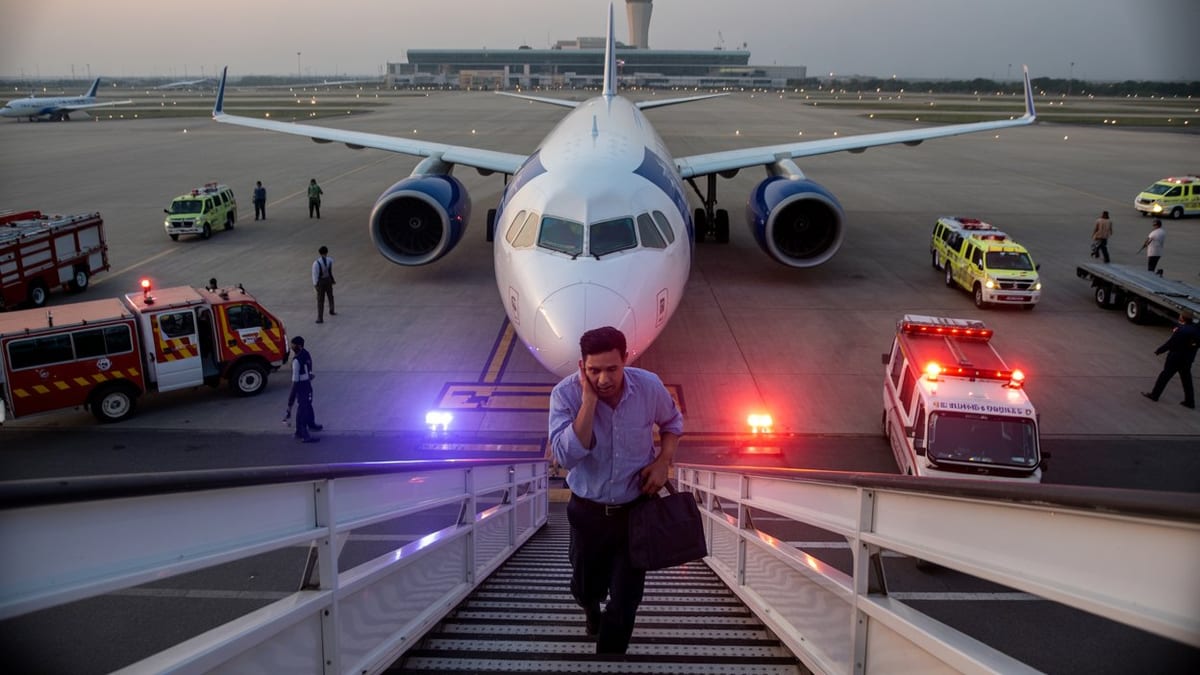
Image by Global Travel Alerts, Advisories, International Travel Alerts
What Happened On Board IndiGo Flight 6E 579
According to publicly available reports, the aircraft was operating as IndiGo flight 6E 579 from Visakhapatnam to Delhi when the crew reported a technical issue as the flight neared the capital. Initial coverage indicates that the problem was suspected to be connected to one of the engines, although the exact nature of the malfunction has not yet been detailed by investigators.
Reports indicate that an emergency was declared as a precaution while the aircraft was still airborne, allowing Delhi airport to activate its standard response protocols. Fire and rescue vehicles were positioned alongside the runway, and medical support was placed on standby as the aircraft prepared to land.
The aircraft landed safely at Delhi’s Indira Gandhi International Airport with 161 passengers on board, along with crew members. Published coverage notes that the landing was controlled and that there was no runway excursion, fire, or visible structural damage to the aircraft, despite the suspected engine fault.
Post-landing inspections and formal inquiries are expected to determine whether the incident involved an actual engine failure, a sensor or systems alert, or a broader technical malfunction. Until those assessments are complete, references to the event as an engine failure remain preliminary.
How Passengers Escaped Without Injury
News reports and passenger accounts suggest that all those on board disembarked without serious injury. The aircraft came to a complete stop on the runway, from where it was either taxied or towed to a parking stand once the situation was assessed as stable by on-site teams. Standard operating procedures typically call for passengers to remain seated until the crew confirms it is safe to move.
In this case, there have been no credible reports of an emergency slide evacuation or any uncontrolled rush to exit the aircraft. Instead, the available information points to an orderly disembarkation through the standard doors and stairs, consistent with a precautionary emergency rather than a catastrophic engine event involving fire or structural damage.
While some travelers described a tense atmosphere and uncertainty during the incident, publicly shared accounts indicate that the crew provided instructions and reassurances as the aircraft descended into Delhi. Aviation safety guidelines emphasize clear communication and calm cabin management as key factors in preventing panic when a technical alert occurs.
Medical teams on standby at the airport did not report a surge of trauma cases linked directly to the landing. Some passengers, however, are expected to seek follow-up support for stress or anxiety related to the event, a common outcome after any in-flight emergency.
Emergency Procedures at Delhi Airport
Delhi’s Indira Gandhi International Airport operates under a tiered emergency framework that allows ground teams to scale up their response depending on the severity of the incident. In situations where a flight reports a technical problem that could affect landing, airport control typically declares an emergency level that brings firefighting, rescue vehicles, and medical units into position along the runway and taxiways.
Published aviation guidance explains that such measures are often precautionary rather than an indication that a crash is expected. By positioning equipment in advance, airports seek to minimize response time in the event that a landing leads to a runway excursion, fuel leak, or fire. This approach appears to have been followed in the case of IndiGo flight 6E 579, with emergency vehicles visible and ready as the aircraft touched down.
After an emergency landing, the runway may be temporarily closed to assess the aircraft and check for debris or fluid spills. Other departures and arrivals are sometimes delayed or rerouted, creating knock-on effects for air traffic but helping to safeguard subsequent operations. Initial coverage from Delhi indicates that disruptions were limited and that normal movements resumed after safety checks were completed.
The airport’s response in such incidents is designed to integrate with the airline’s internal procedures and national regulatory oversight. Once the immediate risk to passengers and crew has passed, attention typically shifts to data collection and preservation so that investigators can reconstruct the sequence of events.
Engine Reliability and IndiGo’s Broader Safety Context
The incident involving flight 6E 579 comes against a wider backdrop of scrutiny on aircraft reliability in India. Recent reporting has highlighted that a significant number of commercial aircraft audited in the country over the past year showed recurring technical findings, ranging from minor faults to more serious issues that required corrective action before further flight.
IndiGo, India’s largest carrier by market share, has faced separate challenges in recent months related to schedule disruptions and operational strain. However, publicly available information indicates that the airline continues to operate under the same safety regulations and inspection regimes that apply across the country’s commercial aviation sector. Emergency landings prompted by technical alerts, while unsettling for passengers, are considered part of a safety-first culture that prioritizes precaution.
Modern commercial aircraft are engineered to operate safely even after the loss of an engine, and global aviation data shows that genuine in-flight engine failures remain rare in relation to the total number of flights. In many cases, what passengers experience as an “engine failure” may in fact be a controlled engine shutdown or a systems alert prompting pilots to divert or land at the nearest suitable airport.
Industry observers note that each event still demands thorough follow-up to confirm whether the issue stemmed from a component defect, maintenance lapse, operational factor, or software or sensor anomaly. The outcome of that analysis helps shape future inspection programs, manufacturer advisories, and crew training.
What Travelers Should Know After the Incident
For travelers passing through Delhi or flying with IndiGo in the coming days, publicly available schedules do not suggest widespread cancellations linked directly to this single emergency landing. Individual flights can nevertheless be affected by aircraft rotation changes or short-term maintenance checks, so passengers are advised to monitor airline notifications and airport displays closely on the day of travel.
Experts in commercial aviation safety consistently point out that emergency landings, while dramatic, are usually evidence of systems and procedures working as intended. The ability of pilots to divert, declare an emergency, and land promptly with emergency services on standby is a core reason why modern air travel maintains a strong safety record even when technical malfunctions occur.
Passengers who were on board flight 6E 579 may seek assistance from the airline regarding onward connections, baggage, and any immediate support. In similar incidents, carriers typically offer rebooking options and, where required by local regulations or company policy, hotel accommodation or meal vouchers for severely disrupted journeys.
As investigators review flight data and maintenance records linked to this IndiGo aircraft, the findings are expected to inform whether any fleet-wide checks or additional directives are necessary. For now, publicly available evidence points to a serious but contained incident in which rapid emergency coordination at Delhi airport and established cockpit procedures allowed all passengers and crew to escape without major injury.