

More news on this day
Passengers on IndiGo flight 6E-6457, expecting a routine hop into Dibrugarh, instead found themselves unexpectedly landing in Imphal after severe weather over Upper Assam made a safe approach impossible, triggering a tense diversion and a long, uncertain wait for onward travel options.
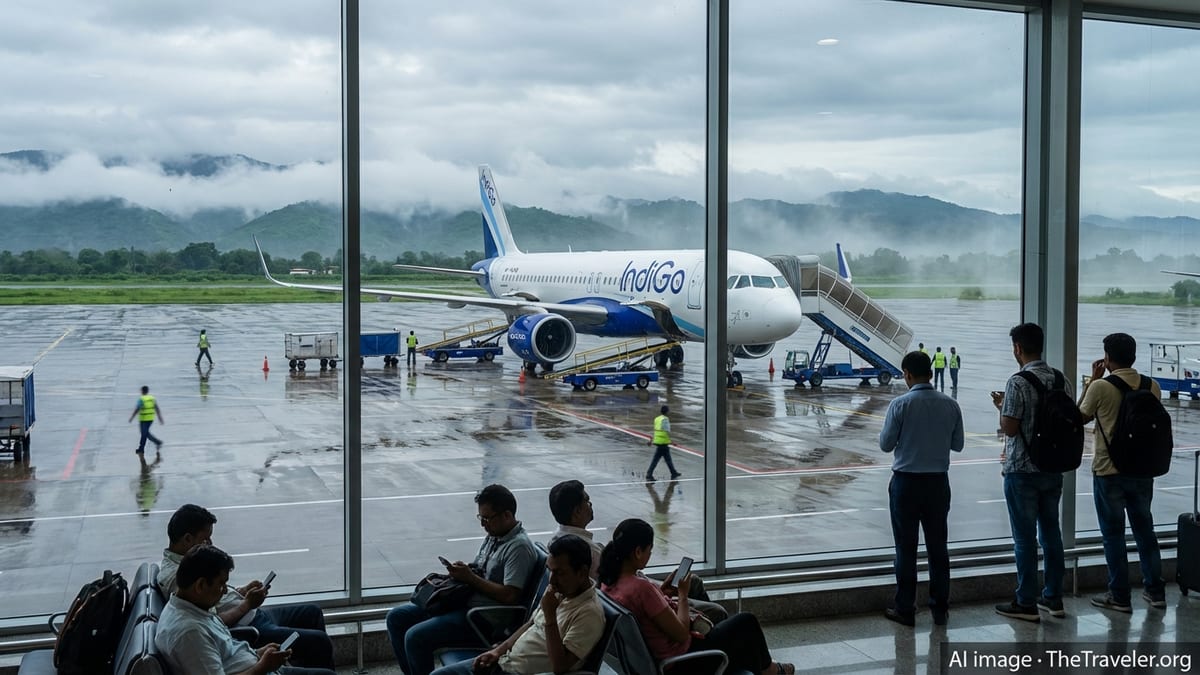
How a Routine Regional Hop Turned Into an Unplanned Diversion
IndiGo flight 6E-6457 was operating as a short regional sector into Dibrugarh when fast-deteriorating weather conditions over the northeastern state of Assam forced pilots to abandon their planned arrival and divert to Imphal. What was scheduled to be a straightforward flight turned into an anxious experience for passengers as the crew informed them midair that Dibrugarh’s weather had slipped below safe operating minima.
According to initial accounts from passengers and aviation trackers, the Airbus narrowbody had already begun its descent towards Dibrugarh when the crew initiated a go-around, a standard safety procedure when visibility or wind conditions do not allow for a stable landing. With dense cloud build-up and poor visibility reported around the airport, the cockpit crew opted for their designated alternate, Imphal, where weather remained within operational limits.
The aircraft landed safely in Imphal, but the diversion instantly upended travel plans for scores of passengers heading to Dibrugarh and onward across Upper Assam and Arunachal Pradesh. Families, business travelers, and students found themselves suddenly grounded in a city that was never part of their itinerary, with little clarity on how soon they would reach their original destination.
While no injuries were reported and the flight landed without incident, the episode has once again highlighted how vulnerable regional air operations in India’s northeast are to sudden weather shifts and limited alternate routing options.
What We Know About the Weather Disruption Over Dibrugarh
The diversion of flight 6E-6457 was triggered by a rapid deterioration in weather over Dibrugarh, a key aviation gateway for Assam’s tea belt and parts of Arunachal Pradesh. In this region, intense convective activity, low clouds, and heavy rain can quickly reduce visibility and disrupt aircraft approach paths, especially during transitional seasons and active weather systems.
While full meteorological details are still being compiled, early indications point to a combination of poor visibility and unstable winds around the time of the scheduled arrival. In such conditions, pilots and airlines must adhere strictly to instrument landing minima: if visibility, cloud ceiling, or crosswinds fall outside these thresholds, a landing cannot legally or safely be attempted.
Dibrugarh’s airport, like many regional facilities in the northeast, operates under infrastructure and terrain constraints that can magnify the impact of adverse weather. Short weather windows, limited precision approach aids, and a lack of multiple nearby alternates mean that airlines must pre-plan diversion strategies and be ready to reroute quickly when conditions deteriorate.
Aviation safety experts note that the decision to divert is a core part of standard operating procedures, not an exceptional failure. In this case, the diversion of 6E-6457 to Imphal reflects that protocol working as intended: when the environment threatens safe operations, getting passengers and crew to a suitable alternate becomes the only acceptable choice.
Inside the Cabin: Passenger Experiences After an Unplanned Landing
For passengers onboard 6E-6457, the first sign that something was amiss came in the form of a prolonged holding pattern and then a clear announcement from the cockpit that Dibrugarh’s weather no longer allowed a safe landing. Many travelers described a mix of relief and anxiety: relief that the crew prioritized safety, and anxiety over being diverted hundreds of kilometers away from their intended destination.
Upon landing in Imphal, the aircraft taxied to a remote bay as ground staff, already managing scheduled operations, worked to accommodate the unexpected arrival. Some passengers reported delays in receiving definitive information about next steps, a common challenge during unplanned diversions when airline operations teams must simultaneously coordinate crew duty limits, aircraft rotations, and airport slots.
Families traveling with children, elderly passengers, and those with tight onward connections were among the most impacted. For many, hotel bookings and ground transport plans in Dibrugarh were suddenly in limbo. Students and working professionals heading towards university towns and industrial hubs in Upper Assam faced the possibility of missing exams, interviews, or critical meetings.
However, several travelers acknowledged that the crew maintained a calm and professional demeanor, repeatedly emphasizing that the diversion was a safety-first decision. For frequent flyers in India’s weather-prone corridors, the experience is a reminder that aviation safety standards are designed to err on the side of caution, even at the cost of short-term disruption.
IndiGo’s Response: Rebooking, Refunds, and Care for Stranded Flyers
Following the diversion, IndiGo’s immediate challenge has been to manage the disrupted travel plans of everyone on board 6E-6457 while keeping its broader network operating smoothly. Standard practice in such cases involves a combination of rebooking passengers on the next available flights to Dibrugarh or nearby airports, arranging surface transport where feasible, and providing refreshments and, where required, accommodation.
Passengers can typically expect the airline to offer a no-cost transfer to the next suitable IndiGo service heading into Dibrugarh once weather improves and operations resume. In some instances, especially when seats are limited or delays extend into the next day, IndiGo may explore rerouting via other northeastern hubs such as Guwahati, with additional ground transfers filling the final leg of the journey.
For travelers who choose to abandon or significantly alter their plans due to the disruption, airline policies generally allow for refunds or credit vouchers, particularly when the root cause is an operational safety decision rather than a passenger-driven change. However, the exact compensation and support framework can vary, depending on India’s evolving regulatory guidelines and the airline’s own service commitments.
Customer experience in the hours after a diversion often hinges on clear, proactive communication. As IndiGo’s operations and airport teams work through the backlog of queries and rebooking requests, affected passengers are being encouraged to monitor app notifications, SMS updates, and airport information desks to understand their options in real time.
Regulatory Framework: Safety First, Even at the Cost of Convenience
Under India’s civil aviation regulations, flight safety is paramount, and commanders are empowered and expected to divert whenever weather or other operational factors compromise a safe approach and landing. The Directorate General of Civil Aviation sets minimum visibility, wind, and approach criteria that airlines and pilots must observe, particularly at regional airports with more limited infrastructure.
In practice, this means that once Dibrugarh’s observed or forecast conditions fell below defined minima, the commander of 6E-6457 had no discretion to continue attempting landings. Instead, the crew would move to a pre-briefed diversion plan, calculating fuel reserves, confirming alternate weather, and coordinating with air traffic control to secure a slot at Imphal.
While this regulatory environment sometimes leads to frustrating delays and diversions for travelers, aviation specialists consistently argue that it is the cornerstone of India’s strong commercial safety record. The transparent, rules-driven framework ensures that commercial pressures or schedule commitments can never override safety considerations in the cockpit.
For passengers on 6E-6457, the experience underscores a fundamental truth of modern air travel: a flight that does not reach its intended destination on time can still be considered operationally successful if everyone steps off the aircraft safely at a suitable alternate airport.
The Geography Problem: Why Diversions in the Northeast Are So Disruptive
The diversion of a Dibrugarh-bound flight to Imphal also highlights the geographic and infrastructural challenges unique to India’s northeast. Unlike more densely served corridors such as Delhi–Mumbai or Bengaluru–Chennai, the northeast is stitched together by a comparatively sparse network of airports, separated by difficult terrain and limited all-weather road connectivity.
Dibrugarh sits at the edge of the Brahmaputra valley, serving as a crucial entry point for Assam’s eastern districts and neighboring Arunachal Pradesh. When weather shuts down this airport, the nearest practical alternates may be hundreds of kilometers away, often across state lines. Imphal, while a modern and increasingly busy hub, is still a long drive from many of the destinations that Dibrugarh typically serves as a gateway to.
For airlines like IndiGo, this reality means that operational planning for northeastern routes must include robust contingency scenarios, with alternates such as Guwahati, Imphal, or even Kolkata factored in. Yet even the best contingency planning cannot fully eliminate the inconvenience to passengers when a diversion suddenly transforms a one-hour hop into an all-day multi-modal journey.
Regional aviation advocates argue that sustained investment in navigation aids, runway enhancements, and more diversified air connectivity will be critical to reducing the disruption footprint of such weather events in the coming years.
What Happens Next: Possible Scenarios for Completing the Journey
In the short term, the key question for passengers of 6E-6457 is simple: how and when will they reach Dibrugarh or their final destinations beyond it? Several scenarios are now likely in play, depending on how quickly weather improves and how much operational flexibility IndiGo has across its northeastern network.
The most straightforward option would be for the same aircraft, after appropriate refueling, crew duty checks, and regulatory clearances, to reposition from Imphal to Dibrugarh once conditions permit. If that is not immediately possible due to weather, airport slot constraints, or crew hours, passengers may instead be rebooked on later IndiGo services that route through regional hubs such as Guwahati, with onward connections into Dibrugarh when the airport reopens.
In some cases, especially for travelers heading to towns and cities that lie between Imphal and Dibrugarh or within driving distance of either airport, IndiGo may coordinate with local transport operators to organize buses or shared vehicles. While far from ideal, such hybrid air–ground solutions are a pragmatic feature of disruption management in regions with challenging geography and limited airside redundancy.
For now, affected flyers are being advised to stay close to airline communication channels and to keep boarding passes, booking references, and receipts handy. These documents will be important not only for rebooking but also for any refund or reimbursement discussions that may follow once operations stabilize.
Growing Pressure on Airlines to Improve Disruption Handling
Episodes like the diversion of 6E-6457 are adding to a wider conversation in India about how airlines manage irregular operations, particularly in weather-prone regions. As domestic passenger numbers grow and secondary cities like Dibrugarh handle more flights, expectations around timely updates, transparent rebooking policies, and basic care standards during disruptions are rising sharply.
Consumer advocates point out that while diversions and cancellations for safety reasons are unavoidable, the stress they cause can be mitigated through better real-time communication and more predictable support frameworks. This includes clear guidance on when meals, accommodation, or ground transfers will be provided, and under what circumstances passengers can opt for full refunds or alternative routings.
For IndiGo, which carries more passengers than any other airline in India, the handling of each such incident feeds directly into broader perceptions of reliability and customer care. The response to 6E-6457’s diversion will be watched closely by both regulators and travelers as a test of how well the carrier has absorbed recent lessons from past operational disruptions.
As the stranded flyers of 6E-6457 wait for their onward journey, their experience encapsulates a central tension in modern aviation: the uncompromising priority of safety, and the growing demand for resilience and empathy when things do not go according to plan.