

More news on this day
India’s largest airline, IndiGo, has further scaled back its Middle East network, with Qatar now joining the United Arab Emirates, Kuwait, Oman and Bahrain on a growing list of Gulf destinations where planned services are suspended as the carrier navigates volatile geopolitics and sharply higher operating costs.
Get the latest news straight to your inbox!
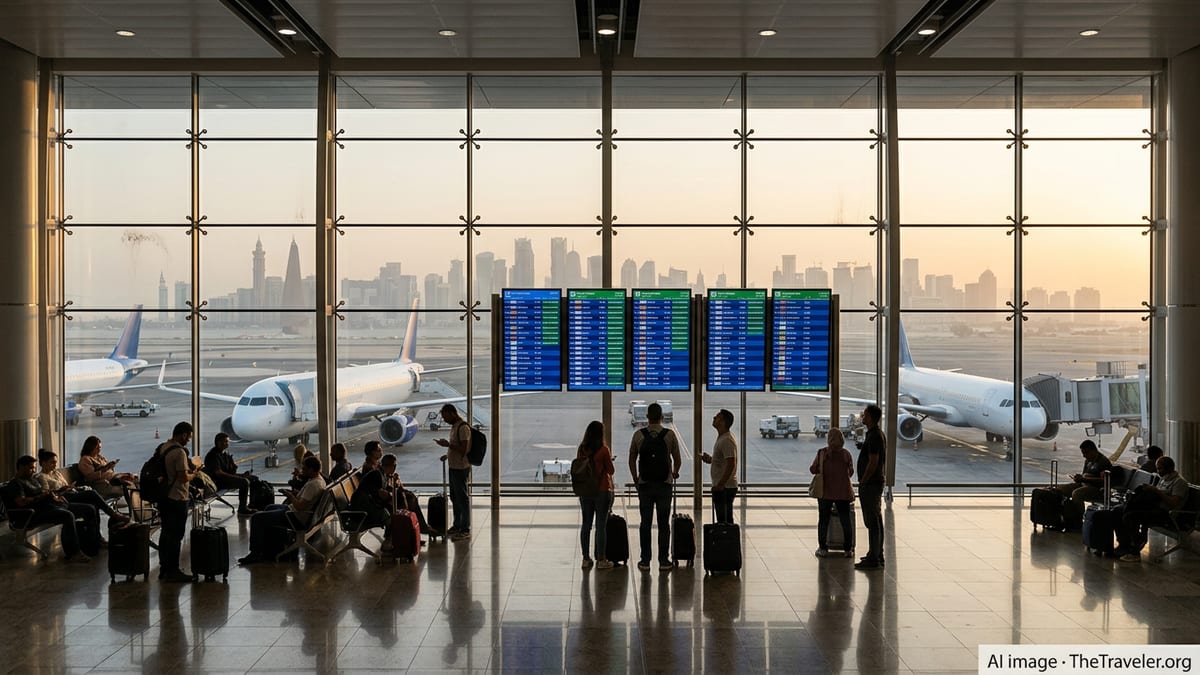
Expanded Suspensions Hit Seven Key Middle East Gateways
Publicly available schedules and recent advisories indicate that IndiGo’s latest changes affect a cluster of high-demand routes linking Indian cities with major Gulf hubs. With Doha in Qatar now added to the list, planned operations to at least seven key destinations across the United Arab Emirates, Kuwait, Oman and Bahrain are on hold, compounding an earlier wave of suspensions triggered by rapidly shifting regional security conditions.
Reports from aviation trackers and travel industry coverage show that the airline has already paused or significantly reduced flying to popular points such as Dubai and Abu Dhabi in the UAE, Kuwait City, Muscat in Oman and Manama in Bahrain, while adjusting frequencies to other Gulf cities as airspace closures and risk assessments evolve. In several cases, services that were due to start or ramp up for the upcoming season have been shelved, rather than simply delayed by a few days.
The expanded pullback underscores how exposure to the Gulf, long a core pillar of Indian carriers’ international growth strategies, can quickly become a liability when regional tensions flare. For IndiGo, which built a sizeable footprint transporting migrant workers, business travelers and visiting friends and relatives traffic to Gulf states, each suspended station represents both lost revenue and a complex operational puzzle.
While some routes remain technically open, industry data suggests that IndiGo is treating large parts of the northern Gulf as commercially and operationally unviable in the short term, consolidating traffic through a reduced set of corridors and prioritizing markets where airspace and insurance conditions are more predictable.
Geopolitical Shocks Reshape Gulf Airspace
The latest adjustments come against the backdrop of an escalating conflict centered on Iran and its Gulf neighbors, which has led to a patchwork of airspace closures and overflight restrictions across West Asia. According to published coverage and aviation safety notices, Iran’s confrontation with regional and Western powers has prompted authorities in the UAE, Qatar, Kuwait, Bahrain and parts of Oman to restrict or temporarily close segments of their airspace, especially around critical infrastructure and coastal approaches.
These moves have forced airlines to reroute traffic over longer, less direct paths, sometimes skirting the Arabian Peninsula entirely. For Indian carriers trying to connect South Asia with Europe and the wider Middle East, the closure of relatively short corridors across the northern Gulf significantly alters traditional flight planning and compresses available capacity into narrower lanes farther south.
Analysts quoted in public reports note that the current disruption builds on earlier shocks to regional aviation, including temporary suspensions following missile incidents and the broader security fallout from the conflict in and around the Strait of Hormuz. Together, these events have created an environment where operational decisions can change within hours, compelling airlines like IndiGo to adopt a more conservative network stance.
The strategic importance of Gulf hubs for global connectivity magnifies the impact. Even when specific airports remain technically open, the combination of heightened security alerts, rerouting requirements and the risk of sudden escalation means carriers must constantly reassess whether a route remains viable on safety, cost and reliability grounds.
Operational Costs and Insurance Premiums Climb Sharply
Beyond immediate security concerns, IndiGo’s decision to suspend flights to Qatar and other Gulf states reflects a steep rise in operating expenses on regional and long-haul sectors. Publicly available industry analysis shows that rerouting to avoid high-risk skies can add hundreds of nautical miles to a single flight, increasing fuel burn, crew duty times and maintenance exposure.
In parallel, insurers have reportedly expanded war-risk classifications to include wider portions of Gulf airspace and coastal waters, pushing up premiums for aircraft flying near conflict zones. For low-cost carriers that rely on tight cost control, even modest increments in insurance and fuel outlays can tip thinly profitable routes into loss-making territory, particularly when demand is jittery and last-minute cancellations remain a real possibility.
Airlines across the region are absorbing additional costs associated with ground handling disruptions, irregular operations and passenger care. For IndiGo, which operates a high-utilisation narrow-body fleet, the knock-on effects ripple through the schedule, reducing aircraft productivity when aircraft must be rotated to safer routes or held in reserve to manage potential diversions.
Sector-by-sector, these pressures combine to make some Middle East markets uneconomical for now. Travel industry observers note that IndiGo appears to be concentrating capacity on a smaller number of corridors where yields can better offset elevated costs, while treating suspended Gulf destinations as candidates for phased re-entry once conditions stabilize and premiums ease.
Passenger Disruption and Shifting Travel Patterns
The suspension of services to Qatar, the UAE, Kuwait, Oman and Bahrain has immediate consequences for passengers, particularly Indian workers and families who rely on frequent, relatively low-cost connectivity between tier‑two Indian cities and Gulf employment hubs. Public reports from airports in India describe travelers facing last-minute cancellations, longer transit times via alternative carriers and, in some cases, the need to rebook itineraries through more distant hubs.
With IndiGo stepping back from several routes simultaneously, passengers are turning to rival airlines based in the Gulf and beyond, including full-service carriers that still maintain partial operations despite the turmoil. This shift can raise travel costs for budget-conscious flyers and reduce competition on certain trunk routes, at least until Indian carriers feel confident enough to restore their full schedules.
Some travelers are also altering their plans altogether, opting to postpone discretionary trips or reroute via Europe, Central Asia or East Africa, depending on available capacity. Travel agents cited in media coverage report increased interest in itineraries that bypass the northern Gulf, even when this adds hours to journey times, reflecting a growing preference for perceived stability over pure convenience.
The disruption is also feeding into remittance and tourism flows. With fewer direct links between India and key Gulf labor markets, outbound worker traffic has become more fragmented, while inbound tourism from the Gulf, traditionally an important segment for several Indian states, faces a temporary setback.
IndiGo’s Strategic Balancing Act in an Unstable Region
IndiGo’s rapidly shifting Middle East schedule highlights the delicate balance airlines must strike between maintaining market presence and protecting operational resilience. Prior to the latest crises, the carrier had invested heavily in building a dense Gulf network, leveraging strong bilateral ties and India’s vast diaspora to fill aircraft year-round. The decision to suspend flights to Qatar and multiple Gulf states suggests a willingness to sacrifice short-term growth in favor of risk management.
Industry commentators note that the airline is using its sizeable domestic network and alternative international routes to absorb some of the displaced capacity, redirecting aircraft into more stable, high-demand markets in South and Southeast Asia as well as select long-haul corridors that can be operated without crossing the most volatile airspace. This redeployment may help limit financial damage while preserving flexibility to re-enter Gulf markets when conditions improve.
At the same time, IndiGo’s experience underscores broader questions about how airlines should price geopolitical risk into their long-term network strategies. The events affecting Qatar, the UAE, Kuwait, Oman and Bahrain demonstrate that even well-established corridors can be disrupted suddenly, with implications for fleet planning, crew deployment and customer loyalty.
For now, the picture remains fluid. Publicly available information suggests that IndiGo and other carriers are reviewing their Middle East operations on a rolling basis, leaving open the possibility of selective resumptions or further suspensions depending on how security and cost dynamics evolve in the coming weeks.