

More news on this day
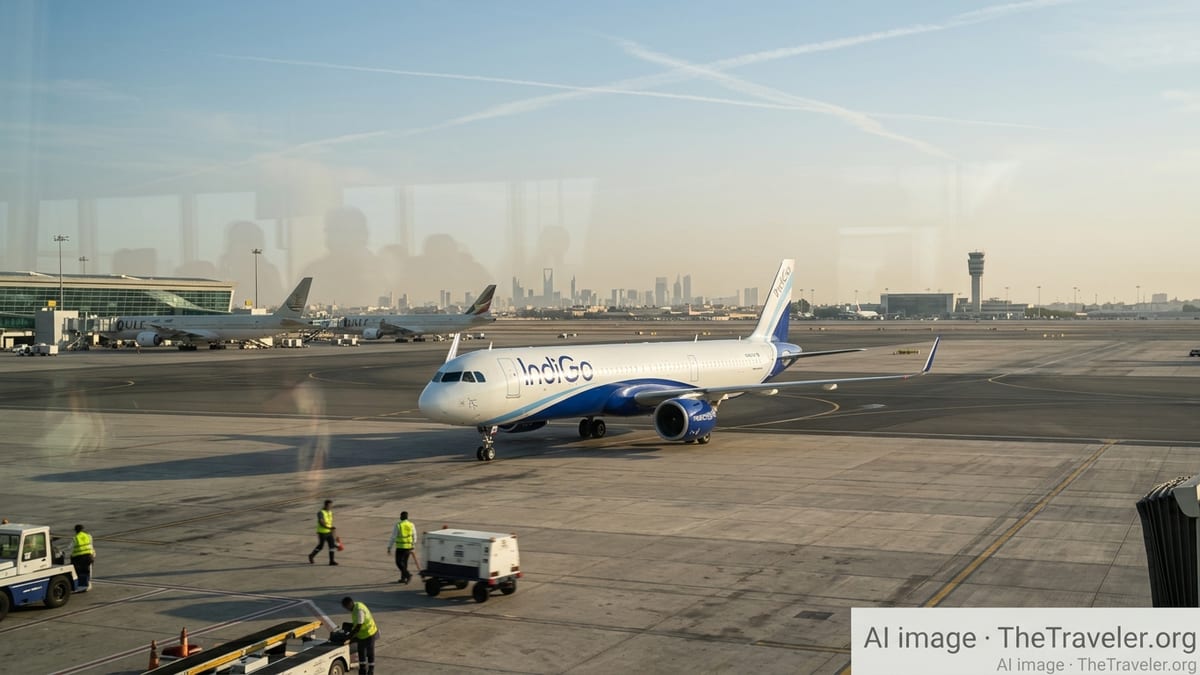
IndiGo is cautiously rebuilding its Gulf network as Saudi Arabia, the United Arab Emirates and Oman progressively reopen airspace, prompting a new wave of schedule revisions to Riyadh, Abu Dhabi, Dubai, Muscat and other hubs amid ongoing regional conflict and security concerns.
Get the latest news straight to your inbox!
Middle East Routes Return Under Tight Constraints
After weeks of rolling suspensions triggered by the latest escalation in the Iran conflict and closures across key Gulf flight corridors, IndiGo has begun restoring a limited schedule linking major Indian cities with Saudi Arabia, the UAE and Oman. Publicly available information from Indian and Gulf aviation bulletins indicates that services to cities such as Riyadh, Jeddah, Dubai, Abu Dhabi and Muscat are back on specific days and time bands, rather than on the dense daily pattern that existed before the current crisis.
Reports on recent operations show IndiGo operating a trimmed roster of departures to Middle Eastern destinations alongside other Indian carriers, while keeping several links on hold where security risks and airspace restrictions remain acute. Industry coverage notes that flights to and from Abu Dhabi, Doha, Kuwait and Riyadh were among those suspended into early March, underscoring the uneven nature of the recovery and the likelihood of further short-notice adjustments as the situation evolves.
The reintroduction of Gulf services is particularly significant for India’s low-cost leader, which has spent the past two years turning the Middle East into one of its core international growth pillars. Even a partial resumption allows IndiGo to reconnect large expatriate communities and business travelers who rely heavily on fast, affordable links to West Asia, but the airline is doing so with schedules that remain fluid and exposure to renewed disruption.
Saudi Arabia, UAE and Oman Emerge as Early Reopeners
Among the Gulf states, Saudi Arabia, the UAE and Oman have moved fastest to reopen at least portions of their airspace to commercial traffic following the late February strikes on Iran and subsequent missile alerts. Advisory notes circulating within the aviation and logistics sectors in early March describe Saudi and Omani airspace as open on a limited basis, with restrictions on certain corridors and altitude bands, while UAE skies are described as partly open with capacity caps and tighter route controls around major hubs.
These changes have allowed Indian carriers to rebuild a corridor serving Riyadh, Jeddah, Dammam, Dubai, Abu Dhabi and Muscat using modified routings that skirt the most sensitive areas over Iran, Iraq and parts of the Persian Gulf. IndiGo’s restored operations form part of a broader Indian effort that, according to publicly available government briefings, has seen roughly 50 flights a day mounted between India and West Asia despite patchy closures and dynamically updated Notices to Air Missions.
For IndiGo, the relative stability of Saudi, Emirati and Omani gateways provides a crucial platform to re-establish its Gulf footprint. Earlier commentary from airline leadership highlighted Abu Dhabi as a standout example of rapid scale-up, with the carrier having expanded from a handful of Indian origins to dozens of weekly connections. That strategy is now being stress-tested by airspace volatility but also reinforced as these same markets become the first to reopen.
Rerouting Around Conflict Zones Reshapes Flight Times
Even where flights are operating, the path across the map has changed markedly. Airspace closures and warnings spanning Iran, Iraq, Israel and sections of the Persian Gulf have forced airlines to redesign routings in coordination with regional aviation authorities, often adding time, fuel burn and complexity. Coverage of Indian long- and medium-haul operations over recent months has already documented similar adjustments on routes to Europe and Central Asia following Pakistani airspace restrictions, and those workarounds now intersect with the latest Gulf closures.
For IndiGo’s Middle East services, this means some sectors to Riyadh, Dubai, Abu Dhabi and Muscat are flying longer tracks that bend south or west of traditional corridors, sometimes adding 30 to 90 minutes to flight times depending on the day’s active restrictions. These extended routings ripple through the airline’s broader network, affecting crew rotations, aircraft utilization and onward connections within India. In a tight low-cost operation built on quick turnarounds and high daily aircraft hours, every extra minute in the air reduces the margin for schedule recovery when delays occur.
The rerouting is also happening against the backdrop of increased military activity, naval deployments near the Strait of Hormuz and shifting missile alert zones. Industry analyses of the current crisis emphasize that aviation planners are factoring in not only formal closures but also evolving risk assessments around potential miscalculation or stray projectiles. Airlines like IndiGo are therefore balancing commercial imperatives against a safety-first approach that can see routes altered or suspended at short notice when risk profiles change.
Security, Insurance and Operational Risk Under the Spotlight
The latest round of schedule changes has drawn attention to the layered security and financial calculations that underpin every commercial flight in and out of the Gulf. Aviation risk insurers have reportedly revised premiums and war-risk surcharges for operations transiting certain parts of Middle Eastern airspace, while airports across Saudi Arabia, the UAE and Oman are operating with heightened security postures. Although these developments are largely invisible to passengers, they influence which routes are viable and at what cost.
IndiGo operates a predominantly single-aisle Airbus A320 and A321 fleet, a configuration that generally offers flexibility on short- and medium-haul sectors but also leaves the airline exposed when a high number of aircraft must be retimed or idled simultaneously. Previous scheduling turbulence in late 2025, when IndiGo faced widespread cancellations on its domestic network, illustrated how quickly disruptions can cascade through such a tightly wound operation. The current Gulf crisis is testing that resilience again, this time with the added complexity of war-risk zones and external constraints on routing.
Travel advisories and port and airspace bulletins issued in early March repeatedly stress the possibility of rapid change, urging airlines to keep contingency plans ready for further missile activity or cyber incidents affecting air traffic control. For IndiGo, that translates into a playbook of alternative routings, backup aircraft allocation and coordination with airport operators in Riyadh, Abu Dhabi, Dubai, Muscat and other cities to handle sudden waves of delayed or diverted flights.
Passengers Face Fluid Schedules and New Travel Realities
For travelers, IndiGo’s progressive restoration of flights to Saudi Arabia, the UAE and Oman offers a partial relief valve after days of large-scale cancellations and diversions across the region. Nevertheless, schedules into Riyadh, Abu Dhabi, Dubai and Muscat remain subject to late-hour changes, and airlines and travel platforms continue to advise passengers to monitor flight status closely, allow extra time at airports and be prepared for longer-than-usual flight durations.
Reports on recent operations out of Indian hubs describe immigration and airline desks dealing with complex itineraries involving rebooked or re-routed passengers, particularly among Gulf-based Indian residents returning from visits home. With limited frequencies on some routes and aircraft stretched across a patchwork of alternative corridors, re-accommodation options can be constrained when a single cancellation affects several hundred passengers at once.
Looking ahead, industry analysts suggest that IndiGo’s strategic focus on the Gulf is unlikely to change, even as the airline navigates the current instability. The Middle East remains central to India’s migrant workforce, trade links and emerging tourism flows, and carriers that can maintain reliable connectivity despite airspace disruptions are likely to strengthen their long-term position. For now, IndiGo’s measured return to Saudi Arabia, the UAE and Oman underlines how aviation in the region is learning to operate in a climate where geopolitical shocks and security risks have become a central, rather than peripheral, planning assumption.