

More news on this day
India’s largest airline IndiGo is rapidly redrawing its route map across West Asia, adding Turkey to an improvised network through the United Arab Emirates, Saudi Arabia, and Oman as it works to keep passengers moving during one of the most disruptive aviation crises the Middle East has seen in decades.
Get the latest news straight to your inbox!
Rapid Rerouting As Airspace Closes Over the Gulf
IndiGo’s latest schedule adjustments come against the backdrop of a widening conflict around Iran and the Strait of Hormuz, which has triggered rolling airspace closures and severe restrictions across several Middle Eastern states. Publicly available aviation advisories show that Bahrain, parts of the United Arab Emirates, Iraq, Israel, Kuwait, Qatar, and Syria have imposed varying degrees of flight bans or operational limits, forcing airlines to abandon their usual overflight corridors and scramble for safe alternatives.
For IndiGo, which built much of its international growth on relatively short hops from Indian hubs into the Gulf and on efficient transits to Europe via the Middle East, the sudden loss of those corridors has had an outsized impact. Reports from Indian and Gulf media in early March describe waves of cancellations, diversions to secondary airports, and extended ground holds as carriers reacted to overnight changes in airspace status and the shifting trajectory of the conflict.
In that environment, any open corridor is a prize. Industry briefings on the crisis have repeatedly described southern Saudi Arabia as one of the few viable east–west air bridges still functioning, with Oman’s airspace and select airports in the UAE providing additional, if constrained, options. IndiGo has begun leaning heavily on these countries, redesigning routings and aircraft rotations to keep at least a skeleton network in operation while avoiding active conflict zones.
Turkey Joins IndiGo’s Patchwork Corridor Strategy
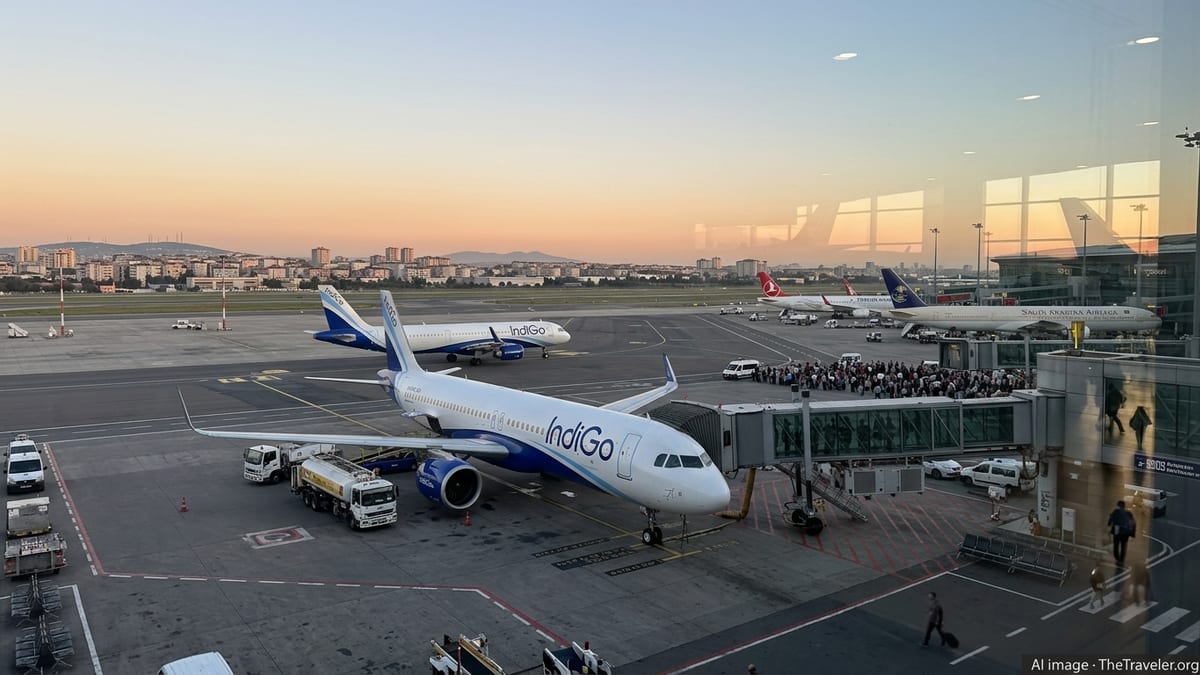
The newest piece of IndiGo’s crisis network is Turkey, where the carrier is using airports such as Istanbul as staging points to reconnect long-haul flows between India and Europe. Flight-tracking data and traveler accounts indicate that services between Indian cities and Turkish gateways have gained prominence in recent days, as they offer a way to skirt closed Gulf airspace and still link into major European and transatlantic connections.
By combining Turkey with already established links into the UAE, Saudi Arabia, and Oman, IndiGo is effectively building a multi-node detour that bends north and south around the tightest choke points. Rather than flying straight across the Gulf on traditional routes, aircraft are being routed via safer airspace slices over Saudi Arabia and Oman, then onward to Turkey or select Gulf hubs that remain open, adding time but restoring a measure of predictability.
These adjustments are not cost-free. Longer routings increase fuel burn, crew duty time, and scheduling complexity, all acute concerns for a carrier still recovering from its own scheduling crisis in late 2025. However, aviation analysts note that maintaining operational continuity, even at higher cost, can be critical to preserving market share and passenger trust during a prolonged regional emergency.
Stranded Travelers Find New Gateways in the Gulf and Anatolia
For travelers, IndiGo’s emergency network has meant new, sometimes unfamiliar escape routes. As airspace closures rippled outward in late February and early March, thousands of passengers bound for or transiting through the Gulf found themselves marooned at hub airports, waiting for rerouted flights or special one-off services to materialize.
Reports from regional newspapers and passenger forums describe how Oman and Saudi Arabia quickly emerged as pressure valves, with open airports such as Muscat and Riyadh absorbing diverted flights and ad hoc evacuations. Many travelers originally ticketed through Dubai or Doha were urged to rebook through these secondary gateways, often reaching them by overland journeys from temporarily shuttered hubs.
Turkey’s addition to IndiGo’s options has created yet another release point. Istanbul’s role as a major intercontinental hub means that once passengers reach Turkish soil from India, they can often reconnect to Europe or North America with relatively limited detours compared with the more circuitous southern routes via Africa or Central Asia. While seats on these flights remain tight and schedules are subject to rapid change, the Turkish corridor has started to relieve some of the pressure building in Gulf terminals.
Operational Headwinds: Longer Flights, Higher Costs, Fragile Schedules
Even as IndiGo showcases its ability to reconfigure routes at speed, the operational headwinds are significant. With much of the traditional Gulf overflight path off-limits or heavily constrained, aircraft must fly longer arcs over southern Saudi Arabia, Oman, or the eastern Mediterranean, adding hundreds of kilometers to some journeys. That additional distance translates directly into higher fuel costs at a time when oil prices are already elevated by the broader Strait of Hormuz crisis.
Extended flight times also ripple through the airline’s intricate scheduling system. Crew duty limits become harder to manage, turnarounds at improvised hubs can be slower, and delays in one sector cascade into missed connections on the next. Earlier disruptions in 2025 highlighted how quickly such stresses can compound for IndiGo when operating close to the limits of its available fleet and staff resources.
There is also the constant risk that a corridor used today may be curtailed tomorrow. Advisories from aviation regulators and security consultancies emphasize that airspace permissions are being revised with little notice, forcing airlines to submit multiple contingency flight plans and maintain spare capacity where possible. This fragile environment explains why passengers are being urged to check flight status repeatedly and remain prepared for last-minute changes, even on routes that appear stable.
Balancing Safety, Connectivity, and India’s Global Linkages
IndiGo’s push to weave Turkey into a broader network spanning the UAE, Saudi Arabia, and Oman underscores the balancing act facing carriers that sit at the crossroads of Asia, the Gulf, and Europe. Safety remains the first filter for any routing decision, with airlines avoiding not only active combat zones but also adjacent airspace perceived as high risk due to missile activity or electronic interference.
At the same time, India’s economic and social ties to the wider Middle East ensure that demand for travel into and out of the region remains high, even during periods of instability. Millions of Indian nationals live and work in Gulf states, and a growing share of India’s outbound tourism and business travel flows through regional hubs. IndiGo’s rapid restructuring of its network is in part an effort to maintain those lifelines, even if journeys take longer and involve unfamiliar waypoints like Muscat or Istanbul.
For now, publicly available information suggests that IndiGo’s improvised corridors through Turkey, the UAE, Saudi Arabia, and Oman are helping to reconnect at least some of the travelers stranded by the crisis, proving that even when key airspace is suddenly taken off the map, airlines can still find room to maneuver. How sustainable these solutions will be depends on the trajectory of the conflict, future airspace decisions, and whether the current patchwork of routes can be stabilized into something resembling a new normal for West Asia’s skies.