

More news on this day
Strategic flight reductions, geopolitical turbulence and relentless demand for religious travel are converging in 2026 to force a fundamental reset of the busy air corridor linking Indonesia and Saudi Arabia, a route that moves millions of Hajj and Umrah pilgrims each year.
Get the latest news straight to your inbox!
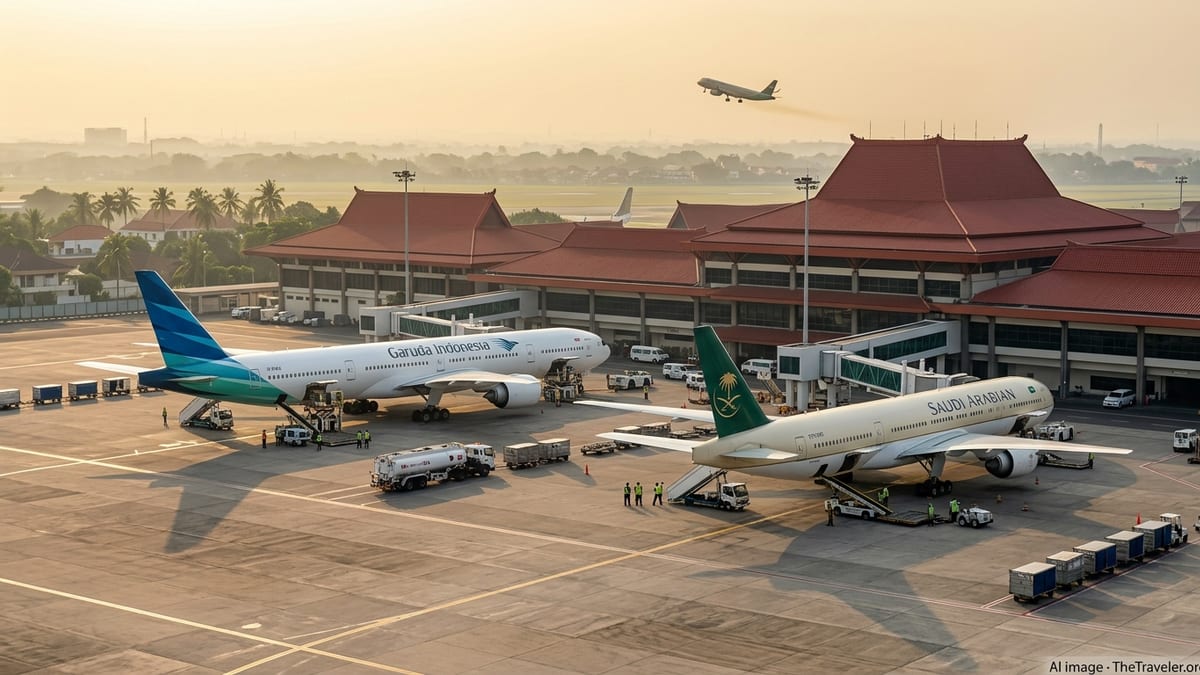
A High-Demand Corridor Under Pressure
Indonesia and Saudi Arabia are connected by one of the world’s most important religious travel corridors, with publicly available data showing that Indonesians account for well over a million Hajj and Umrah trips to the kingdom in recent years, and remain among the top three source countries for pilgrims. At the same time, Indonesian officials have noted that only around 120,000 Saudi tourists visit Indonesia annually, underlining how heavily the corridor is weighted toward outbound religious travel from Southeast Asia.
Saudi Arabia’s broader tourism strategy, framed within Vision 2030, is accelerating this flow rather than easing it. Government statistics and industry research indicate that foreign Hajj and Umrah visitors surpassed pre-pandemic levels by 2024, with more than 18 million foreign pilgrims in that year and an even higher total of around 19.5 million foreigners recorded in 2025. In the first quarter of 2025 alone, official figures cited by regional media put Umrah visitors at more than 15 million, highlighting the sustained surge in demand.
This growth places constant pressure on the aviation link between Indonesia and Saudi Arabia. Carriers ranging from Indonesia’s full-service flag airline to low-cost and charter operators compete for seasonal Hajj contracts and year-round Umrah traffic, while Saudi-based airlines adjust capacity from Jeddah and Madinah to Jakarta and secondary Indonesian cities. In 2026, however, the combined effects of conflict-related airspace closures, regulatory tightening and new operational constraints are pushing airlines toward what industry observers describe as a pivot toward more selective, strategically reduced flying.
Conflict, Airspace Closures and Sudden Capacity Cuts
The most visible trigger for the 2026 aviation pivot has been the widening impact of conflict in the Middle East on commercial airspace. In late February 2026, Indonesian media reported that Garuda Indonesia temporarily suspended flights to and from Doha after Qatar’s airspace was closed amid escalating regional tensions. While Doha is not a pilgrimage destination, the disruption underlined how quickly long-haul networks that feed Indonesia–Saudi traffic can be upended by geopolitical risk.
Regional carriers have already been forced to redesign Hajj and Umrah routes to avoid sensitive airspace. Indonesia’s Lion Air, for example, publicly detailed alternative routings for its 2025 Hajj operations that kept aircraft away from Pakistani and northern Indian skies, lengthening journeys between Indonesian embarkation cities and Saudi gateways. Such rerouting adds fuel and crew costs, and can reduce the number of rotations possible during the tightly scheduled Hajj season, encouraging airlines to prioritize higher-yield or contract-secured flights over marginal services.
Published schedule data for Saudi airlines suggest that targeted reductions in Indonesia-linked capacity began even before the latest conflict escalation. Saudia has trimmed frequencies on certain Madinah–Jakarta services, and network planners have rebalanced aircraft toward new leisure destinations and high-demand regional routes. These adjustments signal a shift from simply adding seats for every peak to more deliberate allocation of widebody capacity, especially on routes where yields are pressured by intense competition from charter and low-cost carriers.
Policy Tightening and Pilgrim Management Strategies
On the Saudi side, policy shifts are reshaping when and how Indonesians can travel for Hajj and Umrah, indirectly influencing airline scheduling. For the 2025 Hajj season, Saudi authorities introduced stricter controls intended to curb unauthorized pilgrims and manage overcrowding, after extreme heat in 2024 led to hundreds of reported deaths among worshippers from multiple countries. New rules included prioritizing first-time Hajj participants and prohibiting children from joining pilgrim groups, while enforcement against those attempting to perform Hajj without permits intensified.
In April 2025, Saudi Arabia also temporarily suspended short-term visa issuance for several high-demand countries, including Indonesia, as part of an effort to reduce pressure on inbound travel systems ahead of Hajj. That move, reported by international media, effectively throttled last-minute Umrah trips and forced Indonesian travel organizers to recalibrate departure waves. Fewer short-notice pilgrims meant airlines could not rely as heavily on late-season demand spikes and instead had to align capacity more tightly with approved quotas and pre-planned group allocations.
Longer term, Saudi planning documents and economic reports portray religious tourism as a core non-oil growth engine, with projections of tens of millions of annual Umrah pilgrims by the end of the decade. However, the combination of climate stress, crowding risks and security concerns is prompting a more managed growth model. For Indonesian travelers, that is likely to translate into stricter booking windows, more centralized digital systems for visas and permits, and less tolerance for ad hoc charter operations that do not fit into carefully designed arrival and departure slots.
Stranded Pilgrims and the Human Impact of Flight Reductions
The consequences of these aviation and policy shifts became highly visible in early March 2026, when coverage by international news agencies highlighted that more than 58,000 Indonesian Umrah pilgrims were stranded in Saudi Arabia. The disruption was linked to war-related travel chaos and constrained airlift back to Southeast Asia, with Indonesian officials publicly urging tens of thousands of would-be travelers to postpone their trips until at least April for safety and logistical reasons.
For individual pilgrims and small travel agencies, the sudden lack of return seats and the cost of extended hotel stays exposed the fragility of a system built on tight aircraft rotations and slim financial buffers. Many Indonesian pilgrims had already paid in full for packages that assumed predictable flight schedules and rapid turnaround between groups. When airlines were forced to cancel, reroute or consolidate services, ground arrangements in Makkah and Madinah became harder to synchronize, creating ripples through the entire ecosystem of bus operators, hotel owners and local guides.
Reports from Indonesian and Saudi outlets indicate that both governments are now negotiating with airlines to spread the financial burden of disruptions and to improve contingency planning for future seasons. The current crisis is likely to accelerate interest in more robust insurance mechanisms, clearer passenger rights frameworks and stronger oversight of intermediaries who bundle flights, visas and accommodation into pilgrim packages.
Rebalancing the Corridor: From One-Way Flow to Two-Way Tourism
While the Indonesia–Saudi corridor has long been dominated by outbound religious travel, both sides are increasingly looking to rebalance flows. Indonesian tourism officials have spoken publicly about encouraging more Saudi tourists to use Hajj and Umrah return flights as an entry point to explore destinations such as Bali, Lombok and Bandung. The current round of aviation recalibration may create an opening to design more deliberate two-way itineraries, tying Saudi stopovers and leisure trips in the kingdom to longer holidays in Indonesia.
Saudi Arabia, for its part, is positioning coastal developments on the Red Sea, sports events and heritage sites as extensions of religious journeys rather than competitors to them. As infrastructure at new airports and resort regions comes online, airlines serving Indonesia may be encouraged to operate triangle routes that combine Jeddah or Madinah with leisure-focused gateways, or to time flights so that pilgrims can add extra days at non-religious destinations within the kingdom.
However, the same strategic flight reductions that aim to stabilize the corridor may also limit experimentation. If carriers concentrate on core pilgrimage city pairs and trim secondary routes, opportunities for diversified itineraries could narrow in the short term. Policymakers and tourism boards in both countries will need to coordinate closely with airlines to ensure that efforts to protect safety and reliability do not inadvertently freeze the corridor into a purely seasonal, single-purpose pipeline.
Looking ahead through 2026, the Indonesia–Saudi aviation pivot appears less like a retreat and more like a controlled restructuring. As airspace risks, climate pressures and surging demand collide, airlines are being pushed to trade volume for resilience and predictability. For millions of Indonesian pilgrims, that may mean fewer flight options and more planning, but also the potential for safer, more orderly journeys and, eventually, a corridor that supports a broader spectrum of travel in both directions.