

More news on this day
Indonesia has finalized a landmark trade agreement with the United States that pairs sweeping tariff cuts with a commitment to purchase 50 Boeing aircraft, a move Jakarta and Washington say will turbocharge Indonesia’s aviation growth while cementing a new phase in economic relations between the two countries.
A Landmark Deal Capping Months of Hard Negotiation
The trade pact, formally concluded in Washington on February 19, 2026, follows months of intense negotiations sparked by Washington’s move in 2025 to impose steep reciprocal tariffs on Indonesian exports. Under the final agreement, Indonesia scraps tariffs and a wide range of non-tariff barriers on the vast majority of US goods, while the United States locks in a 19 percent tariff on Indonesian exports, lower than the 32 percent rate that had been threatened but still above those applied to many other trading partners.
The breakthrough reflects a broader US strategy of embedding long-term tariff structures into its trade relationships, while using access to the American market and major commercial deals as leverage. For Indonesia, the accord is being framed as a painful but necessary trade-off to preserve its export access to the world’s largest economy and unlock new investment in energy, critical minerals and advanced manufacturing.
Central to the package is a headline commitment worth roughly 13.5 billion dollars in aerospace and aviation-related purchases, anchored by a deal for 50 Boeing jets. The aircraft order, which Jakarta has cast as a “meeting of interests” between Indonesia’s need to modernize its fleet and Boeing’s search for stable demand, is designed to showcase tangible industrial gains from the pact on both sides of the Pacific.
Fifty New Boeing Jets at the Heart of the Aerospace Push
The promise to buy 50 Boeing aircraft has quickly emerged as the symbolic centerpiece of the deal. US and Indonesian officials say the order will be drawn largely from Boeing’s widebody range, including the 777 family and potentially newer-generation long-haul models, with some flexibility to adapt the mix as Indonesia’s route network evolves. The aircraft will be configured to serve both dense regional corridors in Asia and intercontinental routes linking Jakarta and other Indonesian hubs to North America, Europe and the Middle East.
While the precise delivery timetable has not been made public, Indonesian officials and executives involved in the talks acknowledge that the jets are unlikely to arrive before the early 2030s. That reflects both Boeing’s crowded production lines and the time needed for Indonesian carriers to restore balance sheets, secure financing and prepare infrastructure such as hangars, simulators and maintenance capacity.
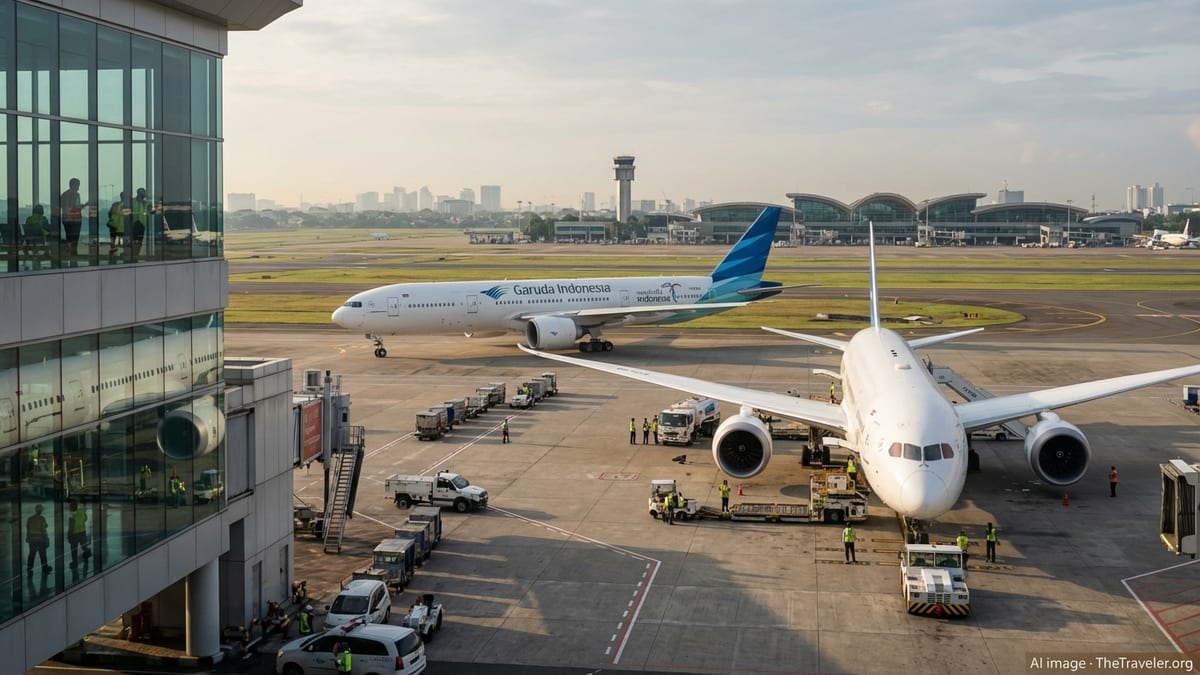
The new order builds on earlier, sometimes dormant, agreements for Boeing aircraft linked to Indonesia’s flag carrier Garuda Indonesia and its low-cost affiliates. Some of those pre-pandemic contracts were restructured or suspended during Garuda’s debt workout; the fresh commitment is presented as part of a “reset” that aligns aircraft procurement with the new trade architecture and with Indonesia’s broader aviation strategy.
Garuda Indonesia and the National Carrier Strategy
President Prabowo Subianto has repeatedly cast the aircraft deal as a pillar of his plan to restore Garuda Indonesia as a source of national pride and a visible symbol of the country’s global ambitions. Garuda, which underwent painful restructuring after the pandemic, has steadily rebuilt its network but remains well short of pre-crisis capacity and still relies heavily on leased, aging aircraft.
Officials close to the negotiations say the 50-jet commitment is intended to support a long-term target of expanding the combined fleets of Garuda and its subsidiaries to around 120 aircraft, serving roughly 100 destinations. The focus, they say, is on deepening connectivity between Indonesia’s secondary cities and major Asian hubs, while reinstating or launching new non-stop long-haul services to North America and Europe that can compete with rival carriers in Singapore, the Gulf and East Asia.
In practice, the financial burden of such an expansion remains a major concern. Garuda has only recently returned to a fragile profitability, supported by state-backed funds and a more disciplined approach to routes and leasing. Aviation analysts in Jakarta warn that the airline will need continued government support, creative financing structures and careful phasing of deliveries to ensure that the Boeing order strengthens, rather than strains, its balance sheet.
Officials insist the pact’s aviation chapter goes beyond headline aircraft numbers. They point to provisions on maintenance, repair and overhaul services, pilot and engineer training, and potential US-backed investments in Indonesian aerospace manufacturing as crucial elements that could generate local jobs and technological spillovers well before the final jet is delivered.
Transforming Indonesia’s Aviation Landscape and Connectivity
If implemented as envisioned, the Boeing order and associated investments could significantly reshape Indonesia’s aviation landscape. With more than 17,000 islands and a fast-growing middle class, the country is one of the world’s most promising aviation markets, yet it remains under-served by long-haul connections and constrained by capacity at key airports such as Jakarta’s Soekarno-Hatta and Bali’s Ngurah Rai.
New long-range aircraft would allow Indonesian carriers to bypass congested transit hubs and offer more direct services between Indonesia and major US gateways, as well as secondary cities in Europe and East Asia. This, industry executives say, could boost high-spending tourism, draw more business travelers and strengthen Indonesia’s role as a logistics and services hub for Southeast Asia.
The expansion is also expected to spur infrastructure upgrades at airports across the archipelago. Plans already under discussion include expanded terminals, longer runways capable of accommodating larger widebody jets, and investments in air traffic management technology to safely handle increased flight volumes. These projects, often financed through public-private partnerships, could in turn generate thousands of construction and services jobs.
For domestic travelers, additional aircraft and improved connectivity should translate into more frequent flights and potentially lower fares on key routes, particularly if competition intensifies between full-service and low-cost carriers. However, regulators will face the challenge of ensuring that rapid capacity growth does not come at the expense of safety standards, which have come under scrutiny in Indonesia in previous decades.
Economic Stakes: Balancing Tariffs, Trade Flows and Investment
The aviation commitments sit inside a much broader economic package that sharply widens US commercial access to Indonesia’s 270 million-strong consumer market. Under the final text of the Agreement on Reciprocal Trade, Indonesia has agreed to remove tariffs on more than 99 percent of US exports, from agricultural goods and medical products to auto parts and chemicals. It has also pledged to dismantle local-content rules and other regulatory requirements that US businesses long criticized as discriminatory.
In return, Indonesia secured certainty on its own tariff treatment, with the United States locking in a 19 percent tariff ceiling on most Indonesian goods instead of moving ahead with the previously announced 32 percent rate. That offers exporters in sectors such as textiles, footwear, electronics, palm oil and rubber more predictable access to the American market, though still at a cost higher than many regional peers face.
Jakarta is banking on the promise of roughly 33 billion dollars in new US-linked commercial deals, ranging from energy imports and agricultural purchases to aviation, to offset some of the adjustment pain. Officials argue that the inflows will support Indonesia’s infrastructure build-out, stabilize supplies of fuel and food, and create high-value industrial jobs in areas such as mineral processing and semiconductor assembly.
Critics, however, warn that the energy and aircraft commitments may deepen Indonesia’s dependence on US suppliers and strain its external accounts if not matched by stronger export performance and technology transfer. They also question whether the high tariff rate will, over time, erode Indonesia’s competitiveness in the US market, particularly if other Asian economies secure more favorable terms.
Implications for US–Indonesia Relations and Regional Geopolitics
The trade pact and Boeing deal carry significance well beyond economics. For Washington, the agreement reinforces a strategy of drawing key Southeast Asian partners closer through a mix of security cooperation and tightly structured trade arrangements that favor US firms. For Jakarta, it is an opportunity to anchor its relationship with the United States on firmer economic foundations while maintaining its long-standing “free and active” foreign policy.
Indonesian officials have highlighted the accord as evidence that the country can secure substantial concessions even within a tariff-heavy US trade posture. By avoiding the steepest proposed duties and attracting new investment, they contend, Indonesia has shown it can both protect national interests and signal reliability as a partner for American companies.
The aviation element plays directly into this narrative. By tying a high-profile purchase of Boeing jets to broader commitments on tariffs and investment, both governments can point to visible proof of cooperation that resonates with domestic audiences: manufacturing jobs and export gains in the United States, and modern aircraft and new routes in Indonesia.
The deal also unfolds against a regional backdrop in which other Southeast Asian states, including Vietnam, are striking their own large aircraft and trade agreements with Washington. Analysts say Indonesia’s pact strengthens its hand in regional diplomacy, signaling that it intends to remain a central player in discussions over supply chains, digital trade and critical minerals, even as it continues to engage with China and other major partners.
Industry Reactions, Risks and the Road Ahead
Reactions from Indonesia’s business community have been mixed. Exporters in sectors facing the 19 percent tariff regret losing some of their cost advantage but express relief that the most punitive measures were averted. Importers and retailers, by contrast, are more upbeat about the prospect of cheaper US goods and greater product choice, particularly in consumer electronics, automotive parts and medical equipment.
Aviation insiders broadly welcome the clarity on fleet expansion but caution that translating political commitments into commercially viable contracts is complex. Questions remain over how the 50 aircraft will be allocated among Garuda, its low-cost affiliate Citilink and potentially other Indonesian carriers; what mix of purchasing, leasing and sale-and-leaseback arrangements will be used; and how quickly Indonesia’s airports and maintenance facilities can scale up.
Financing is another open issue. With global interest rates still relatively high and airline credit profiles fragile after the pandemic, Indonesia will likely seek support from export-credit agencies, commercial banks and possibly capital markets to fund the jets. The government may also explore structures that tie aircraft financing to broader investment and industrial cooperation packages with US partners.
For both Indonesia and the United States, implementation will be the ultimate test. The coming months will bring detailed negotiations between carriers and Boeing over specifications and delivery slots, while trade officials work to codify new customs procedures, certification rules and dispute-settlement mechanisms. How smoothly these processes unfold will determine whether the historic pact delivers on its promise of stronger aviation growth and deeper, more balanced economic ties.