

More news on this day
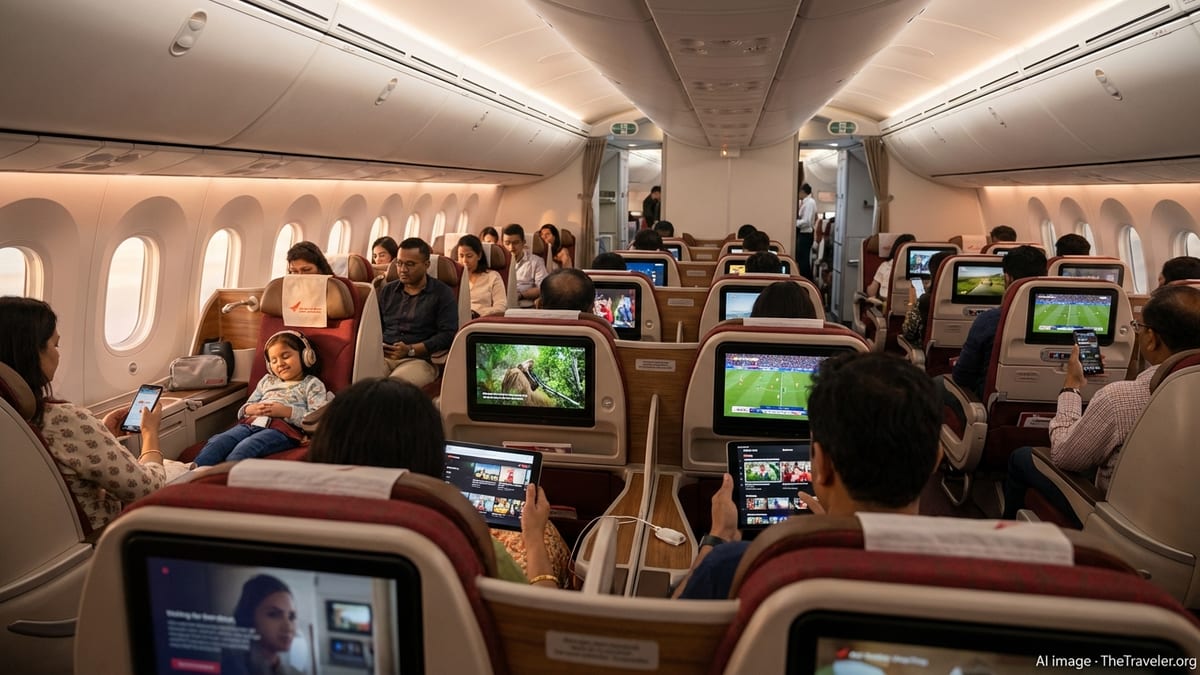
Settling into an Air India seat in 2026 feels markedly different from just a few years ago, as the carrier’s once-patchy in-flight entertainment is replaced by a tightly curated, ultra-connected ecosystem that aims to keep every age group engaged from takeoff to touchdown.
A Rapid Makeover at 35,000 Feet
For decades, Air India’s in-flight entertainment was often cited by frequent flyers as one of the airline’s weakest points, marked by dated screens, limited content and occasional system failures. Under the Tata Group’s ownership and the Vihaan.AI transformation roadmap, that legacy is being aggressively rewritten, with the passenger experience in the spotlight and entertainment positioned as a flagship proof of change.
Executives involved in the overhaul have been frank that the in-cabin experience needed to improve fast if the airline was to win back global travellers. At the APEX TECH 2026 forum in January, Air India leaders described in-flight entertainment and connectivity as among the very first areas targeted for visible transformation, precisely because screens, apps and connectivity are where passengers notice progress quickest.
That strategy has led to a two-track approach: a wholesale hardware upgrade on new and retrofitted widebody aircraft, and a parallel expansion of wireless streaming on other jets. The goal is to ensure that whether a passenger is flying a brand-new Airbus A350 or a narrowbody workhorse, the entertainment experience feels recognisably “new Air India.”
The scale of the project is vast. Alongside orders for hundreds of new Airbus and Boeing aircraft, a multiyear retrofit of the legacy widebody fleet is under way, with modern cabins and updated in-flight entertainment scheduled to be progressively rolled out through the late 2020s. For travellers boarding in 2026, that means a growing chance of stepping onto an aircraft with a dramatically different look and feel to what they may remember.
4K Seatback Screens and a New Generation of Cabins
On long-haul routes, the most visible symbol of Air India’s entertainment reset is the arrival of new-generation seatback systems. The airline has selected Panasonic Avionics’ Astrova platform for 34 new widebody aircraft, including Airbus A350s and Boeing 787-9s, bringing 4K OLED screens, high dynamic range video and Bluetooth audio to passengers who prefer traditional seatback viewing.
These latest seatback units are designed to resemble premium home streaming devices more than the bulky boxes of old. Travellers can expect slimmer profiles, touch responsiveness that feels closer to a modern tablet and the ability to pair personal headphones without adapters. At the same time, the system’s modular architecture is intended to make it easier for Air India to refresh software and features without major cabin overhauls, a key consideration for keeping pace with fast-changing digital expectations.
The improved screens are complemented by broader cabin upgrades unveiled on Air India’s updated long-haul aircraft. Refurbished interiors typically feature a three-class layout with all-new seats and cabin materials, positioning the entertainment screen as part of a coherent design language rather than a standalone add-on. In premium cabins, larger screens and higher-resolution interfaces reinforce the sense of a flagship experience, while economy passengers benefit from clearer visuals and more reliable touch controls than on older jets.
Crucially, these hardware changes are not restricted to newly delivered aircraft. A long-delayed retrofit programme for the airline’s existing Dreamliner fleet began moving forward in 2025, with timelines stretching to the end of the decade. While that means passengers may still encounter inconsistent cabins on some routes, the direction of travel is clear: over the coming years, more of Air India’s long-haul flights will feature the latest screens and a consistently modern interface.
Vista and Vista Stream: The Heart of a Hybrid Entertainment Strategy
Beneath the sleek new hardware sits Vista, Air India’s unified in-flight entertainment platform. First introduced as a wireless system and now expanded across both widebody and narrowbody aircraft, Vista and its wireless variant Vista Stream serve as the backbone of what passengers see when they tap their screen or connect a device.
Vista Stream operates on a bring-your-own-device model, allowing travellers to connect phones, tablets or laptops to the aircraft network and stream movies, television and other content without using personal mobile data. Initially rolled out on select aircraft, the service has been steadily extended to more of the fleet, especially where retrofits for traditional seatback screens will take longer to complete.
Air India positions Vista as a way to smooth over the complexity of operating multiple aircraft types and legacy systems. Instead of passengers encountering sharply different interfaces depending on the jet they are flying, the airline has prioritised a uniform look and feel, so a traveller who uses Vista Stream on a narrowbody between Indian metros sees a similar design and content structure to someone watching on a 4K seatback screen en route to Europe or North America.
By 2026, the carrier reports that wireless entertainment has become a mainstay rather than a niche add-on, especially on domestic and short-haul flights where travellers are comfortable relying on their own devices. At the same time, long-haul cabins with new seatback units still integrate with Vista’s underlying content catalogue, meaning that whether a passenger plugs into a screen or streams to a tablet, they are drawing from the same expanding library.
From Bollywood to K‑Drama: Curating a Truly Global Library
Content, as much as hardware, is where Air India is betting it can differentiate. The Vista catalogue has grown into a multi-thousand-hour library that spans Hindi blockbusters, regional Indian cinema, Hollywood releases and an increasingly international mix of television and documentaries. Airline executives say decisions about what makes the cut are heavily data-driven, with viewing patterns and post-flight feedback shaping monthly updates.
One visible shift is the prominence of Korean dramas and other Asian series, mirroring global streaming trends. Air India’s content planners have cited this genre as an example of how quickly tastes can pivot and how the airline’s entertainment mix now tries to reflect what passengers are actually binge-watching on the ground. For international travellers, the presence of familiar global titles alongside Indian hits is central to the airline’s ambition of positioning itself as a serious competitor to established Gulf and European carriers.
Music and audio programming have also expanded, with a mix of film soundtracks, independent Indian artists, global pop and wellness tracks. Documentary content increasingly highlights travel, food and culture, aligning with passengers’ interest in destinations they are flying to or through. The airline is working with content suppliers and destination marketing partners to surface more region-specific material, so a flight to Europe, for instance, is more likely to feature city guides and local culture features relevant to where passengers are headed.
Underpinning these choices is a tighter feedback loop than in the past. Air India tracks not only which titles are started and finished, but also what passengers say in surveys and complaints. That data is then fed back into programming meetings, with underperforming categories swapped out and high-demand genres promoted more prominently on the Vista home screen.
Screen-Free Stories and Safer Viewing for Young Flyers
Families flying with Air India in 2026 are encountering one of the more innovative corners of the airline’s entertainment revamp: a stronger focus on screen-free and age-appropriate options. In 2025, the carrier partnered with audio platform Vobble to introduce curated storytelling content for children aged roughly 4 to 12, delivered via its wireless entertainment system.
The collaboration surfaces more than 20 hours of screen-free audio adventures spanning fantasy, science, history and life skills, designed to keep children engaged without constant exposure to backlit screens. Parents can plug children’s headphones into their own devices, connect to the onboard network and select from a dedicated kids’ section within Vista Stream, turning cabin time into something closer to a podcast or audiobook session than a video marathon.
This push reflects feedback from parents who wanted their children occupied but were wary of extended screen time during long flights. It also dovetails with a broader rethink of the kids’ section on Vista, which now blends animated films and series with educational shorts and interactive audio. The airline has emphasised that all children’s content is screened for age suitability, and parental controls make it easier to confine younger viewers to the family-friendly catalogue.
For Air India, the kids’ strategy is about more than goodwill. Families are a key segment on the carrier’s domestic and international network, and positive experiences for younger travellers often translate into repeat bookings. By positioning itself as a thoughtful choice for parents looking to manage screen exposure while still keeping boredom at bay, the airline is seeking a distinctive edge in a crowded market.
Connectivity, Consistency and the Road to 2028
Entertainment in 2026 is also becoming more intertwined with connectivity. Air India has begun offering onboard Wi-Fi on select aircraft, initially via complimentary plans on certain domestic routes, allowing passengers to browse the web, message contacts and, in some cases, access limited streaming services. While coverage is not yet fleetwide, the carrier frames connectivity as a core part of the in-flight experience it is building toward by the end of the decade.
In parallel, the airline is working to reduce the inconsistency that has long frustrated regular customers: one flight with crisp screens and stable Wi-Fi, another with dated hardware or limited options. With a large fleet and a retrofit programme that extends through 2028, some variability is inevitable, a reality that Air India leaders have acknowledged publicly. To bridge that gap, they are prioritising a uniform user interface and content backbone so that even when the hardware differs, the digital experience feels familiar.
Passenger expectations, however, remain high. Recent consumer cases in India have highlighted the lingering consequences when older entertainment systems malfunction on long flights, underscoring how central screens and content now are to perceived value. Air India’s management has repeatedly pointed to these legacy issues as part of the case for accelerated investment in cabins and digital services.
By 2026, close to half of the airline’s weekly international flights are operating with upgraded interiors and enhanced entertainment, with more coming online as new deliveries arrive and older aircraft rotate through refurbishment. For travellers, that translates into a growing probability that the next booking will feature a cabin aligned with the airline’s updated brand rather than its past.
Why Travellers Are Beginning to Take Notice
The early verdict from many frequent flyers is that Air India’s entertainment transformation is visible and, in many cases, compelling, even if not yet universal. Passengers boarding refurbished A350s and 787s speak of a step-change in how the cabin looks and feels, with sharp displays, intuitive menus and a content library that no longer feels like an afterthought.
On regional and domestic routes, the combination of Vista Stream, personal devices and, where available, Wi-Fi has quietly normalised the expectation that an Air India flight can double as a mini streaming session or productivity window. For business travellers, being able to move seamlessly from catching up on a series to answering emails adds to the appeal. For leisure passengers, particularly younger ones, the presence of familiar global titles and high-quality Indian content makes the hours pass quickly.
The ultimate test will be consistency: delivering the same level of entertainment across an expanding global network, from new routes in Europe and Southeast Asia to long-standing services connecting India to North America and beyond. Yet the direction is strikingly different from only a few years ago, when Air India’s screens were often a symbol of stagnation. In 2026, they have become one of the clearest indicators of an airline determined to compete at the top tier of global aviation.
For travellers choosing between carriers, that shift matters. Modern in-flight entertainment no longer sits on the margins of the travel decision but is part of how passengers gauge value, comfort and even a brand’s personality. Air India’s bet is that by putting Vista at the centre of its onboard experience and backing it with serious investment in hardware, content and connectivity, those hours spent in the sky will become a reason to book, not merely something to endure.