

More news on this day
Alaska Airlines is introducing a new Boeing 787 Dreamliner business-class cabin as it pivots toward long-haul flying across the Pacific and to Europe, unveiling enclosed suites, lie-flat beds and a design language that blends the carrier’s Pacific Northwest roots with tropical influences inherited from its Hawaiian Airlines acquisition.
Get the latest news straight to your inbox!
A Widebody Era for Alaska’s Transpacific Ambitions
The arrival of the Boeing 787-9 in Alaska Airlines’ fleet in early 2026 marks a turning point for a carrier long associated with single-aisle jets shuttling up and down the West Coast. Public filings and recent announcements indicate that Alaska now operates a small but growing subfleet of 787s, with additional aircraft on order to support an ambitious intercontinental expansion centered on Seattle-Tacoma International Airport.
The 787s are being deployed on routes that stretch well beyond the airline’s historical network, including long-haul services across the Pacific to Tokyo Narita and Seoul Incheon, as well as forthcoming transatlantic flights from Seattle to Rome and London. Industry analysis suggests that these widebody additions, combined with the long-haul expertise and aircraft Alaska gained through its 2024 merger with Hawaiian Airlines, have given the group a ready-made platform for global growth years ahead of schedule.
Recent investor presentations outline a goal of operating at least a dozen intercontinental routes from Seattle by 2030, with the Dreamliner at the center of that strategy. The aircraft’s range, fuel efficiency and passenger-friendly cabin pressure and humidity have made it a favorite among long-haul travelers, and Alaska is positioning its version as a premium showcase for the brand’s new global identity.
Business-Class Suites With Transpacific Comfort in Mind
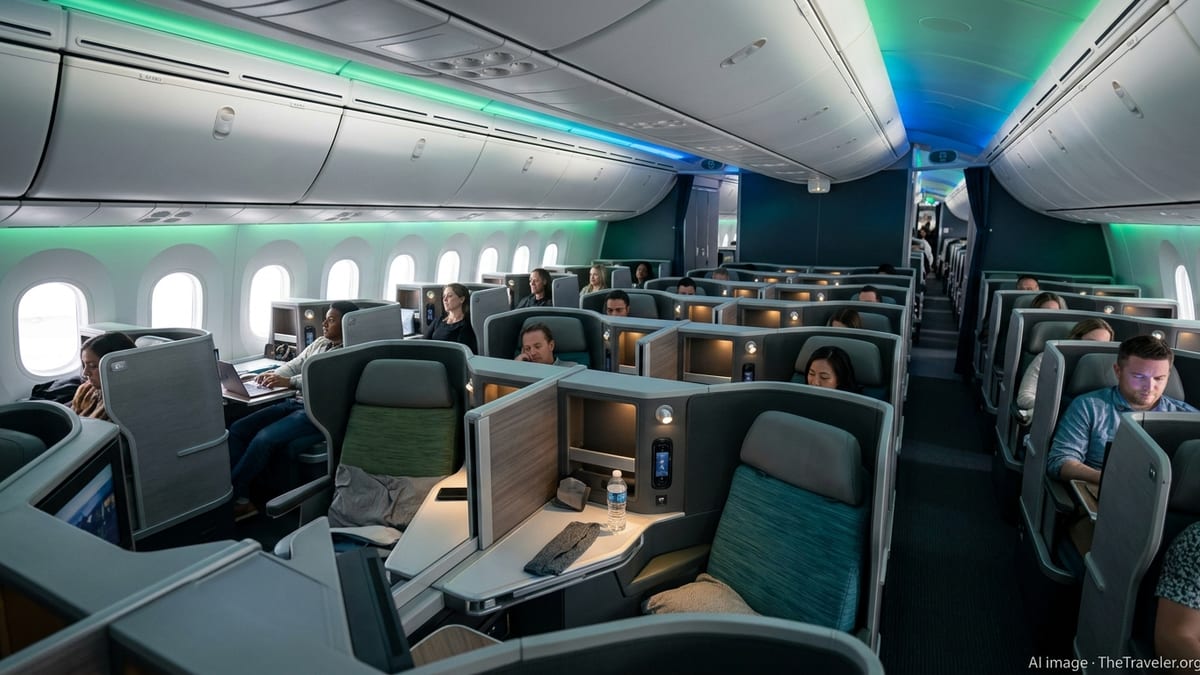
At the heart of Alaska’s long-haul push is a new business-class product tailored to the long overnight sectors that define transpacific and transatlantic flying. According to recent product briefings and trade coverage, the Boeing 787-9s are configured with 34 business-class suites in a 1-2-1 layout, giving every passenger direct aisle access, a key benchmark in today’s premium market.
Each suite features a fully flat bed designed for true overnight rest on flights that can exceed 10 hours between the West Coast and Asia or Europe. Industry reports describe sliding privacy doors at every seat, high shell walls and individual storage spaces, elements intended to create a sense of seclusion even in the busiest part of the cabin. Larger entertainment screens, multiple charging options and wireless connectivity are expected to appeal to both business travelers and leisure passengers looking to stay connected across the Pacific.
The center pairs in the middle of the cabin are arranged to suit couples or colleagues traveling together, with adjustable dividers that can be raised for privacy or lowered for conversation and shared meals. Along the windows, solo travelers will likely gravitate toward the deeply angled window suites, which offer both views and a cocoon-like feel, especially once the door is closed and the seat is converted into a bed.
Tropical Meets Pacific Northwest in the Cabin Design
Alaska’s 787 interior aims to visually communicate the airline’s evolving identity as a carrier that connects the forests and fjords of the Pacific Northwest with the beaches and volcanic landscapes of Hawaii and beyond. Publicly released imagery of the cabin shows a palette of deep greens and cool blues accented by warm neutral tones, an aesthetic that draws inspiration from northern lights, coastal forests and Pacific island waters.
Reports on the new global livery describe a tail and fuselage treatment inspired by the aurora borealis, with flowing bands of color that extend into the cabin lighting concept. Onboard, programmable LED mood lighting is used to simulate sunrise and sunset during long transpacific flights, supporting circadian adjustment while underscoring the “global Pacific” narrative the airline is cultivating.
Textured seat shells, wood-look surfaces and subtle tropical motifs in fabrics and wall panels nod to Hawaiian’s design heritage without duplicating it, signaling that the combined group is leaning into a broader Pacific identity. Aviation analysts note that this approach sets Alaska apart from both traditional mainland U.S. carriers and purely island-focused competitors, positioning the brand as a bridge between cool northern landscapes and warm tropical destinations.
New Routes Linking the Pacific Rim and Europe
The Dreamliner’s business-class cabin is being introduced in tandem with a slate of new long-haul routes that expand Alaska’s footprint far beyond North American shores. According to route announcements and schedule data, the airline’s 787s are slated to operate flagship services from Seattle to Tokyo and Seoul, capitalizing on strong demand for business and leisure travel between the Pacific Northwest and major Asian hubs.
On the other side of the ocean, Alaska has also confirmed its first self-operated flights to Europe, with Rome and London set to join the network from Seattle in 2026. Travel-industry reports indicate that these routes will be flown by 787-9 aircraft in a three-cabin configuration: Main Cabin, Premium Class and Business Class, with the lie-flat suites serving as the marquee feature for high-yield passengers.
Observers note that these moves place Alaska in more direct competition with global network carriers that have long dominated transpacific and transatlantic markets from the U.S. West Coast. The strength of the new business-class product on the 787 will likely be a key factor in attracting corporate contracts, premium leisure travelers and members of partner frequent-flyer programs who might once have overlooked the Seattle-based airline for long-haul journeys.
Competitive Positioning in a Crowded Premium Market
Alaska’s decision to equip its Dreamliners with privacy-door suites and all-aisle-access seating reflects the increasingly competitive landscape for long-haul business class. Rival airlines across the Pacific already field cabins with individual suites, bespoke bedding and elevated dining experiences, setting a high bar for comfort and privacy.
Aviation analysts point out that Alaska’s 787 business class will be judged not only on hard-product elements like seat dimensions and storage, but also on the soft-product details that matter on flights exceeding eight or nine hours. That includes bedding quality, meal presentation, beverage selection and the consistency of service across both transpacific and transatlantic routes.
Public information indicates that Alaska is aligning its premium offering with the expectations of alliance and codeshare partners, ensuring that passengers connecting from other global carriers experience a comparable standard on board the Dreamliner. If the airline can sustain that level across a growing network of long-haul destinations, the 787 business-class cabin may become a defining asset in its transformation from regional heavyweight to fully fledged global player.